Thursday, June 13, 2019

Of Posters And Productions

When was the last time you looked at a movie poster and thought, "Wow. I have to see that!" I'm going to wager a guess and say "a long time."

It's not your imagination. Movie posters have been crap for many years. In their defense, I don't think that they are getting worse, but that is faint praise. The days of masterpieces like Star Wars, Anatomy of a Murder, and Conan The Barbarian are seemingly long since dead. We have a few stars shine through, some with real staying power like the Saul Bass-inspired Precious, which had a magnificent poster that dramatically communicates information about the movie.

Many have argued that it is because Photoshop has eliminated the need for true artists to paint posters. Others have said that the financial focus has shifted within movie studios to short video clips for social media. Others still say that in an era of iPads and Android, the movie trailer has become the new poster. I think there is truth to all of these things, although they are not the whole story. And in many ways, it doesn't matter. Something that could, should, be beautiful and artistic, usually isn't.

This is a painful thing for me. I love movies. I also love all of the ancillary elements of the movie experience. I love the DVD case, I love watching old copies of movies on old hardware. I love movie trailers. And I especially love movie posters. They are an art form that has laid dormant for far too long, and I think that their fall mirrors the fall in vision in the modern movie industry.

In a way that isn't entirely metaphorical, the poster represents the decline of Hollywood — a decline from an industry that produced experiences to a industry that produces noise. The poster represents the decline of the industry from something great albeit incredibly flawed, to something that shovels out as much lowest-common-denominator stuff that it can, every year, year after year. It is not simply flawed; what it is is bad.

---

I'm no curmudgeon. In most ways, the world of today is better than the world of yesterday. Most of the time, when someone says "back in my day," they're about to say something stupid. I'm saying "back in my day," but not really. Because this wasn't back in my day! It was before my day! I'm arguing this from the perspective of someone who doesn't have an emotional stake in a position. I am an impartial third party.

Perhaps I'm giving myself too much credit. I do have some investment in the era. I grew up during the transition. The 1980's were the beginning of the end for a great period of cinema that directly followed the fall of the Hays Code and preceded the rise of Eisnerian High Concept production. Every filmmaker who lived during this transition talks about it, be it Spielberg, Lucas, Redford, or Beatty. They lived it.

Some of them take the curmudgeon route, but others are pragmatic about it. They lament what was lost while celebrating what was gained. My concern is that some of the things that were lost were incredibly valuable and have no analog in today's industry to act as a replacement.

For example, we no longer have B-movies. Today's analog for that is television. The money-making tripe that was once ground out onto the big screen to fund the big budget "jewel" productions has shifted to money-making tripe on the small screen. It's simply a different form of the same stuff. I'd argue that old B-Movies may have had more artistic merit to them than today's television, but that's a subject for another article.

Similarly, movies today have shorter lifespans in theaters, but make a lot of money on home media that didn't exist. Indeed, the home media revolution has been a savior to some movies that would have otherwise been forgotten after failing in the box office. The "cult" movie would not exist if not for home media. That is a great thing.

But something was lost that has not been replaced, and it is hard to nail down. I suspect that it's hard to nail down because there is nothing there to nail... giggle... It is, in fact, many things all interacting with one another to cause change in the industry, and one of the side-effects is a drastic loss of quality and innovation in big-budget media.


http://www.cracked.com/article_19903_9-actors-who-do-exact-same-thing-every-movie-poster_p2.html?wa_user1=4&wa_user2=Movies+%26+TV&wa_user3=article&wa_user4=companion

There are some movies that go against this grain, and I appreciate them. While I didn't like the movie Inception, I did appreciate its craft. But what struck me about it wasn't the movie, but the reaction to it. People were shocked that a movie this daring would get made. They were doubly shocked that it was a big success; it earned over $800 million worldwide.

All the while, I was shocked that other people were shocked! It showed how far the industry has fallen when Inception is called daring, and when everyone is surprised that a well-written, well-acted, inventive movie, gasp, does well!

You'll notice that after Inception, its poster and BWAAA sound were stolen by everyone ever.

There are many great movies made every year, but very few in the vein of the Hollywood greats. Most of the daring, inventive, grand pictures are produced by small studios. They usually fail, but they are at least trying. I am also hoping that a resurgence of quasi B-movies will emerge, giving studios increased revenue flow and moving some of the focus away from the "tent-pole" releases.

This isn't happening, but perhaps Spielberg and Lucas will be proven correct. If Hollywood actually collapses at some point in the next few years, they may be forced to conjure up a better business model.

The logic behind that terminology was once sound. The "tent-pole" release would hold up the rest of the release schedule by providing hype, advertising, and getting people into theaters. But the tent-pole logic only works when there are things to hold up.

Today, we have become so entirely focused on the big releases, that if a single one fails, a studio's entire fiscal year can be hosed. That is not a tenable business model! And with every ridiculous cycle of the movie industry, their problems get more complex and expensive.

Freedom from this theatrical samsara will, I think, come in the moksha of cheap cinema equipment. It is the reason why I am so furious with Canon for abandoning the D-SLR video revolution in favor of their super-expensive line of cinema cameras. They did it out of greed, and as a result, the EOS 5D Mark III is barely an upgrade as regards video from the then-over-three-year-old 5D Mark II, which launched the cheap video revolution.

While Canon is daft and is leaving it behind, other companies are not. Sony, Blackmagic, and Panasonic are all taking of the mantle dropped by Canon. With free programs such as Blender 3D available, and computers powerful enough to run both it and video production software like Adobe's After Effects and Premier, the world of grand, polished, cheap productions is, I think, nearing a golden age.

It is odd, that as the trailer has risen in quality and importance, the poster diminished.

Indeed, it is important to understand what I'm about to argue. I'm not saying that movies from years ago were better or worse. I'm saying that the industry today is different from the industry of yesterday, and because of that, the products are different. 


Where is the drama?! Where is the design?! I understand that posters don't carry the marketing importance that they once did, what with the internet turning trailers into a medium all their own, but come on Hollywood! Back in the day, even horribly crappy films had good posters. Look at the poster to the right for the less-than-B movie, Curucu: Beast of the Amazon.

We simply don't have posters like that, anymore. Every year, we have a handful of posters that really stand out. 300 harkened back to the days of B-movie posters with its hilariously over-the-top "Prepare for Glory!" tagline. Walk The Line was also worthy of note for being boldly designed. But those are the exceptions... Very much the exceptions.

While I don't like most of James Cameron's work, I think that there is a good reason why his movies do so damned well in the box office; they harken back to an era of Hollywood where a studio brought all of its financial abilities to bear on a "jewel." There was a belief, gummed up as it was with many stupid ideas, that a studio shouldn't just make box-office fodder. That is what the B-movies were for. The movies, the real movies that everyone really cared about, would be epic productions where every element of the film was intended to wow, impress, and win awards.

For example, adjusted for inflation, the most expensive movies of all time include Pirates of the Caribbean: At World's End, a variety of other boilerplate blockbusters, Avatar, Titanic, and finally, Cleopatra. Cleopatra was a Brobdingnagian undertaking. It nearly bankrupted Fox and was the very embodiment of its era. That film would never get made today. Granted, it could be argued that it shouldn't have been made back in the 60's, as well, but that's beside the point. The important point is that a movie with a budget like that wouldn't get made unless it had product-placement opportunitiesX and a PG-13 rating.X

Cameron doesn't give a shit. He makes movies to make movies. And when he does that, he brings everything. He busts out makeup, and special effects, and the best technology of the time. Whether he entirely succeeds or not is unimportant. He's doing what they once did in Hollywood and his box office receipts speak for themselves. His movies are the only movies of the past fifteen years that are either in, or anywhere near, the top-ten all time box office takes.

This vision and sense of grand, award-worthy entertainment is something that Hollywood lost long ago. When this happened is an academic question, but I think that the emergence of television had the most to do with it. B-movies shifted from being viewed in theaters to being seen on TV. Revenue streams changed. Today, the internet is changing the business even more, and while the industry should be ecstatic about these developments, they stagnate. They refuse to advance.

I await the day that the industry realizes that they are stupidly ignoring the fantastic and profitable possibilities inherent in modern technology. Then, maybe then, they will forget their increasing obsession with lowest-common-denominator, big-budget, PG-13 garbage, and bring us all back to a day when the images that didn't move were themselves a grandly artistic promise of drama, romance, and adventure.

I don't know how much of it has to do with the technologies necessary to make posters. Movies were once products made with hands. If you wanted a monster, you had to go all Creature From The Black Lagoon on an actor. If you wanted a space ship, you had to build that spaceship. CGI effects have completely changed the way that films are planned.

So it goes with posters. Now, with Photoshop


That is why fewer movie tickets are sold per capita today then in the past.SUP3SUP That is why less food is sold at theaters. That is why not a single movie from the past fifteen years is in the top-ten all-time movie box office list, Avatar included. The last movie to crack the top-ten was Titanic, which is #6 or #7, depending on data. And the last movie before that was E.T., fifteen years before that.

At the same time, the inflation-adjusted biggest opening weekends top-20 list is entirely made of films from the past ten years.4

The inflation-adjusted climb is what we should be seeing as population increases. Theoretically, people want to see movies. The more people we have, the more tickets that should be sold. But we aren't seeing that. Instead, movie ticket sales have been more-or-less flat, with a slow drop over the last decade, for the past thirty years.

The movie industry is thus becoming increasingly dependent on massive "tent pole" releases to suck up as much of the limited number of tickets as possible.

This further explains the ballooning budgets of films as time goes on. Again, this list on Wikipedia shows that the inflation-adjusted cost of movies is dominated by movies from the past ten years. Of the top 36 films, only six were made before the year 2000. It's more money, chasing fewer customers, thus amping up the stakes of the game.

Movies are costing more, earning less, being seen by fewer people, all the while movie theaters can barely turn a profit. Why?

Because they lost focus on value. Instead of giving more for the same price or lowering the price, movie ticket prices have wildly exceeded inflation. Movie food is so far beyond inflation as to be comical.SUP5SUP As time has gone on, the value of going to movies has done nothing but go down.

The stupidity of this is further illustrated by the emergence of the first truly successful attempt at 3D since they first started trying to make 3D a thing back in nineteen-fifteen. An industry focused on value would have seen the increase in 3D and thought "wow! Here's a great way to increase value!"

Of course, instead, they kept value the same or actively lowered value yet again by increasing prices for 3D. This is, again, the reason why 3D sales continue to drop. We see big success with Avatar, which was essentially a tech-demo, and fan favorites like Titanic and The Lion King, which succeed because of the novelty of seeing something that is already loved in a new way. 3D was, and always will be, a gimmick, and Hollywood is doing nothing to prevent this.

It's not all gloom and doom in Hollywood, though. There are a few who "get it." For example, Arclight Cinemas in California has been doing nothing but grow since its inception in 1997. They understand that what a theater is, no matter the state of the movie production industry, is a venue. That necessarily has value because most people cannot afford to have a theater at home.

And even if they did, going out to the movies has value. It's a cultural and social experience. Just because I can make great coffee at home doesn't mean that I don't like going to a cafe.

i forgot
My favorite era is absolutely the 1960's with the 1980's and their hilariously over-the-top drama coming in second. But for the purposes of this post, I'm going to focus on the 1960's and the inspiration to the brilliant posters produced.

The assholes of yesterday were the same assholes that we have today. The difference is where they derive their egos. In the past, being seen as great artists and patrons was the ego fuel that drove behavior. Today, it is money. Every now and then, cracks of the old ego shine through, such as when Michael Bay described his pain about the critical railing that Armageddon received. But mostly, it's all money, all the time.

This has resulted in an odd dichotomy. Everything in America is being distilled. The middle class is being broken into the haves and the have-nots. The technology world, the toy world, the clothing world — it is becoming impossible to find quality in the middle-ground. You either pay a fortune for quality, or wallow in crap with everyone else.

In the Hollywood of old, award winners were frequently the box-office kings of the year. Look at The Sound of Music, Casablanca, All About Eve, On The Waterfront, Around The World in Eighty Days, etc. Today, award-winners are almost never blockbusters. In the last thirty years, best picture has broken $200 million only three times: Forrest Gump, Titanic, and The Lord of the Rings.

The story actually gets worse when you take inflation into account.


A few considerations with the chart. Movies before the Eisnerian Shift were frequently given multiple releases. As such, comparisons to modern movies aren't entirely accurate. It's for this reason that I relied on Titanic's original box office take of $600 million to determine its current IA amount.

But post-Eisner, most movies received a single release, so this chart is comparable. The red lines are the important things to watch. As we near today with Argo on the left side of the chart, the red lines get smaller. In fact, aside from the incomparable Lord of The Rings win, Best Picture films are the worst-performing they have ever been in history. If I found some way to accurately compare older films, this chart would undoubtedly still hold.

Even the recent addition of 12 Years a Slave does little to alter the general landscape of the data. It has earned $187 million.

-------------------------------------


3: http://www.the-numbers.com/market/ This trend holds even though during this 17-year span, the US added fifty million people to its population.

4: These numbers are difficult to parse since no one has ever made a definitive list. Wikipedia has an original table of data showing record-setters and the inflation-adjusted revenues. Look at the climb in inflation-adjusted values. From 1975 to 1983, the real numbers climb while the inflation numbers remain relatively flat. Return of the Jedi spikes the numbers which again remain flat until Batman, six years later, spikes the numbers yet again. The Lost World causes the next big spike, which pushes the inflation numbers above $100 million and they have been climbing ever since. The Avengers broke $200 million in 2012. If the trajectory holds, we will see our first $250 million opening by the year 2018. The next Star Wars movie, perhaps?

5: http://gizmodo.com/5169552/movie-theater-popcorn-it-really-is-that-expensive


X: One of the most egregious examples in recent memory is the lumbering beast of product placement known as The Avengers films: Iron Man, Captain America, and Thor. Acura had purchased placement of their cars in Iron Man 2, but had not yet been cleared in Thor. So when a bunch of Acura cars rolled on screen during the first prints of Thor, the Acura logos on various vehicles were mysteriously edited out. In later versions, like those on the DVD, Acura's placement plan was fully paid for and all of the logos were magically back.

http://www.dailymail.co.uk/news/article-2141624/International-companies-banking-product-placement-The-Avengers-shatter-box-office-records.html?ito=feeds-newsxml

Or perhaps the absolute poochscrew that was Sahara, where scenes were not allowed to be removed because they contained product placement for alcohol companies. http://www.latimes.com/business/la-fi-movie15apr15,0,6005119.story?page=3&coll=la-home-headlines

X: http://www.the-numbers.com/market/MPAARatings/Rated-R.php This isn't your imagination. Both the output and success of R-rated films has been on a downward trend for the past twenty years.

Saturday, November 29, 2014

Ultra Mega Super Turbo: A New Cafe

I am Kickstarting a new cafe. I need your help. I need this cafe to be scattered far and wide. I want as many people as possible to know about it. This is my shot, and I'm damn proud of it.

You can go directly to the Kickstarter page here.


Wednesday, June 18, 2014

More Boxtrolls Goodness!


I'm not posting very often, and when I do, it seems to always be about The Boxtrolls, but I don't care... see what I did there? No? Watch the trailer.


I'm gearing up to be pissed this September when The Boxtrolls — a film that will undoubtedly have more creative spark in the first ten minutes than all of Frozen — will open to less than half of what Frozen opened to. I am actively angry that Frozen did so well in the box office. It wasn't very good.

I suppose that I should avoid being too angry. I was equally angry when Avatar became the #1 movie of all time and the #16 movie inflation adjusted, in spite of having a storyline so cliched and racist that I nearly left the theater. And don't even get me started on The Sound of Music being the #3 of all time, inflation adjusted. And what's Titanic? I think it's #6, or thereabouts.

At least Titanic was melodramatic spectacle. I'll give it that. It was maudlin, inane, and so cloying as to again nearly make me leave the theater, but at least it was spectacle. The same could be said of Gone With The Wind, which is far and away the #1 movie of all time, inflation adjusted. No other movie even comes close. And while we look back on it fondly, it's not a great movie. It's an event, certainly, but it's not great. This truth is magnified when viewed on its own merits in comparison to other films of the age. It has aged very poorly while other great films have aged well.

So, in conclusion, the viewing public is comprised of tasteless swine. Q.E.D.

Drops mic.

Wednesday, February 12, 2014

"Breadwinners" Is Nickelodeon's Limp Hail Mary


Nickelodeon is in the shitter. They have managed ratings increases over the course of the past year, but are still far below their ratings of a few years ago. Their money-making goliath is still Spongebob. Their new shows are flopping with both audiences and critics. And if the resistance to Legend of Korra is any indication, their executive ranks are filled with the sort of borderline-retards that one would expect of executive ranks at a company that sells ADHD-addled retrograde social concepts to children who are slowly being turned into diabetics by the breakfast cereals that are Nickelodeon's primary ad buyers.

It reminds me of the scene in Big, where Tom Hank's character is in an executive meeting for the toy company at which he has managed to get a job, and he dismantles the stupid idea of another executive, an idea to compete with Transformers with buildings that turn into robots. It is a shockingly stupid idea, and yet the executive doesn't realize that. Even when faced with the simple question of "why is this fun?" he is unable to answer. He is the perfect representation of an executive that doesn't actually have any abilities. All he can be is an "executive." As such, he can be the "executive" of anything. Why bother learning about it?

And so we come back to Nickelodeon. They are executives who can be executives and that is it. They don't understand their shows or their market. They understand charts and numbers and believe, with all the weight of their degrees and breeding behind them, that this is somehow real. They are the ones who truly understand things. Not these foolish artists. The people who actually create things are nothing more than interchangeable grunts.

Media executives are the money-sucking parasites of the media industry. No one is paid more to do less aside from investment bankers.

But I digress, as I'm known to do. This is about Nickelodeon's attempts to not be horrible.

I have to admit, I was expecting something different considering all of the hype Nickelodeon has been churning up. I was expecting something of Spongebob or Korra caliber. Instead, I got a show that was obviously animated with a Wacom tablet, Illustrator, and Flash. At least this helps to explain the strongly negative reviews of the show. This is some crazed, spastic, hyperactive shit. I don't mean shit in that this show is shit, I mean that this show is some shit. And I have now seen it.


As I mentioned, the show is getting very poor reviews. I'm not surprised. This is a web short. It was intended to be a web short. It feels like a web short. It wasn't even a terribly successful web short. But Nickelodeon damned the torpedoes and ran full speed ahead with it in a desperate attempt to find... anything. It is manic in a way that Spongebob could only ever hope to be. If children today are truly riddled with ADHD, shows like this are causing it. Hell, this show cannot slow down because it is set to a beat that is inspired by electronic music such as dubstep.

The funny thing is that this reminds me of old Fleischer shorts — a noble pedigree indeed. Just as with Betty Boop, the characters of Breadwinners bob up and down at all times to the music. Everything is alive. This should be a good thing, but instead the show just appears unfocused and manic. Importantly, even the Fleischer shorts were never intended to be seen in quick succession. They were four-minute doses of madness that showed before feature films.


The above video is a comparison between the original video and the Nickelodeon version. In case you wanted evidence that Nickelodeon is still just as moronic as it has always been, look no further than the changes made. For example, when Swaysway smacks Buhdeuce around, in the Nickelodeon version, he is using a piece of bread. That may seem like a random change, but it fits in perfectly with Nickelodeon's bizarre and idiotic conservativism; with the toast, no direct, violent physical contact is taking place. Similarly, both uses of the word "die" and its variants have been removed. "Die a fiery death" was changed to "end up roast beef." And "We didn't even die once" was changed to "we're still alive still."

While these don't qualify for the pantheon of great examples of television censorship, they reveal a company so utterly crippled by idiotic, corporate tampering as to be barely functional. No wonder Homestar Runner repeatedly rejected Nickelodeon's entreaties.

It reminds me of an episode of Behind Closed Doors With Joan Lunden where she profiled Domino's Pizza (trust me, I'm going somewhere with this). Amazingly, the shake-up of the company that was to come in a few years was presaged by the show. In one part of the episode, she sits in on a meeting between Domino's marketing executives (the worst kind of executives) and the team from the advertising company that is producing a television commercial.

In the commercial, a very small dog is attacking a man's leg and making over-the-top sounds, as though a bear were mauling a couch. After the viewing of the prototype commercial, one of the executives leans forward at the table and says "are we sure we want to have that level of violence in the commercial?"

Uhhh... what?

My father worked in corporate America for a long time. One of the things that he noticed is that people sitting in a meeting will lean forward, produce words, then lean back, place their hands in their lap, and relax, confident that they have just done "work." Of course, they haven't. Only someone with an MBA could ever believe that this was work. Work requires actual work, not simply asking stupid questions like some over-paid, wannabe Socrates.

In these meetings, sometimes actual work would get put on the table, be it a project, simple task, or something requiring actual insight and research. When this happened, those surrounding the table would physically push away from the table. The idea of real work was literally repulsive and caused actual, manifest behavior.

I saw this in the video of the Domino's executives. I actually saw it. They did it on camera. It blew my mind. I honestly did not believe that people this useless existed in the real world. But exist they do, and they get their fingers into everything.

As such, when you see changes that seem bizarre and pointless, that is their handiwork. The executives make these changes because they are hard to argue against because they make little sense and yet can be couched in terms that make them appear rational. It also lets them make changes without spending too much time or energy, thus allowing them to run about, infecting projects.

Changes for the sake of changes to appear as though they are doing work. It's the raison d'être of the media executive.

This show does nothing but confirm what Marc Summers said about Nickelodeon: the network is going into the dumper. Just as with Symbionic Titan's cancellation at Cartoon Network, all that Nickelodeon cares about is selling garbage. They don't care about quality. They don't care about positive change. They care about selling junk based on terrible shows. All they want to be is a mechanism to suck up money from a population.

In its current state, Nickelodeon is destined to die.

In late January, the CEO of Bayer said that "We did not develop this medicine for Indians. We developed it for western patients who can afford it." He is an executive in the truest American sense. Compare that to George Merck, then CEO of Merck, in 1929.
We try never to forget that medicine is for the people. It is not for the profits. The profits follow, and if we have remembered that, they have never failed to appear. The better we have remembered it, the larger they have been.
One chases quality, and expects that profit will follow; the other simply chases profit. One is a leader, innovator, and pioneer; the other is an overpaid bean counter with a fancy degree. One is worthwhile; the other should simply be euthanized.

It's time to euthanize Nick. Time to make way for something better.

Monday, December 30, 2013

The Boxtrolls Is The Best Movie You Won't Go See When it Comes Out


How do I know that? Because almost no one went to go see Coraline or Paranorman when they came out. Instead, people will go and see Frozen or some equally overstuffed piece of claptrap. Make no mistake, there is more creativity, soul, spirit, and artistry in a single frame of Paranorman than in the whole of Disney's work from the past fifteen years. I say that with the deepest respect and admiration for those who work at Disney, and to be fair to them, the failings of Disney's work are not their fault. It is the fault of the soulless pieces of executive garbage that run the corporation.

So, yeah. Go see The Boxtrolls.

Thursday, December 12, 2013

Another Random Betty Boop

It's been awhile since my last post. Life has a tendency to get in the way of such things. But here's another Betty Boop vector. As with all of them, if you would like an editable vector .png file that's openable in Illustrator and Fireworks, send me an e-mail. I can't post them in Picasa or on Flickr since both services mangle your images when you upload them. They are absolutely not left untouched.

Tuesday, October 8, 2013

In Defense of Lino DiSalvo And Disney's Frozen

I came out of blogging hiatus for this one.

Head of Theatrical Animation for Frozen, Lino DiSalvo, has triggered a shit storm with some comments about animating female characters.

“Historically speaking, animating female characters are really, really difficult, ’cause they have to go through these range of emotions, but they’re very, very — you have to keep them pretty and they’re very sensitive to — you can get them off a model very quickly. So, having a film with two hero female characters was really tough, and having them both in the scene and look very different if they’re echoing the same expression; that Elsa looking angry looks different from Anna (Kristen Bell) being angry.”

Taken at face value, this is a collossal pile of garbage. The problem is that this statement cannot be taken at face value. This statement does not just represent him, his work, or the film; it represents all of Disney. His statement is the end result of a complex system of artists, writers, marketers, designers, executives, and blithering idiots on all levels and from all corners of Disney Corp.

---

You have to ask yourself, why would he say something that even vis-a-vis the rest of the Disney catalog, is entirely false. Look at Pixar's various females. Look at the characters in Bolt. Disney's two greatest feats of character animation of the past thirty years, Ursula and Yzma, were both females. He knows full well that it's very easy to create a female that is loaded with character and energy. He has to know. As such, his statement must mean something else.

What is not easy is creating a female that fulfills all of the other requirements of a massive, vertically-integrated, monstrosity like an animated Disney tent-pole film. These characters must be pretty, and accessible, and not too complex, and must sell toys, and fit into the Disney Princess Line, and sell comics, and be on Halloween costumes, and this, and that, and everything. Yeah! That sounds like a nightmare!

Basically, I think that this guy stuttering was not him trying to avoid insulting people, it was him trying to complain about the difficulties of working within Disney without saying that working within Disney sucks! He was complaining about being the factory grunt in charge of creating grist for the Disney mill. He is only a single part of a massive machine that produces everything from branded toothbrush heads to Happy Meals. His work can never stand alone as is. It must always play nice with the other parts of the company.

Let's pick apart his statement a bit to figure out how and why this is so.

First, when he says "female characters," he actually means lead female characters. He's not talking about Ursula or Mrs. Potts. He's talking about Belle and Jasmine. He's talking about princesses.

Next, he puts the concept of emotions in conflict with keeping them pretty. Basically, he's saying that the character needs to be kept attractive at all times while still displaying emotion. That's true of every Disney film. Go watch any Disney movie. Watch the emotions. Not a single Disney Princess is an ugly crier.

He then reveals that his situation is only one part of a broader system when he talks about emotions getting off a model. All characters are designed with character sheets that come from character designers and usually have pages of facial expression sketches. If an animator gives a character too much emotion, it usually falls off the "spec" for that character. And when a character is intended to be as bland as possible, it's going to be super-freaking-easy to fall off "spec."

This applies to the males as well, just not to the same extreme. There is some flexibility in lead male design, but not much. Aladdin was boring as hell, and the princes in Sleeping Beauty, Cinderella, and Snow White were ambulatory coma patients.

In short, lead characters must be boring, bland, attractive, and as ever more people are attacking Disney for, white. How the hell does an artist work within those boundaries? Apparently, by creating the same character over and over and over.

But why the hell is that the case? Why is Snow White a soulless cypher while the dwarves are literal embodiments of character? It's because the cartoonish characters are intended to be entertaining; the lead characters are intended to be shells — avatars that carry retrograde sociocultural views in ways that would be subtle if they weren't so fucking blatant. They epitomize ideals so deeply entrenched in our zeitgeist that we may not even be aware of many of them. There is a word to specifically describe what these avatars carry: mores- folkways of central importance accepted without question and embodying the fundamental moral views of a group.

As such, they need to be somewhat soulless. If they have souls, if they have character, than that would overwhelm the underlying values that we are subconsciously projecting onto them.

Disney's cartoon characters, such as the dwarves, bad guys, any sidekicks — actually, anyone who isn't the white, cisgendered, heterosexual couple at the center of the story — are free to be fully realized characters. We can love them, hate them, relate or not relate. That's because it's the lead characters that are intended to be the characters with whom we actually relate. For me, that's what makes these characters so malicious. They are the characters in whose roles we see ourselves. No one sees themself as Cogsworth.

(Conversely, fans of animation universally despise the lead characters and instead spend all of their time waxing poetic about the bad guys. Seriously, go look at the list of Annie Award winners for Character Animation in a Feature Production. Not a single one is a lead character.)

An excellent exemplar for this are Disney Theme Parks characters. They have characters and then they have face characters. These are the people that are not hidden behind masks and must speak and directly interact with park guests. The face characters are always the leads. They're the pretty ones. They are the ones that speak and smile and emote. They are the ones who are, essentially, human.

By keeping the characters bland, the maximum number of people can effectively project themselves into the fantasy, which means maximum profit when time comes to sell toys. At least theoretically, this needn't be bad. Theoretically, these could be classified as archetypes. It becomes pernicious when that also means catering to the worst elements of our social mores. Here, archetypes are used as tools for reinforcing those bad elements instead of being used as tools to make an otherwise good, complex story relatable in a universal way.

Disney isn't just selling a product, they are reinforcing and encouraging negative elements of our society that we are fighting to get rid of! As we fight to eradicate homophobia, sexism, racism, classism, ageism, and all other forms of prejudice, Disney is actively fighting against us because they know that many people want these prejudices to be true.

We may not admit it and we may not really think about the ramifications of these stories, but we want them. Some of us want them so bad it hurts. We want our princes and princesses; we want to be beautiful, white, straight, and rich; we want our fairy tales; we want a reality that plays to our complex underlying mores and doesn't challenge us. Disney plays like crazy to these prejudices.

For example, go Google "Princess." Princess Cruise Lines is the first entry, but Disney Princesses are the second, and the image search is nothing but Disney. The princess fantasy existed before Disney, but sweet mother of God has Disney expanded its significance. At this point, Disney fucking owns the word.


Disney's face characters are not products in themselves. They are vessels that Disney crafts that are then filled with prejudice. Some of this prejudice comes from Disney, but much of it comes from those eating it up; it is a cultural problem, not just a Disney problem.

So do not attack Lino for his quote, attack all of Disney, and indeed all of society, for what the quote represents. It represents a culture of sexism, racism, ageism (ewww), rapacious capitalism, and a lack of creative vision that has been rotting the company from the inside for years.

Walt Disney wasn't a perfect guy, but he was interested in art. The Disney of today couldn't care less about art, as Michael Eisner famously said. The Disney of today is only interested in creating a movie that fits in with what Disney actually sells: junk.

The actual creative element at Disney is a mere supporting role, intended to do nothing more than generate grist that can be milled into junk that is manufactured in China, sold in New York, and eventually tossed into the trail of trash, left through time and space, by our society as it charges drunkenly forward, obsessed with a corrupt fairy tale about itself.

What a magical kingdom we have built.

Sunday, February 10, 2013

Why Michael Eisner Failed

What a coincidence, as I am reading my ongoing tale of sturm und drang in the form of the rise of Disney and the subsequent creation of Dreamworks, a study comes out showing why Michael Eisner failed. It paints in raw, scientific language, the very impression that I think any person would take away from the Books Keys to the Kingdom and Disney War.

Both of those books showed a relationship between Michael Eisner and the late Frank Wells as one where Eisner would go off into a bout of mental and verbal diarrhea, and then Frank Wells would jump in, clean it all up, and get it ready for prime time, as it were. After Wells died, Eisner lost that binary partner that took his ideas and work and made them functional elements of a grand machine.

What this illustrates very well for me is that the high-powered people at the top of company are frequently, if not primarily, not important. What is important is the machine around them. This just makes me even angrier when you see the chief executives and presidents of major corporations earning tens of millions in salary while their average employee barely brings home $50k. They think, nay, they are convinced that they are critically important.

In defense of Eisner, and I think this a very important point since so much of Eisner's later tenure was defined by conflict with Jeffrey Katzenberg, is that he was correct not to give Katzenberg Frank Wells' job. Katzenberg is another high-powered, hard-charging executive type, and that would have likely either only amplified Eisner's problems, or caused so much internal conflict that it could have ripped Disney apart.

But again, in defense of Katzenberg, he appears to be more aware of this limitation than Eisner was. Katzenberg is famous in Hollywood for surrounding himself with powerful women -- a group that is more than slightly underrepresented in most studios. This drive to associate with those that are not simply more hard-charging white guys has undoubtedly played a large role in his ongoing success.

Wednesday, February 6, 2013

Large Layoffs Expected at DreamWorks


These events couldn't possibly be more of a co-ink-ee-dink for me. I recently finished Disney War and have since moved on to The Men Who Would Be King. Both were good and go well with each other. For those who aren't up on the history. Jeffrey Katzenberg (the K in DreamWorks SKG) was the head of Disney Studios from 1984 to 1994. After his falling out with Michael Eisner, he joined up with bosom chum David Geffen and (apparently) child-like airhead Steven Spielberg to form DreamWorks.

The studio was big on dreams and short on actual success for a long time. For every huge hit, they seemed to have a dozen films that didn't do very well. This situation came to a head in 2005, when the company sold itself to Paramount, but not before it spun off DreamWorks Animation in 2004.

DreamWorks Animation has tried its best to develop a solid financial foundation. The standard strategy to achieve this is to broaden the productive base outside of just movies. Most major studios rely on television shows to provide constant revenues, and DreamWorks on the whole hasn't been terribly successful with this.

Because of this, neither the studio nor its parent has ever been on terribly solid financial footing, thus triggering things like today's announcement. This is unfortunate, because frankly, we need another studio out there producing high quality animated films other than Disney. Every other studio has completely, freaking failed to do anything on the level of the two D's. Sony produces utter shit like Planet 51. Fox has Ice Age and that's about it. We have two bright spots in Illumination Entertainment -- makers of Despicable Moi -- and ILM's Rango, but other than that, nothing. Disney and DreamWorks are it.

I hope the dispossessed workers land on their feet. Even better, I hope that they pollinate out into the wider industry, triggering further evolution and development of not just the technologies and art, but of the business itself. Because one menacing shadow lurking behind the layoffs, and a point underlined in The Men Who Would Be King, is that the old business model isn't working as well as it once did. If companies don't act with foresight and innovation, the animation world of tomorrow will be dominated by names we've not yet heard of.

Come to think of it, perhaps that's not such a bad thing after all.

Friday, February 1, 2013

WATCH THIS: Paperman


Paperman premiered before Wreck-It Ralph. I liked it. The fusion of 2D style with 3D technology is something that CGI artists have been trying to do for years, but before this, the efforts have been... less than convincing. I like CGI, don't get me wrong, but even the best work of CGI animators pales in comparison to the lively, organic look of hand-drawn work. I am certain that the greatest animated CGI works are in the future, as the ability to merge the hand and the polygon becomes ever greater. Big kudos goes to the technical team who made this possible.

Thursday, January 31, 2013

WATCH THIS: Salvador Dali & Disney's Destino


Animation is such a wonderful medium for art. Unlike film, which has a limited development life-span because actors age, production can start, stop, start, stop, and even let an animation project stagnate for decades before finishing. Perhaps the greatest example of this is The Thief and the Cobbler, but another project followed a similar path: Destino.

Destino was a pet project of Salvador Dali and Walt Disney Studios, specifically a single animator. Sadly, the studio faced difficult times post-World War II, and the project was dropped for over fifty years.

Roy Disney discovered the finished story boards and decided to complete the project, and we should all be thankful. While it's not as... yeah... as Un Chien Andalou, it is a visual tour de force in its own right. More to the point, it perfectly manifests Roy Disney's belief in art over commercialism — success follows artistic integrity. Sometimes this is true, other times not. But what's important is that legacies are built upon art, and this work helps to further cement the legacies of Dali, Disney, and "that idiot," Roy.


Walt Disney y Salvador Dali - Destino HD from Ivan Wenger on Vimeo.

Sunday, January 13, 2013

WATCH THIS: Clone High


The late 90's and early 2000's saw a number of funny, inventive, more adult-oriented cartoons. Almost all of them failed, and without Adult Swim there to pick up the slack, they fell into obscurity. In some cases, this was a significant shame, as it is with Clone High. It aired for a single season on Teletoon in Canada and MTV in the US, and was then unable to secure further funding.

The animation is abysmal, but everything has sufficient character. It's the ridiculous scenarios and voice-overs that bring the show over the top. It's a long-lost gem and you should watch the entire season.


And just for fun, here's a great take on the cast from The Atrix over at DeviantArt. My favorite is easily the Principal.

Saturday, January 12, 2013

Men-Ups: Pin-ups With Men

I don't know how I missed this, because this is awesome. The entire series of photos is available on Flickr.


As many of you know, I am both the author of this website -- which is, or at least was, predicated on the objectification of women -- and am also a rabid feminist. I live in a state of constant cognitive dissonance. So something that is both pin-up oriented, while also illustrating the ridiculous portrayal and objectification that takes place, fits neatly in between both viewpoints.


It reminds me of the fan-freaking-tastic fan art of The Avengers, all posed like they are constantly posing Black Widow: the booty shot.

Image by Kevin Bolk.

The only way this would have been better is if they had taken the photographs and had a digital painter do the full Elvgren treatment, thus allowing for the hilariously exaggerated facial expressions common to pin-ups.


An important point of discussion is how this posing is assumed to be silly by those making the images, but the posing of the women is not. Obviously, that's the point that they are making, but it is still worth emphasizing that we have had our perceptions of women so wildly sexualized, that utterly stupid portrayals of them are not only normalized, but visually appealing.

This again comes back to something that I have dealt with for years: the non-sexualization of men. The idea of a strongly sexualized male in imagery is almost exclusively associated with homosexuality. And while I would never claim that this particular arrangement has been harder on men than women, it has done damage to us. I have spent my entire life convinced, on some level, that I am unattractive. One of the causes of this is because me, a male, is never portrayed as visually arresting, or sexy. I could never be an object of desire. (I have since overcome the majority of these issues and generally feel alright about myself.)


Oh sure, some men are portrayed as attractive, but it has more to do with their wrapping than their physical form. Their jacket is cut just so. Their car is expensive. Look at GQ or Esquire magazines' covers. The body is not attractive, it is the clothing, the watch, the style that is important. The body is ugly.

Perhaps, then, it is not surprising that the photographer who created these images is himself a homosexual. He must be keenly aware of the dichotomy of male and female portrayals in the media, and that straight men are always portrayed in a particular way.

Obviously, things are changing. Since the 1980's, we've seen an increasing number of media portrayals of the male body as specifically attractive, even though they are not specifically sexualized. Today, we live in an odd mish-mash of media portrayals. We have advertisements that, at least initially, seem to sexualize men but are actually sexualizing women -- advertisements like BOD. In them, the men are still doing something, usually sports, and are not simply out on display, and the message of the ads is identical to those of AXE or any other male-aimed advertisements from the past: get laid by hot women.

We also have Dolce & Gabbana advertisements and their ilk that literally drip with homoeroticism.

I look forward to the day when males are sexualized to the same degree as females. Objectification is fine, because for all of our wondrous humanity, we are also objects to one another. Unfortunately for women in our society, that objectification is concomitant with ignoring of their humanity -- they are reduced to nothing but an object.

There was a time when the male form was seen as a glorious object: Classical Greece. This was replaced with the adoration of the female form in Hellenistic Greece, which has unfortunately remained ever since. I want a return to the recognition of the male form as an object it its own right.

Monday, December 31, 2012

New Trailer For Dreamworks' "Turbo" Is Actually Really Good


I don't think that I have bashed Dreamworks Animation trailers enough recently. So, once more with feeling, they suck. Badly. To be fair, they haven't been sucking quite as much with more recent movies — certainly nowhere near the colossal mountain of suck that were trailers for The Road to El Dorado and Over The Hedge. And I absolutely give them some benefit of doubt, what with the trailers to Madagascar 3 being an absolute eye-sore to me but apparently being very popular.

But in the main, their trailers fail to do anything more than make the movies seem far more juvenile than they actually are.

Trailers must have structure just as any movie must, because the trailer should an essence be a mini-movie. I frequently joke that the best trailer that I have ever seen was for the movie Bratz, where quite literally the entire movie happens in the trailer. It's a masterpiece.


The theoretically ideal trailer has an exposition where the basic characters and plot are introduced, conflict is introduced as the action rises, the climax, as it were, of the trailer is usually music and a montage of clips meant to give an overview of how the movie is going to feel, and the trailer will sometimes stop suddenly, thus not giving the satisfaction of a completed story, thus forming the desire to see the film. Always leave them wanting more, is how it goes.

This trailer for Turbo is a teaser trailer, and teaser trailers are in many ways both easier and harder to make. One, the company making the trailer is usually working with a smaller pile of completed scenes, and movies frequently don't achieve their final form until right before release. Two, the point of a teaser trailer is to do just that, tease. The question of what element of the film is going to be the biggest tease thus needs to be decided upon. This is easier in high-concept films, like Turbo obviously is, but then you have the problem of not wanting to reveal too much of the concept for fear of giving it away.

I think that this trailer gets the balance just right. It has the comedy, the music, the visual impact, the dramatic impact. It is the best teaser trailer that Dreamworks Animation has made. And, unlike shockingly awful concepts like Rise of the Guardians, this concept actually seems like a cute enough idea to really drive characters and humor. Thumbs up, Dreamworks. Thumbs up.

Saturday, December 29, 2012

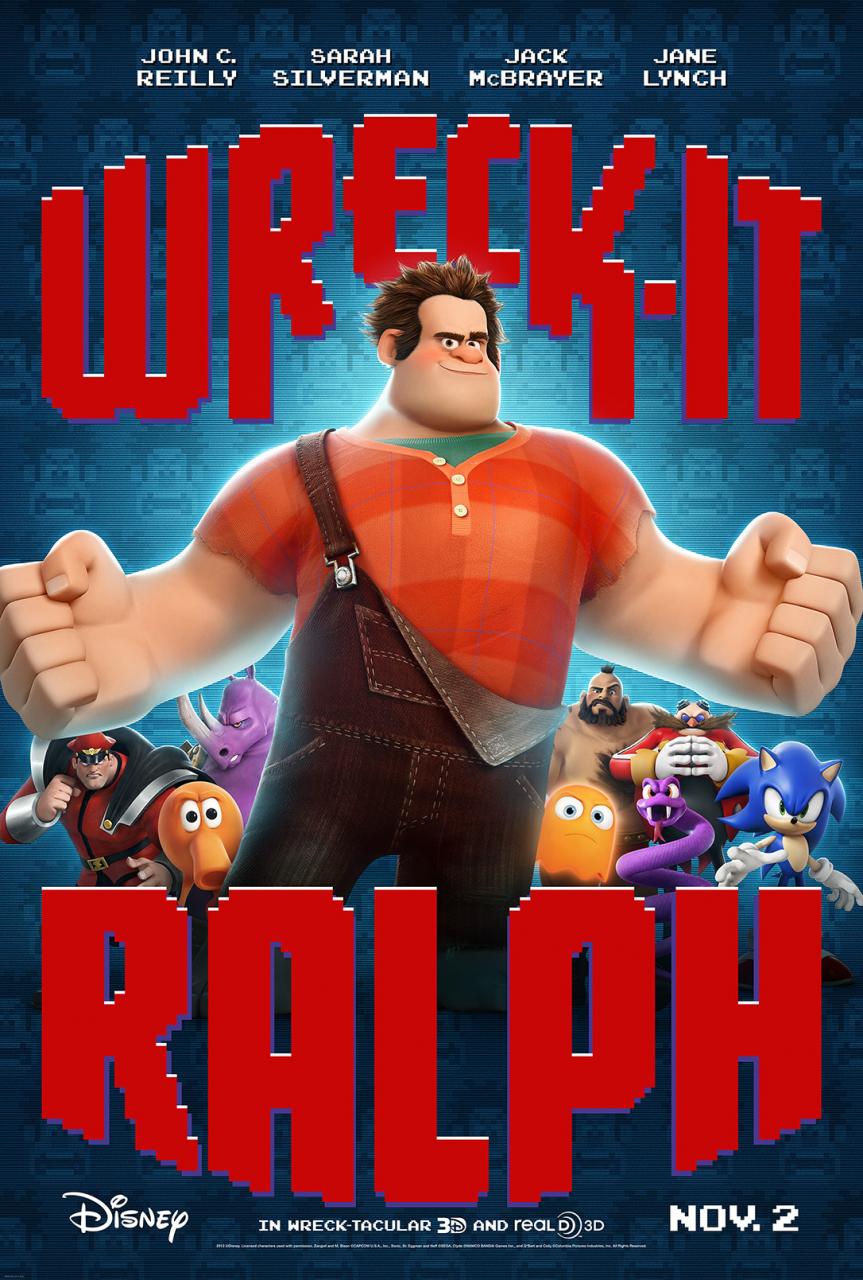
Wreck-It Ralph Limps to $240 Million

I loved Wreck-It Ralph. I think it is the best animated film of 2012. That said, I find its financial under-performance to be somewhat satisfying.

The geniuses running Disney — and by geniuses I mean complete idiots — named Tangled Tangled because they wanted to de-emphasize the female character to attract a male audience. The same logic is undoubtedly  underlying their renaming of The Snow Queen to Frozen. Honestly. Where do they get these ideas? I wish that I was as smart as them.

They believed that The Princess and the Frog under-performed because, I'm not kidding, the word "princess" was in the title. As such, one would expect a movie with the word "wreck" in the title to perform amazingly, because, ya'know, boys like violence... or whatever.

Instead, Ralph is trailing Princess's receipts by over $25 million. Account for inflation, and it's probably over $30 million. Suck it, Disney.

Now, don't misunderstand me. I am reveling in Ralph's performance in the way that I hate Disney executives, but not in the way that I hate to see artists who have dedicated five years of their life to a project only to see it not set the world on fire. The amount of work that goes into an animated film is enough to make me desire that every animated film, almost regardless of its quality, sells millions of tickets. The consummate artists behind the scenes deserve it.

But what I hate more than anything is when a movie studio condescends to us, and animation companies do it more often than anyone this side of romantic comedies. I cannot help but derive some degree of satisfaction when that condescension is proven wrong.

A Very Short Review Of Paranorman


The second exceptional animated film to break from the Disney mold in as many years? We're going to get spoiled.

Paranorman opens with scenes from faux 1950's monster movies to explicitly state where they acquired their inspiration, and indeed, the movie does derive a good deal of texture from these old concepts. It's only a gloss, though, and the underlying script, character construction, and wholly progressive undertones are far beyond anything Robot Monster, or Them could have ever hoped for.

Before I get into any detail, you should go see this movie immediately. Judging from box office receipts, there are many people who didn't, and this is a shame. I can't say that this is the best animated film of 2012--we had some exceptional films this year and choosing an absolute best is mostly academic--but it is in the top five.

If you haven't yet seen it, I also cannot blame you. The trailers are some of the worst that I have seen this side of Dreamworks Animation. They completely, totally, 100% fail to effectively advertise what the movie was going to be about and what mood the movie was going to capture. The trailers make the movie appear to be goofy and corny, and it is anything but. It is quiet and contemplative at times, and far from the constant stream of silly one-liners that comprised the advertisements.


The animation is mind-blowing. I thought that Coraline made Corpse Bride and The Nightmare Before Christmas look dated. Well, this movie makes Coraline look old and unrefined. Not only is there a stunning amount of detail and life to the character designs, not only is the film possessing of texture that other movies would kill for, but the animation itself raises the bar for stop-motion work. It's like nothing I have ever seen. It bobs and weaves, crackles and jumps, all with a jaw-dropping smoothness and vivacity. This makes Frankenweenie, released about a month later, look uninspired in comparison.

Similarly upgraded from Coraline is the sound production. Coraline's audio was disappointing, lacking depth, complexity and impact. The scene that I remember most distinctly was when Coraline spins around a door, with her yelling not fading in and out as she went behind and in front of the door. None of that in Paranorman! The audio is loaded with detail and punch. Truly, they seem to jump to scenarios that are tailor-made for wild audio after only fifteen minutes.

The problems are those that equally affected Coraline. I don't know what it is about the writers at Laika, but they don't seem to like traditional dramatic structure. Coraline had odd rises and falls in its action, culminating in a double climax that made almost no sense. Paranorman has character and concept exposition, then a stratospheric leap to maximum action, which drops off for a period of time before maxing out again, then finally the falling action and denouement.

I appreciate that not everything needs to follow the traditional dramatic pyramid, but it became a thing because it works. It is very hard to write something that doesn't follow the standard structure and still "works," and Paranorman doesn't quite work. There's very little drama in the lead-up to the action, and then there is so much drama piled on top of itself that it is hard to appreciate it. It becomes all the more important for a movie, if it is rejecting traditional dramatic structure, to ensure that its cause-and-effect chain is strong, with each cause and each effect emphasized in the dialog and direction. Paranorman fails at this on more than one occasion.

This is a structural and somewhat academic analysis and criticism of the story. My more personal view is that the story is one that has been done many times before, with characters that have been done before, but the entire thing is constructed with so much color and inventiveness that these faults are immediately lost. Yes, this is another story about an outsider, with geeks and bullies at odds, with parents that don't understand, blah, blah, blah. I didn't care though!

The voice overs are somewhat muted in comparison to the highly emotive work done by professional voice actors, but this goes well with the tone of the film. They also go well in creating the unique characters that, much like Coraline, feel as though they come from a different universe than the characters in Disney or Dreamworks films.

I mentioned how the trailers fail to capture the personality of the film, and this is a tragedy. Paranorman is an exceptional film with an atmosphere that is just this side of comedy as opposed to a traditional horror flick. It is a movie that relies heavily on atmosphere and mise-en-scène to communicate emotions and takes all of these aspects beyond Coraline's already notable achievements.

More over, the film never once condescends to the children watching the film. It is entirely sincere. It is also one of a recent batch of animated films that recognizes that children are not innocent little things that need to only be exposed to pure, traditional subject matter, or ironic takes on pure, traditional subject matter. Monster House, Coraline, Rango, Fantastic Mr. Fox, The Secret of Kells, The Adventures of Tin Tin, and even some work from the major studios like Up, Puss in Boots, and Kung Fu Panda., all of them are part of a large renaissance of animation that I assumed would happen in the smaller, independent studios, but appears to have begun in the large studios.

These films understand that for movies to have an impact, they must have real drama. They must have danger, and violence, and dirty words, and all of the other things that comprise real drama in the real world. While Paranorman may not take place in the real world, it feels more real, more alive, than anything that Disney has produced in twenty years. If they had left the script in the oven for a little while longer, they would have had a masterpiece. As it stands, Paranorman is an exceptional film, utterly deserving of your attention, with many parts so good as to make the parts where it fails all the more frustrating.

Thursday, December 20, 2012

Disappointed By Disney's Frozen


Some early images of Disney's Frozen have come out, and I can't help but be disappointed. Early reports and sketches were giving the impression that the movie would dare to be different, as it were, and contain some non-traditional elements. This stands in contrast to Tangled, which tried desperately to be hip, but was square as a Canadian wheel (South Park reference), and was super-traditional Disney through and through.

And it looks like Frozen is going to be yet another Tangled. The bright-eyed manic pixie female, the world-weary, cynical male. Puh-leeze. I'm going to wait to pass judgment, of course. While I was disappointed in Tangled, and I knew that I was going to be long before watching it, it was still an enjoyable movie. And lord knows, Disney's stuff from the 90's was a constant flow of traditional values, and I enjoyed many of those. I guess that I can only hope for the same from

Sunday, December 16, 2012

A Very Short Review Of The Hobbit


I've been looking forward to The Hobbit for some time. Not just because I liked The Lord of the Rings, but because it is the first technical demonstration of cinema development since Avatar. And being a total cinema geek, for better or worse, I was giddy as a school girl. A very large, hairy, school girl.

First, the movie. It is better than I was expecting. After learning that Jackson was going to be stretching what is arguably a simple, twee, children's adventure story into three movies, giving them the benefit of the doubt was a difficult task. The film mostly pays back that benefit.

Many have complained about the slow pacing of the film, and I didn't mind that at all. I liked the leisurely walk through Tolkien/Jackson's world, and enjoy the time given to appreciate the texture of everything. I disliked the overly-goofy portrayal of some things. The Hobbit book was distinctly more childish than The Lord of the Rings, and I don't mind that element coming into the movie, but they went a bit over the top with the trolls and especially Radagast the wizard, who is borderline Pythonesque.

But now for the part that actually got me out of my hovel and into a theater for a midnight premier: 48 frames per second.

It's not bad! I was honestly expecting it to be worse than it was. In recognition of Jackson's push to have this done, The Hobbit successfully convinces me that there may, in fact, be potential in 48fps at some point in the future. That is still only a possibility, though, and my initial beliefs may yet hold true.

Many people have had a hard time describing the sensation of 48fps. Some call it too real, but I actually see it as less real. Anyone who has ever played extensive video games knows that one of the reasons why they don't look real, regardless of the polygon count or texture detail, is because they lack blur. It doesn't matter if it is at 30fps or 300fps. Since there is no actual object moving through the visual field, there is no blur. There are, instead, 300 perfectly clear, distinct images flashing in front of the player.

Game companies tried implementing motion blur to increase realism, but that generally had a negative effect on the game play, because it is actually better to have everything crystal clear to better facilitate navigation of the world in which the game takes place. But for movies, there are no bad guys that the player needs to dispatch. No details that the player must discern else fail at the game. A movie is a movie — an artistic creation intended to be experienced, not interacted with. The director has absolute control of whether what appears on screen is clear or indistinct. Realism via blur is thus desirable.

It is for this reason why sets and props looked fake. Not because they actually looked fake, indeed, in photographs, everything looks great, and at 24fps, everything looks great. No, they looked fake for the same reason that video games look fake, no matter how detailed they get.

Perhaps think of it another way. A film is a series of still images. We need to get motion out of these images. A very short exposure for each individual frame will give very clear individual images, but it will fail to catch much motion. Much like the Heisenberg Uncertainty Principle, where measurements of particles can either be accurate about location or direction, but not both at the same time, a photo can either tell us where something is going when the photo is taken, or tell us where something is when the photo is taken, but it cannot tell us both.

Movies are not about where things are, they are about where things are going. The more we know about where things are, the less we know about where they are going, and this plays tricks on our minds when happening forty-eight times per second.

Importantly, and this is something that has been lost in the discussion, is that frame rate only tells part of the story. As I'm sure you started considering as you read the above paragraphs, the exposure time is just as important as frame rate, because it is the exposure time that determines the amount of blur. Cinema cameras are based on exposure time in the terminology of rotary disc shutters, and an excellent work up of this is available at Wikipedia.

So with all of that description out of the way, back to my belief that 48fps may actually be useful. Once I got accustomed to the new rate, it provided a unique and enjoyable texture in many of the scenes. The large, sweeping shots that would have otherwise suffered severe strobing, such as the mountain shots and field chase scenes, were buttery smooth. And since these shots would have had very little motion blur at 24fps, the majesty of the image is not greatly altered.

Likewise, any scenes that involved slow motions, such as discussions and activity in Rivendell, looked great. The water flowing and trickling around the elven city was wonderfully detailed and smooth. And during these scenes, the 3D looked great. Jackson was correct in saying that 3D looks better at a higher frame rate. Unfortunately, Jackson had a penchant for severely deep focus, which produced shots that were cluttered and overwhelming in 3D. Doubly unfortunately, not doing deep focus causes its own problems, when the eye naturally tries to refocus to see objects in the background and foreground.

And perhaps because of the skill of Jackson and his team, there are even a few high-speed scenes that look magnificent at 48fps, most memorable is the stone giants fighting with one another. It needs to be seen to be believed. And scenes shot in slow-motion, because we are accustomed to no blur, such as when Thorin walks through flame to fight his nemesis, looked awesome.

Sadly, for every scene that looked good in 48fps, there were five scenes that looked awful. The shot that most perfectly embodied every issue was when Radagast the wizard is being pulled on his sled by... magic bunnies... and there is a brief shot of the camera rushing forward through leaves. It is one of the worst-looking shots that I have seen in recent films. It looked exactly like a video game.

All things considered, The Hobbit is a success. The 48fps is only a partial failure, and while it is stretched a bit far, it's not nearly as thin as I feared. In fact, I think that it works pretty well. Moreover, Jackson's additions like the Pale Orc Azog, the conflict between the dwarves, elves, and Saruman really add some gravitas to what wasn't a really epic story to begin with. It builds excitement at seeing what else Jackson and Guillermo Del Toro have added, and turns the entire thing into something unique.

I liked The Hobbit. I liked the early extended stay in Bilbo's house. I liked the time given to appreciate the details. And while it doesn't elicit the same gleeful impatience that I felt for the second part of LOTR, I can still scarcely wait for next December.

Saturday, December 1, 2012

New Bimbo Artwork

There's a pretty popular image of Betty Boop in a chair and Bimbo acting as a director. I'm re-doing it with high-resolution vectors, and as I work, I'll upload the individual characters. So here is Bimbo, being all directorial.