Showing posts with label disney. Show all posts

Tuesday, October 8, 2013

In Defense of Lino DiSalvo And Disney's Frozen

I came out of blogging hiatus for this one.

Head of Theatrical Animation for Frozen, Lino DiSalvo, has triggered a shit storm with some comments about animating female characters.

“Historically speaking, animating female characters are really, really difficult, ’cause they have to go through these range of emotions, but they’re very, very — you have to keep them pretty and they’re very sensitive to — you can get them off a model very quickly. So, having a film with two hero female characters was really tough, and having them both in the scene and look very different if they’re echoing the same expression; that Elsa looking angry looks different from Anna (Kristen Bell) being angry.”

Taken at face value, this is a collossal pile of garbage. The problem is that this statement cannot be taken at face value. This statement does not just represent him, his work, or the film; it represents all of Disney. His statement is the end result of a complex system of artists, writers, marketers, designers, executives, and blithering idiots on all levels and from all corners of Disney Corp.

---

You have to ask yourself, why would he say something that even vis-a-vis the rest of the Disney catalog, is entirely false. Look at Pixar's various females. Look at the characters in Bolt. Disney's two greatest feats of character animation of the past thirty years, Ursula and Yzma, were both females. He knows full well that it's very easy to create a female that is loaded with character and energy. He has to know. As such, his statement must mean something else.

What is not easy is creating a female that fulfills all of the other requirements of a massive, vertically-integrated, monstrosity like an animated Disney tent-pole film. These characters must be pretty, and accessible, and not too complex, and must sell toys, and fit into the Disney Princess Line, and sell comics, and be on Halloween costumes, and this, and that, and everything. Yeah! That sounds like a nightmare!

Basically, I think that this guy stuttering was not him trying to avoid insulting people, it was him trying to complain about the difficulties of working within Disney without saying that working within Disney sucks! He was complaining about being the factory grunt in charge of creating grist for the Disney mill. He is only a single part of a massive machine that produces everything from branded toothbrush heads to Happy Meals. His work can never stand alone as is. It must always play nice with the other parts of the company.

Let's pick apart his statement a bit to figure out how and why this is so.

First, when he says "female characters," he actually means lead female characters. He's not talking about Ursula or Mrs. Potts. He's talking about Belle and Jasmine. He's talking about princesses.

Next, he puts the concept of emotions in conflict with keeping them pretty. Basically, he's saying that the character needs to be kept attractive at all times while still displaying emotion. That's true of every Disney film. Go watch any Disney movie. Watch the emotions. Not a single Disney Princess is an ugly crier.

He then reveals that his situation is only one part of a broader system when he talks about emotions getting off a model. All characters are designed with character sheets that come from character designers and usually have pages of facial expression sketches. If an animator gives a character too much emotion, it usually falls off the "spec" for that character. And when a character is intended to be as bland as possible, it's going to be super-freaking-easy to fall off "spec."

This applies to the males as well, just not to the same extreme. There is some flexibility in lead male design, but not much. Aladdin was boring as hell, and the princes in Sleeping Beauty, Cinderella, and Snow White were ambulatory coma patients.

In short, lead characters must be boring, bland, attractive, and as ever more people are attacking Disney for, white. How the hell does an artist work within those boundaries? Apparently, by creating the same character over and over and over.

But why the hell is that the case? Why is Snow White a soulless cypher while the dwarves are literal embodiments of character? It's because the cartoonish characters are intended to be entertaining; the lead characters are intended to be shells — avatars that carry retrograde sociocultural views in ways that would be subtle if they weren't so fucking blatant. They epitomize ideals so deeply entrenched in our zeitgeist that we may not even be aware of many of them. There is a word to specifically describe what these avatars carry: mores- folkways of central importance accepted without question and embodying the fundamental moral views of a group.

As such, they need to be somewhat soulless. If they have souls, if they have character, than that would overwhelm the underlying values that we are subconsciously projecting onto them.

Disney's cartoon characters, such as the dwarves, bad guys, any sidekicks — actually, anyone who isn't the white, cisgendered, heterosexual couple at the center of the story — are free to be fully realized characters. We can love them, hate them, relate or not relate. That's because it's the lead characters that are intended to be the characters with whom we actually relate. For me, that's what makes these characters so malicious. They are the characters in whose roles we see ourselves. No one sees themself as Cogsworth.

(Conversely, fans of animation universally despise the lead characters and instead spend all of their time waxing poetic about the bad guys. Seriously, go look at the list of Annie Award winners for Character Animation in a Feature Production. Not a single one is a lead character.)

An excellent exemplar for this are Disney Theme Parks characters. They have characters and then they have face characters. These are the people that are not hidden behind masks and must speak and directly interact with park guests. The face characters are always the leads. They're the pretty ones. They are the ones that speak and smile and emote. They are the ones who are, essentially, human.

By keeping the characters bland, the maximum number of people can effectively project themselves into the fantasy, which means maximum profit when time comes to sell toys. At least theoretically, this needn't be bad. Theoretically, these could be classified as archetypes. It becomes pernicious when that also means catering to the worst elements of our social mores. Here, archetypes are used as tools for reinforcing those bad elements instead of being used as tools to make an otherwise good, complex story relatable in a universal way.

Disney isn't just selling a product, they are reinforcing and encouraging negative elements of our society that we are fighting to get rid of! As we fight to eradicate homophobia, sexism, racism, classism, ageism, and all other forms of prejudice, Disney is actively fighting against us because they know that many people want these prejudices to be true.

We may not admit it and we may not really think about the ramifications of these stories, but we want them. Some of us want them so bad it hurts. We want our princes and princesses; we want to be beautiful, white, straight, and rich; we want our fairy tales; we want a reality that plays to our complex underlying mores and doesn't challenge us. Disney plays like crazy to these prejudices.

For example, go Google "Princess." Princess Cruise Lines is the first entry, but Disney Princesses are the second, and the image search is nothing but Disney. The princess fantasy existed before Disney, but sweet mother of God has Disney expanded its significance. At this point, Disney fucking owns the word.


Disney's face characters are not products in themselves. They are vessels that Disney crafts that are then filled with prejudice. Some of this prejudice comes from Disney, but much of it comes from those eating it up; it is a cultural problem, not just a Disney problem.

So do not attack Lino for his quote, attack all of Disney, and indeed all of society, for what the quote represents. It represents a culture of sexism, racism, ageism (ewww), rapacious capitalism, and a lack of creative vision that has been rotting the company from the inside for years.

Walt Disney wasn't a perfect guy, but he was interested in art. The Disney of today couldn't care less about art, as Michael Eisner famously said. The Disney of today is only interested in creating a movie that fits in with what Disney actually sells: junk.

The actual creative element at Disney is a mere supporting role, intended to do nothing more than generate grist that can be milled into junk that is manufactured in China, sold in New York, and eventually tossed into the trail of trash, left through time and space, by our society as it charges drunkenly forward, obsessed with a corrupt fairy tale about itself.

What a magical kingdom we have built.

Sunday, February 10, 2013

Why Michael Eisner Failed

What a coincidence, as I am reading my ongoing tale of sturm und drang in the form of the rise of Disney and the subsequent creation of Dreamworks, a study comes out showing why Michael Eisner failed. It paints in raw, scientific language, the very impression that I think any person would take away from the Books Keys to the Kingdom and Disney War.

Both of those books showed a relationship between Michael Eisner and the late Frank Wells as one where Eisner would go off into a bout of mental and verbal diarrhea, and then Frank Wells would jump in, clean it all up, and get it ready for prime time, as it were. After Wells died, Eisner lost that binary partner that took his ideas and work and made them functional elements of a grand machine.

What this illustrates very well for me is that the high-powered people at the top of company are frequently, if not primarily, not important. What is important is the machine around them. This just makes me even angrier when you see the chief executives and presidents of major corporations earning tens of millions in salary while their average employee barely brings home $50k. They think, nay, they are convinced that they are critically important.

In defense of Eisner, and I think this a very important point since so much of Eisner's later tenure was defined by conflict with Jeffrey Katzenberg, is that he was correct not to give Katzenberg Frank Wells' job. Katzenberg is another high-powered, hard-charging executive type, and that would have likely either only amplified Eisner's problems, or caused so much internal conflict that it could have ripped Disney apart.

But again, in defense of Katzenberg, he appears to be more aware of this limitation than Eisner was. Katzenberg is famous in Hollywood for surrounding himself with powerful women -- a group that is more than slightly underrepresented in most studios. This drive to associate with those that are not simply more hard-charging white guys has undoubtedly played a large role in his ongoing success.

Friday, February 1, 2013

WATCH THIS: Paperman


Paperman premiered before Wreck-It Ralph. I liked it. The fusion of 2D style with 3D technology is something that CGI artists have been trying to do for years, but before this, the efforts have been... less than convincing. I like CGI, don't get me wrong, but even the best work of CGI animators pales in comparison to the lively, organic look of hand-drawn work. I am certain that the greatest animated CGI works are in the future, as the ability to merge the hand and the polygon becomes ever greater. Big kudos goes to the technical team who made this possible.

Thursday, January 31, 2013

WATCH THIS: Salvador Dali & Disney's Destino


Animation is such a wonderful medium for art. Unlike film, which has a limited development life-span because actors age, production can start, stop, start, stop, and even let an animation project stagnate for decades before finishing. Perhaps the greatest example of this is The Thief and the Cobbler, but another project followed a similar path: Destino.

Destino was a pet project of Salvador Dali and Walt Disney Studios, specifically a single animator. Sadly, the studio faced difficult times post-World War II, and the project was dropped for over fifty years.

Roy Disney discovered the finished story boards and decided to complete the project, and we should all be thankful. While it's not as... yeah... as Un Chien Andalou, it is a visual tour de force in its own right. More to the point, it perfectly manifests Roy Disney's belief in art over commercialism — success follows artistic integrity. Sometimes this is true, other times not. But what's important is that legacies are built upon art, and this work helps to further cement the legacies of Dali, Disney, and "that idiot," Roy.


Walt Disney y Salvador Dali - Destino HD from Ivan Wenger on Vimeo.

Saturday, December 29, 2012

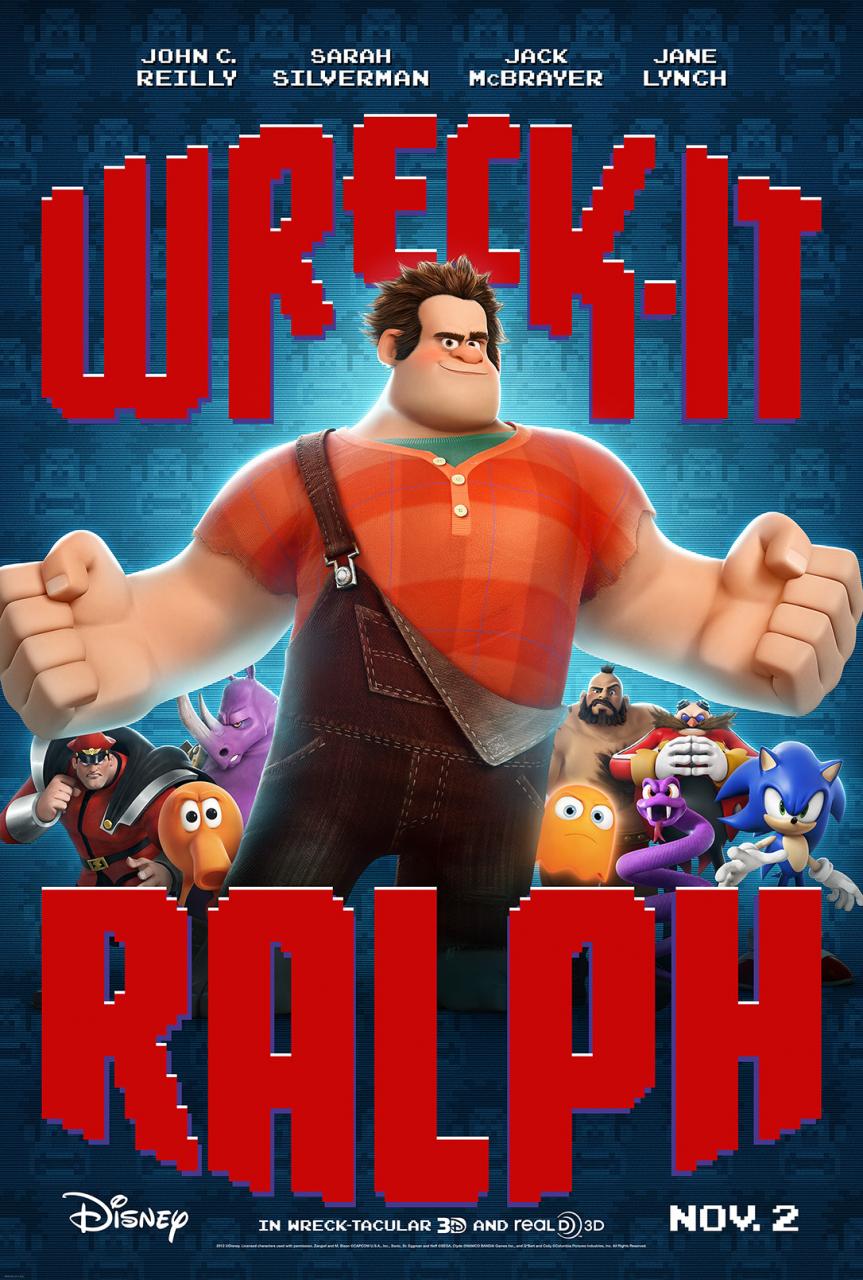
Wreck-It Ralph Limps to $240 Million

I loved Wreck-It Ralph. I think it is the best animated film of 2012. That said, I find its financial under-performance to be somewhat satisfying.

The geniuses running Disney — and by geniuses I mean complete idiots — named Tangled Tangled because they wanted to de-emphasize the female character to attract a male audience. The same logic is undoubtedly  underlying their renaming of The Snow Queen to Frozen. Honestly. Where do they get these ideas? I wish that I was as smart as them.

They believed that The Princess and the Frog under-performed because, I'm not kidding, the word "princess" was in the title. As such, one would expect a movie with the word "wreck" in the title to perform amazingly, because, ya'know, boys like violence... or whatever.

Instead, Ralph is trailing Princess's receipts by over $25 million. Account for inflation, and it's probably over $30 million. Suck it, Disney.

Now, don't misunderstand me. I am reveling in Ralph's performance in the way that I hate Disney executives, but not in the way that I hate to see artists who have dedicated five years of their life to a project only to see it not set the world on fire. The amount of work that goes into an animated film is enough to make me desire that every animated film, almost regardless of its quality, sells millions of tickets. The consummate artists behind the scenes deserve it.

But what I hate more than anything is when a movie studio condescends to us, and animation companies do it more often than anyone this side of romantic comedies. I cannot help but derive some degree of satisfaction when that condescension is proven wrong.

Thursday, December 20, 2012

Disappointed By Disney's Frozen


Some early images of Disney's Frozen have come out, and I can't help but be disappointed. Early reports and sketches were giving the impression that the movie would dare to be different, as it were, and contain some non-traditional elements. This stands in contrast to Tangled, which tried desperately to be hip, but was square as a Canadian wheel (South Park reference), and was super-traditional Disney through and through.

And it looks like Frozen is going to be yet another Tangled. The bright-eyed manic pixie female, the world-weary, cynical male. Puh-leeze. I'm going to wait to pass judgment, of course. While I was disappointed in Tangled, and I knew that I was going to be long before watching it, it was still an enjoyable movie. And lord knows, Disney's stuff from the 90's was a constant flow of traditional values, and I enjoyed many of those. I guess that I can only hope for the same from

Saturday, November 10, 2012

A Very Short Wreck-It Ralph Review

I loved Wreck-It Ralph. It was colorful, high-contrast, efficiently written, with very good voice performances by all parties, especially Alan Tudyk as King Candy and Jane Lynch as Sergeant Calhoun. The character designs were strong and identifiable, as opposed to the complete crap that Dreamworks so frequently puts out.

There's very little about this film that is bad. As expected, the worst part is Sarah Silverman's character, Vanellope Von Schweetz. Early on, she is as annoying as Silverman herself, which isn't surprising, since the character is apparently based on Silverman's memoir. Luckily, she gets much better as the movie goes on, and by the halfway point, she is a fully-formed character complete with pathos.

The mechanics of the movie are worth singling out; they are perfectly consistent. That is a big achievement considering that the characters jump from game to game. A significant problem with movies with extreme premises is that, almost inevitably, an inconsistency or plot hole arises. The writer had a certain scene, line, character, or event that he or she absolutely wanted, and in a less extreme premise would be completely fine, but in the more extreme movie, it makes no sense. Wreck-It Ralph has none of these inconsistencies. It is excellent.

As far as message goes, I think that they should have stressed Ralph's subjugation much more. All he seeks is acceptance, and the characters in his game are outright violent to him, and that is never fully addressed. That, to me, is a major narrative shortcoming. But much like Vanellope, that failing is soon forgotten as the rest of the movie joyfully bounds onward.

In many ways, I am perhaps a poor measure of this movie's quality since I am so affected by the nostalgia that it evokes. I watched with glee as I attempted to pick out references to old video games, frantically searching every scene, every shot, for characters wandering the background, images flashing by, or props lying around. I nearly lost my shit when Sonic gets hit by the out-of-control escape pod in Central Station and loses all his rings.

That said, I like to think that I can provide some significant analysis separate from my giddiness at seeing Pac-Man eating shrimp cocktails. Wreck-It Ralph is the best non-Pixar CGI film made by Disney. It is paced well, with perfect consistency, and rises with great work from all involved. It is the best animated film of 2012.

An Even Shorter Review Of Paperman.

As with all CGI movies, it is preceded by an animated short. Paperman is good, but a bit too twee for its own good. The story is of a man and woman office workers who meet on a train platform. They are attracted to each other, but the meeting fails in a way that only a cartoon could present. He then sees her across the street from his high-rise office, and commences making tons of paper airplanes in an attempt to reach her. The short only gets cuter from there. My personal criticism of it is that, while they set it in the 1950's (or so it appears), the female character is so painfully demure as to be annoying.

The animation is very cool. It's CGI but is rendered to look like a 2D sketch. The effect is very believable and adds a great texture to the entire work. Overall, it was a solid B+ appetizer before the full meal.

Wednesday, September 19, 2012

New Wreck-It Ralph Trailer Looks Good


General audience-oriented animated films frequently have awful trailers. Dreamworks trailers, I think, work against the actual movie more often than they help. For example, Over The Hedge was a funny, entertaining film. Did the trailers make it look like a cliche piece of crap? Yep!

Wreck-It Ralph is in the middle. All three trailers thus far have tried a little too hard for gags, which generally indicates a bad film (it looks like we will have immediate precedent for this in Hotel Transylvania), but the premise is just so great that I can't imagine the movie not having some charms.

Tuesday, July 3, 2012

A Very Short Brave Review


Before you read any further, I reveal some things that may be considered spoilers, in that they were not directly stated in the trailers. There are also a few points that are definitely spoilers. So, be forewarned. In fact, you may as well watch the movie first so you can more fully understand the points that I'm trying to make.

Brave is the least Pixary Pixar film since The Incredibles. There are no cute characters to add levity to the universe a la Monsters Inc. Finding Nemo, or the god-awful cuteness shoehorned into Up. There is very little about this movie that lends itself to Disney-style merchandising. The lead character is also the most classically Shakespearean character to ever come from Pixar. It is fitting that she should be placed in a fairy tale.

Unfortunately, therein lies the problem. This is a fairy tale and, for whatever reason, Pixar didn't have the balls to fully dive into that universe. They also didn't want to apply the full Disney gloss to the story, like Disney became so good at doing in the 1990's. Perhaps because they recognized that there are very significant limitations to the Disney gloss. For example, even when Disney was at its peak, their just isn't enough of that special sauce in the galaxy to make The Hunchback of Notre Dame not dark. Stories must exist in a universe, and that universe must be created specifically to contain a system of cause and effect. If that system is going to be dangerous, don't make the movie.

Pixar tried to walk this odd line between Disney and Brothers Grimm, and was not completely successful. I criticize them because they didn't have to fail. There is nothing that said that Pixar had to attempt full fairy tale, because fairy tales have become so ingrained in our zeitgeist that their gross elements can be used to create any system that a studio wants. They can make The Brothers Grimm and Snow White And The Huntsman, and they can be used equally well to create to Tangled and Shrek. Pixar shouldn't have tried to walk into true Fairy Tale Land. They did, and the movie is less for it.

But before I get to into that, I want to talk about where this movie succeeds. The animation is without doubt the most impressive CGI work ever. Even if you mentally consider the time in which a movie was made, sort of like taking into account creative inflation, Brave is a stunning achievement. There is texture and magic to the world that simply does not exist in any other CGI work. Only Finding Nemo comes close.

I also liked how they changed the way that they rendered the characters. They are not like previous Pixar films, nor are they the Disney style seen in Tangled. They are still obviously the products of Cal Arts students, but different enough as to be refreshing.

The script is pretty tight, bumps along at good speed, and all of the action is quite entertaining. Dialog is fantastic, and scenes of comedy are at times amazingly hilarious. I loved Merida. She is the most vibrant, strongest, and singular character that Pixar has created, with the possible exception of Carl Fredrickson from Up.

Problematically, one of the biggest weaknesses with the film was also one of the best parts: the witch. As you can guess from the trailers, Merida meets a witch who gives her a spell that causes a whole bunch of trouble. The witch is not a bad witch. She's actually quite nice. Instead of simply being some evil forest-dwelling crone, she's a long-lived salesman of spells and bear-themed wood carvings (spot the Pizza Planet truck in her wood shop!). I really loved the different take on the witch, and her sidekick talking crow is a great character. So why is she also one of the biggest problems? Because she is one of the most glaring elements of the film that I suspect was originally darker and more truly Fairy Tale.

So now on to the negative bits. The witch is portrayed as being generally nice. But she gives Merida the spell that turns her mother into a bear, and does so seemingly without malice. But that makes her obfuscation as to the actual effects of the spell completely unexplained. It is also a gargantuan stretch of dialog for Merida to not even come close to asking what the spell is going to do. After the interaction, Merida is magically transported away from the Witch's cabin for no reason at all. Indeed, the entire interaction with the witch is very entertaining but entirely incoherent.

I'm glad that they wanted to do something different with the witch, but her actions could not come from a disinterested third party, as the story says. She would either have to evil, and purposely obfuscate the spell's effects, or be benevolent and obfuscate the effects for the sake of teaching Merida a lesson, or for greater purposes. By greater purposes, I mean that the story spends a great deal of time talking about fate, and they had a chance to create a physical manifestation of fate in the witch, and didn't. Similarly, they never explain the appearance of the Wisps to only Merida. There's a great deal of conflict between fate and choosing one's own path that is never addressed, nor is the question in the trailer of "paying the price for freedom" ever answered. Merida only pays the price for not asking what the freaking spell does.

Perhaps causing this lack of narrative depth is the lack of narrative itself. The story is very simple, and two extended action sequences take up about a third of the movie: getting the mother out of the castle and then getting the mother back into the castle. One of the points in the film where they could have had real character development, they fall into that bastion of lazy filmmakers everywhere, the getting better montage1. Montage in general is the fallback of poor films, but the "getting better" variant is one of the worst. It can sometimes be used for humorous effect and to explain quickly what took time. Pixar is no stranger to this trick having used it in The Incredibles, Ratatouille, and even Cars. But in Brave, it butters over the fact that very little development takes place between Merida and her mother. This is made glaringly obvious when the dual epiphanies near the end of the film have nary a drop of dramatic heft to them.

Epiphany is a difficult thing to write. It requires enormous care, time for the events to stew in the minds of the audience, and enough dialog and behavior to effectively communicate the internal world of the characters. Frequently, the best time to have epiphany is at the very end of the film. The epiphany is literally the climax, and the characters don't expect the event until it happens. One of the best epiphanies that I can think of is Darth Vader at the end of Return of the Jedi. One of the worst is Anakin Skywalker at the end of Revenge of the Sith.

They didn't completely fail in Brave, but they missed the mark. I put 100% of the blame on the aofrementioned overly long action sequences. When over half of the movie is action, with little chance for character and dialog, it's no surprise that the epiphany at the end is a dud. They should have either cut the actions scenes significantly, integrated more dialog and development into the action scenes, or extended the time of the film. Ratatouille, Cars, The Incredibles, and Cars 2 were all fifteen minutes longer or more. There are certain stories that just can't effectively be told in the 90-minute "kid block." Mark Andrews, the second director, said in a review that they stripped the Merida story down to the core. They stripped it too far.

Again, I think the root of every problem in the film is that they didn't want to invest into a fully fairy tale universe, but they also didn't want to add a Disney-style sheen to the fabric of the universe. This internal conflict meant that character development that was necessary didn't take place and caused inconsistencies in the plot.

Fairy tales frequently work without much character development --Sleeping Beauty, Snow White-- because the characters are all archetypes, sometimes even bordering on cliche. This means that development is simply not needed. We all know what this person is because it is stated from the outset. It's fine to play around with the characters a bit, but they more or less remain the same. Build off of the archetypes.

I suspect that this is what Brave originally was, and caused the "creative differences" that resulted in Brenda Chapman's dismissal as director. We know that her version was filled with snow and was generally colder and more magical in its outlook. This lines up very well with the original title of the movie, The Bear And The Bow. That name just drips with traditional fairy tale values.

A traditional fairy tale is going to be dark. Those old fairy tales were almost always a narrative over an underlying story of hellfire and death. The consequences were dark and brutal because they were trying to represent a world that was dark and brutal. I mean, for Christ's sake, in an early version of Cinderella, the prince beheads the evil stepsisters.

I think that because Brave was by Pixar, they should have gone full-comic. Ditch the real bad guys, go for an anthropomorphic bear that's more a highwayman and swindler than a real, deadly threat. I would have personally preferred the dark, true fairy tale, but I understand that that sort of film doesn't really fit well with the Pixar canon. The film that they gave us is neither. It isn't satisfying from a fairy tale perspective, and isn't comic enough to fit in with other Pixar films. I very much enjoyed Brave, but there's so much there that could have been better, it's almost painful for me to watch.

Finally, this is nitpicking, I know, but when the fuck does this movie take place? The architecture is early second millennium. The characters are all wearing traditional modern kilts that weren't created until the mid 1500's (Braveheart made the same mistake). They refer to "clans" which is a concept that dates from the 1000's, although some clans claim lineage back to the 500's. One of the characters is said to have repelled Romans(!?) during a battle. Merida wears a corset, which wasn't invented, at least in the form shown in the movie, until Elizabethan times. And they are still fighting bears, which went extinct in Britain during the late first millennium during the Dark Ages.

An Even Shorter Review of La Luna.

La Luna is the requisite short that precedes Brave, and it was very cute. Not the best short that they have ever done, but light, twee, fun, and incredibly European. I am not surprised that it was created by a guy named Enrico.

-----------------------------------

1: I stole this wording of the phenomenon from my partner, Danielle.

Saturday, June 9, 2012

Disney Releases "Wreck-It Ralph" Trailer

It's been awhile since they revealed the existence of the movie, and they have finally gotten around to releasing the first trailer.

Monday, May 21, 2012

WATCH THIS: Redux Riding Hood

It only took over a decade to finally make this available to the public, Disney is good at shit like that, but here it finally is. The Oscar-nominated short Redux Riding Hood.


And the trailer, just for the hell of it.

Tuesday, April 24, 2012

Final Brave Trailer

The third and likely final trailer for Pixar's Brave has been released, and while not as disappointing as the first, it's still among Pixar's worst trailers. Honestly, what were they thinking with this thing?


In one sense, this gives me hope. That they had such a hard time making a happy, h'yuk kind of trailer (which is the kind of trailer for which all of these idiotic studios seem to shoot) leads me to believe that the movie has very few h'yuk kind of moments. It reminds me of Wall-e, where its trailers featured almost nothing from the second half of the film. It was two solid minutes of Wall-e being cute on Earth.

It also gives me hope that we will see something different. Because, man, after Rango, I'm not sure that good ol' cartoon formula will ever sate me again.

Friday, January 6, 2012

Disney's Frozen Taken Off Ice

I guess that it is official, what with Disney setting a release date, although in this day and age, release dates are meaning less and less. Regardless, the studio's rendition of The Snow Queen will be coming out November 27th, 2013. It's nice to hear that their next hand-drawn production hasn't been relegated to development hell, since starting a new project fresh would have pushed any release into 2014, or possibly even 2015.

I also like that they are dipping into the MASSIVE trove of untouched fairy tales for this one, with one of Hans Christian Anderson's coolest stories. But, this is Disney, afterall, so simply calling it The Snow Queen isn't enough. The fact that the original name is well-known and totally badass-sounding makes no difference to a studio that needs to desperately excrete pop-culture bile from every pore in an attempt to prove that they are hip, and as such they are naming it Frozen. Their lameness truly knows no bounds.

There's very little information as yet. We have a single picture, of what is, I'm assuming, the Snow Queen herself, which you can see right here, and a very brief mention in the included video.

The Snow Queen is a dark tale, and I hope that they keep some of that in the film, as opposed to candy-coating the plot like they did for The Little Mermaid. In their defense, the laughable sexism of The Little Mermaid was probably best excised. I'd love to see some shades of The Hunchback Of Notre Dame (which I'm sure would have been named Lunch With The Hunch by Disney's current executive team) or The Lion King, both of which were wonderfully dark in many places.

I shall withhold any judgment until I see who comprises the producing team. I hope that Lasseter et al. are directly involved.


Saturday, November 19, 2011

New Pixar's Brave Photos And Trailer!

Dammit! I need to be more up on this. These photos have been on the interwebpipes for nearly a week!

The style of the characters appears to be a break from current Pixar models. I don't mean by the texture. Unfortunately, the texture of Pixar films is more-or-less identical from film to film. All of the characters appear to be made out of the same "stuff." Still, their model for humans has followed early Pixar, à la Boo from Monsters Inc. and Wall-e, or the Brad Bird look from The Incredibles, Ratatouille. Here, they've mixed it up a bit. The Disney influence still shines through loud and clear, which I guess isn't a surprise seeing as everyone that started Pixar cut their teeth at Cal-Arts, but it is different, which is nice.

Also, the trailer is terrible. Probably Pixar's worst trailer. Not as bad as Dreamworks movies usually are, but still pretty bad, with no tempo, and too much noise.

Regardless, my excitement cannot be tempered. This is the film event of 2012 for me.


Merida encounters a wisp.

Merida sits with her royal family and views suitors.

The fathers of the suitors.

Wednesday, October 19, 2011

John Lasseter Defends Cars 2

John Lasseter has given an interview discussing Cars 2 to the New York Times. First, he denies that Cars 2 was a money grab. I think anyone who argued that it was knows nothing about the rise and operations of Pixar.

That's not to say the Cars 2 was good. Quite the opposite. I thought it was not just Pixar's worst film, but a bad film in most repsects. But because of Pixar's, and Lasseter's, history, I don't think that any judgments can be drawn from the film and extrapolated out into the corpus of the Disney Company.

The comment of Lasseter's that had me worried was his declaration that “This is not an executive-led studio." Perhaps this applies to Pixar itself, but as I argued in my post Why Tangled Reveals That Poison That's Still Inside Disney, there is no evidence to support that this applies to the rest of the company. Truly, Disney appears to be one of the most executive-led companies on Earth.

Lasseter further defended Cars 2 by saying that he makes films for "that little boy who loves the characters so much that he wants to pack his clothes in a Lightning McQueen suitcase.”He succeeded insofar as he made a movie that only a little boy could enjoy.

The reason why this is a disappointment for me is that their earlier films did just that, but also transcended the "kid-flick" mentality and construction to become something lasting, something great. Cars 2 will not last. Even if you think that it is a good film, I can't imagine anyone arguing that it will last. Wall-E will last. Toy Story will last. Cars 2 will not.

Finally, the article refers to Cars 2 as being the frontrunner for Best Animated Film and the Oscars. This is absurd. If Rango doesn't win, I'm going to have a fit. Granted, the Oscar's are certainly known for absolute stupidity. Hello, Shakespeare In Love.

Monday, September 12, 2011

Why "Tangled" Reveals The Poison That's Still Inside Disney

There is a big update just before the list of citations.

-----------------------------------------------------------------------------------------------------

When Disney bought and then disseminated the neutron star of talent that is Pixar into the rest of the corporation, many people, myself included, saw this as the beginning of a new era for Disney. John Lasseter's immediate takeover of in-production films like Meet The Robinsons, Bolt, and the various Tinker Bell DVD's likely resulted in those films being quite good, and at times legitimately touching, when they were on track to be as pathetic as Chicken Little. The 2009 release of The Princess and the Frog, the first traditional animated feature since the "udder" catastrophe that was Home on the Range, seemed to cement the perception that Disney might be returning to the veritable ejaculation of talent that began the Disney Renaissance, and in a greater sense, the animation renaissance of the late-80's and early-90's and Disney Corporation's veritable rebirth into the Goliath that it is today.

There has been, of course, a great deal of progress. Disney immediately stopped production of its endless stream of direct-to-video sequels, which saw its final abomination in the form of Cinderella, ugh, III, and its final work in the form of a third Little Mermaid film. That in itself is a big improvement, and certainly worthy of praise, but there is still something off, and I see it most prominently in the recent movie Tangled. Basically, the disease that caused Disney to fly off the rails in the 2000's is still there, threatening to derail the company yet again.

---

Depending on how old you are, you might not fully grasp the depths to which American animation had fallen. The 70's and 80's saw some of Disney's least-remembered animated films, and television animation was atrocious. In fact, some 80's TV animation was so bad, it became good again. Cartoons like Turbo Teen were so unbelievably horrific, the only way to explain their existence was to assume that the creators had consciously set out to craft something that bad.


The man most widely credited with fostering the rejuvenation of not only Disney's animation, but its entire film production system, is Michael Eisner.1 Eisner was instrumental in driving Disney to rediscover the values that Walt Disney himself had original used to achieve wild commercial and critical success. Walt thought that movies should be entertaining, honest, accessible, and artistically sound. Decisions weren't made for wholly commercial reasons. Commercial success would follow artistic integrity, and, for Disney at least, it did.

But after Walt's death in 1966, and also Ub Iwerks in 1971, Disney saw a slow but steady decrease in studio production quality. 101 Dalmations, considered by many2 to be Disney Animation's most technically perfect film, was 1961. Then, we have a string of animated films that are remembered as enjoyable and not much else. From 1966 to 1985, Walt Disney Company won a single Academy Award, for special effects in Bedknobs and Broomsticks,3 while Disney's most financially successful film of the 1970's was, ugh, The Apple Dumpling Gang.

By bringing Disney back to its roots, Eisner fomented the creation of Gummi Bears on TV, and The Great Mouse Detective in theaters. Neither would be a runaway success, but they both proved that expensive, high-quality animation was still commercially viable. The payoff would truly come in the wild, historic success of The Little Mermaid. Anyone who has, and has friends who have, seen the film knows how well it sticks with you. It's as though every element of the film was meant to burrow into the pop-culture module of your brain, readying it to, at any moment, throw a Scuttle quote into general conversation.

The Little Mermaid was a rather big gamble. At $40 million, it's budget was twice that of the preceding Oliver and Company, and over three times as much as The Great Mouse Detective. The gamble paid off, though, and pay off it did. To the tune of $211 million, and countless millions more in VHS and toy sales. And who knows how much profit has been made from attaching Ariel to the endless money-printing machine that is the Disney Princess product line.

Fast-forward sixteen years, and Disney is a rejuvenated powerhouse. The 2000's saw more movies produced than the 1990's and 1980's combined. Disney Company was nominated for more Academy Awards in 2009 alone than all of the sixties, seventies, and eighties. In fact, every element of Disney Corporation was vomiting money all over stock holders... except, that is, for its heart and soul: animation. Home On The Range failed. Brother Bear underperformed. Treasure Planet bombed so badly Disney had to restate earnings. The last critical and financial bright spot was Lilo & Stich, which was way back in 2002. Traditional animated features were against the ropes.

---

When Michael Eisner announced the end of traditional animation at Disney, he explained it by positing that audiences had grown tired of these, and instead wanted to see CGI films. He neglected to mention that every traditionally animated film Disney had made in the past five to six years was either marketed poorly or received poor reviews (Rotten Tomatoes scores of 55%, 38%, 70%, and 48%4), and traditionally animated films from other studios were even worse.5 It's as though the Eisner of 1985 had been replaced with a doppelganger Eisner that more closely resembled the blithering idiots at Disney who fired John Lasseter.6

The core of this problem is manifold, but, I think that one very visible aspect of it best encapsulates the totality: Disney cannot figure out what the fuck to do with boys, and it's apparently driving them insane.

In Atlantis: The Lost Empire7, if you watch the director commentary on the DVD, there is a moment early in the film, viewable here... or until Disney acts like an asshole and takes it down. Fast forward to the 8:00 mark for the applicable events.


Helga, acting all seductive, with a distinctly film noir staging, sits down, exposes her shoulders, and then dusts off her knee. In the original staging of the scene, she was supposed to hike her dress up slightly to reveal a Betty Boop-style garter. Disney nixed the idea, saying it was too provocative. Something that, if kept in, wouldn't have even garnered higher than a G rating... was removed from the film. Disney may as well have included a disclaimer in the trailer saying "Just in case you were expecting something different, remember, we have no balls whatsoever."

Remember, scenes like this were put in, hell, the entire movie was created, specifically to attract tween and teenage boys.8 How well do you think that they did considering they didn't even have the cojones to include something that was shown on Betty Boop in NINETEEN-THIRTY? Damn poorly, that's how. Because, shocker, Disney is a massive, soulless, limp-dicked company.

At least, it was.

Pixar was to end this. Pixar was the company that produced films like Wall-E and The Incredibles, two films that Disney as Disney would never have greenlit even if someone was aiming a 300mm naval canon at their genitals. Pixar didn't set out to produce family friendly films, They set out to produce good films that just happened to be appealing to all age groups.

The first strategy, the one that produced Atlantis, is the executive-directed strategy. It's a psychology that holds over from the old studio system days. It frequently works. The second, the one that produced Toy Story, is the artist-directed strategy. It also frequently works. Ideally, like the functioning of a good government, these two strategies find a balance. The executive keeps the artist in check, since artists are a squirelly lot and you can end up with a complete disaster like Heaven's Gate if they are left unmonitored. But in return, the artist is the one who maintains direction, purpose, and quality in the production. The executive is usually unskilled in the ways of art (frequently, they're unskilled in the ways of anything), and is at his best when leaving an artist alone except to restrict the budget and sniff out possible bombs.

At Disney, that artistic element had died. In fact, the two biggest animated successes for Disney since Tarzan, Lilo & Stitch and The Emperor's New Groove, were both produced with spotty oversight and under atypical situations.9 Essentially, the only way to succeed in Disney was to avoid Disney as much as possible.

In the movies that actually had budgets and oversight, the results were either poor or horribly misconceived. For example, no artist would have ever considered Treasure Planet a good idea. They would have immediately realized that shoehorning something that was edgy10 into the classic tale was not only needless, but also utterly, completely, tragically, lame. And in the world of entertainment, lameness is toxic. Your company may as well be run by lepers.

---

And so, after much circumlocution, we come to the ultimate point of this article. Tangled is trying so hard to be hip, there is only one way to explain its bloated, desperate, $260 million existence: Disney's core is still tragically uncool and dominated by executives. Truly, in my review, the strained desperateness of Tangled was the most salient element of the film. That is the biggest issue with the executive approach to film production, the films end up actively trying to be something, in this case cool, and when they fail, the lameness is all the more glaring.

And really, that isn't a shock! The men11 that run these studios were never cool! They were not the cool kids. They were the nerds and the unpopular ones. And even if they weren't unpopular, by some stroke of luck, they undoubtedly didn't know why they were popular. Kids don't understand things, people in general have a habit of forgetting what it was like to be a kid, and then companies expect these same people to know what kids want! It's a recipe for failure, producing things that quantitatively should be successes yet aren't, like Treasure Planet, and alternatively producing things that become certified über-hits for seemingly no reason, like Silly Bandz.

In this void of understanding, we have analysts, interviewers, marketers, advertisers, social media specialists, artists: all of the people who try to quantify coolness. They do this for the same reason that many people12 get into psych studies: it makes them feel like they exist on a level above others. Just as philosophers of old, like Socrates, claimed that physical pleasures like sex were for lesser men probably because they were ugly and couldn't get any,13 these experts know what it means to be cool and popular, so if they aren't cool and popular, it's because they're choosing not to be. If you can't be cool and popular, intellectualize it. They then convince other people, who also don't understand how to be cool, to buy their services.

The thing is, though, coolness and popularity are different things, and while they frequently walk hand-in-hand, they needn't always. Popularity is being liked by people, but coolness is confidence, which frequently attracts people to you, but as I said, it needn't always. When a movie is desperately trying to be something, it is not confident, and cannot possibly be cool, and thus cannot possibly be appealing. This is the reason why movies by the likes of Quentin Tarantino, who is by all accounts a colossal geek, are still cool. Tarantino is a consummate artist who only cares about his vision and is resolutely confident in it.

This is in comparison to a person that we've all known well, or perhaps have been:14 the uncool geek. We're told to not care that people are making fun of us. We're told to be confident. We see other confident people doing confident things, and we try to mimic that. Unfortunately, it's not real confidence. It's mimicry of the gross aspects of the behavior, not the wellspring of the behavior itself. This never works because it is painfully apparent that we are overcompensating. It usually comes across as annoying and only serves to cement our position as uncool.

To achieve that coolness, we must become truly confident in our existential self. We must know, both intellectually and emotionally, that we are worthwhile entities. Because only from this do we achieve a genuine representation of ourselves, and that genuineness is key to being seen as confident. You can't be putting on a show or consciously trying to be one way or another. Because trust me, everyone knows.

This sort of realization usually just comes with age, and by the time we're all in our thirties, we've mellowed. But that's life, and this isn't Walgreens, it's the movie business. And here, to achieve coolness demands a great deal of control from the artistic side of the equation, since the executives have no existential self about which they can feel confident. They are soulless, so they must systematize and quantify the gross aspects of coolness in an attempt to make money. It is the behavior of that poor, high school geek, taken to a Brobdingnagian level.

I like to derisively refer to executives as "idea" people. Because, when you're a super-duper-important idea person, you don't need to get your hands dirty actually doing things. You sit around in your air-conditioned office doing the hard work of brainstorming brilliant stuff.

Part of that process is, of course, believing that they know what people want. This is, of course, arrogant nonsense, even if it's entirely understandable when you understand the uncool, inartistic perspective from which these people are coming. This is the blind arrogance that produces films like College, Rollerball, and just about every Christmas-themed film of the past twenty years.

That is what Disney has been doing since Hercules; they've been letting their geekiness show. This is also why Disney has had such a terrible time appealing to boys, because they are hyper-sensitive to anything geeky. As Hercules and later films would show, if you aren't hip, don't try to be. You'll fail and just look dumb. By the time Home On The Range came out, Disney may as well have been Steve Urkel, because it was the next worst thing: men in suits.

The executive approach isn't entirely doomed, though. As I mentioned, it can, with the intervention of skilled artists, produce works of lasting quality. Dreamworks is possibly the greatest example of a group of immensely skilled people producing great entertainment while being lead by another group of people whose IQ's might be low enough to qualify for disability benefits.15


Dreamworks' creative teams made Antz, a great film, when the executive directive was little more than "copy A Bug's Life".16 They managed to make Over The Hedge funny when the trailer hinted at how horrid it could have been. And recently, they made Kung Fu Panda and How To Train Your Dragon into great films. These are seriously skilled people. But even they can't work their magic on everything. Bee Movie was only tolerable, and Shark Tail was just abysmal.

While Dreamworks has managed to find success with incompetent executives and skilled artists, Disney has lost that compromise. But, man, when the two were in-sync, during the Disney Renaissance, the results were nothing short of astounding. It resulted in the absolute rejuvenation of an entire company. If anything, Disney's success in that regard should be used as a constant reminder of how great things can be when many people work as a well-oiled machine. Auteurs are great, but not nearly as reliable as artists and executives, dreamers and pragmatists, working together to create great works.

---

The problem with executives is that, once money is being made, they find a way to wedge themselves into any and all processes. Because, again, they think that they are skilled auteurs, they think that they know what's going on, and as such, need to have their fingers in every pot. Because, ya' know, their brilliance just makes everything better.

So a company can start with a great creative direction, or maybe soul is a better word, which, if correctly managed, starts to earn buckets of money. This sort of transition from obscurity to success can be seen in many companies. Lots of money results in little internal pressure to force out idiots, and a poorly managed company inevitably ends up infected with large cancerous lumps of idiots surrounded by other idiots.

While this transition was undoubtedly under way in the early 90's, what with the runaway successes of Touchstone Pictures and Disney's new animation, I think that the first visible indication of the cancer was the direct-to-video release of The Return of Jafar, a sequel to Aladdin. Walt would have never allowed a sequel. He was, in fact, explicitly against sequels. In his mind, great artistic works stood alone because they had to.17

Once a company ejects the artistic motivation for making movies, which is a constant force from the talentless18 executives who desperately want to feel important, we're left with people trying to guess what the market wants, as opposed to driving into some new artistic ground. Do you think that executives would have ever created Grindhouse, or Requiem For A Dream, or anything that David Lynch has ever done, through focus groups? Of course not! Focus groups tell you what people think they want. It doesn't tell you what they actually want, and it certainly doesn't tell you what they might want and don't even know it. For that, you need art.

It should be noted that nearly all movie companies suffer from a similar illness. Namely, they are all run by idiots. And just like Dreamworks and Disney, sometimes the artists can transcend what the executives give them. A great recent example is Nickelodeon and its concept call that resulted in Avatar: The Last Airbender:19 action without any violence. This limitation was stark to someone who's grown accustomed to analyzing the texture of an artistic work, and the limitations imposed by Nickelodeon were apparent at every turn. No hitting, no usage of words like "kill" as active verbs, and no deaths. Basically, especially from the perspective of boys, the very definition of lame. Here, though, the art side was so good, it was able to overcome an executive perspective that is one of the worst in the business --Nickelodeon is a cold soulless shell run by brain-eating zombies20-- and produce something that captured the imagination of boys and girls across the country.

Unfortunately, Nickelodeon's true side shone through loud and clear with the management of Avatar. Toy lines? What toy lines? Boys? What are those? It's as though Nickelodeon wasn't expecting to actually get something good. This clusterfuck culminated in the grotesque abomination that was The Last Airbender.21

This is not to argue that all companies are necessarily ill and there's no way to avoid it. Disney managed it for over a decade, so have others. The Weinstein Bros. simply do what they want. And Dreamworks was actually founded on these ideals. It was supposed to follow in the footsteps of United Artists in being a different kind of studio. Unfortunately, instead, it mutated into the same suit-run monstrosity that all of the other studios were.

I pick out Disney from the rest because their illness seems the most bizarre. I also pick them out because Pixar was, is, different. Pixar was supposed to fix the problems in Disney and stop the bean-counters from simply slinging out another Aladdin sequel to DVD. And they did make many good changes, like no more Aladdin sequels, for example. But these lingering issues, the core issues, remain.

---

Disney has mastered the young girl market with aplomb, but every other market eludes them. And instead of going at it from an artistic perspective, they continue to grind out shit from focus groups. No wonder Disney has green-lit two more Pirates of the Caribbean films; it's the only franchise for which boys have shown anything but disgust.22 Disney XD, a television channel, has shown some significant improvements in ratings and penetration in the young male market, but that has yet to translate into greater acceptance by those boys when they get older.

No, we still have Disney being driven mad by boys, and as they flail about, they cover everything that they touch with whatever the hell executives sweat. And what does this have to do with Tangled? Simple. It's named Tangled! It was to be named Rapunzel until it was renamed, and rumored to have undergone an eleventh hour rejiggering at great expense, in a desperate attempt to appeal to boys.23 Variety lampooned the decision, likening it to naming The Little Mermaid "Beached."

Disney tried to defend the decision, saying that it was because the movie wasn't purely about Rapunzel, which is stupid. Beauty and the Beast wasn't simply about a beauty and a beast. Pocahontas wasn't just about Pocahontas. Aladdin was more about the Genie than anyone else. The logic of that argument just doesn't add up. But Disney's ENTIRE HISTORY supports the assertion that they made the name change in an attempt to attract boys.

That is what Disney has done with Tangled. They let their geekiness show. It's a toxic geekiness that infects the board rooms of some of the most powerful companies on Earth. I am attacking Disney because, as I mentioned, their infection is almost entertaining, but also, and more importantly from a cultural perspective, the nature of this geekiness is strongly masculine.

By that, I mean that the geeks who control these boardrooms are almost entirely male. Because of that, the toxicity of trying to figure out what constitutes cool means that the grossest, most culturally prescribed standards are what become most represented in the works. Don't know what's cool? Throw some sex in there! A smattering of sexism and gender roles. Add some generic romantic drama to taste and voila! A movie. This twisted male perspective, programmed by a society that's quite terrible in many ways, is what determines what gets put on screen.24

I hate this for artistic reasons, since I like to see good movies get made. Sometimes, movies are so bad, I ponder about who thought it was a good idea to continue past story-boarding, past the initial script treatment?! But I also hate it for cultural reasons. I don't entirely begrudge Disney for embracing and catering to aspects of the zeitgeist to make money, but when they could help to mold that zeitgeist through works of powerful artistic merit, they simply follow it. Instead of a groundbreaking work, we get the painfully derivative Tangled, which copies Shrek... nine years after Shrek premiered.

I should stress that Disney is a rock-solid company with multiple revenue streams. Their adult-oriented films continue to earn awards and bring in money. Their games and toys earn billions every year. Their amusement parks are singular creations, unique on the face of planet Earth. They are financially secure in essentially every way. But as Disney said, you cannot top pigs with pigs. Disney's ability to blaze new trails, to break new ground, is woefully limited. Lots of money is to be made grinding out chum, but when a company becomes so infected with the mechanisms to grind out chum, they make money at the expense of long-term prestige and viability. No matter how small or how hidden, the infection can line the dominoes up and then trigger their fall, destroying a massive company no matter how stable and diversified it might seem. It happened at IBM. It happened at GM. It happened at Nokia. It happened at Disney once before, and it can happen again. If Disney doesn't start pushing the industry, and themselves, forward, this future will forever loom over them. Like some grim reaper, silently waiting for a moment to strike, the specter of deadly irrelevance is ever present.

---

Whither the avant garde? To what end is Disney? Are they nothing more than a soulless corporate monster, destined to earn buckets of money, and whose only legacy will be the great works of its founder? No! They needn't be that and they shouldn't be that! Disney is the only major corporate entity in Hollywood that has taken serious chances. No other company would have produced Tron. No other company would have produced The Nightmare Before Christmas. Yet today, they stagnate.

Pixar certainly continues to break narrative ground, but even though managers and representatives from Pixar have been scattered about the Disney corpus, we're not seeing this creativity in any large amount in other areas. Instead, Brad Bird is doing Mission Impossible: Ghost Protocol, John Lasseter and friends are remaining in Pixar, and aside from their personal baby, The Princess and the Frog, there's nothing that really diverges from the trajectory that Disney was on before the Pixar acquisition.

As I mentioned earlier, I think Pixar's presence has resulted in a quality increase.25 Even if a film is derivative, it can still be a good derivative. But this only means that the art coming out of Disney is, instead of being done in finger paint, in beautifully stroked oils. The paintings themselves are still fucking still-lifes of fruit. In essense, I see Pixar as better at sailing the ship, but they are still going in the same direction. I wanted more than that. I wanted to see a massive, philosophical shift like the one that triggered the Disney Renaissance. I wanted to see a rebirth.

I have not seen that, and I think that we suffer for it. We suffer because Disney remains as sexist as it ever was and artistic developments that we could be seeing, we aren't. Animation quality, especially on television, remains at a pitifully low level of refinement and writing. And movies that could be capturing the minds and imaginations of children, films that help to define a childhood, are not being made. We will not see another Last Unicorn. We will not see another Secret of NIMH. We will not see another Ren & Stimpy. We are stuck with a single way of doing things: the Disney Way. And apparently, even Disney can't break free.

Post Script:

While writing this, Cars 2 was released to a widespread critical hate-fest. I don't consider this indicative of anything wrong with Disney since it came from Pixar studios and was helmed by John Lasseter. If it had been anyone else, I would have happily called the film a shallow money grab, what with Cars having earned more in merchandise sales than any other Pixar movie. But Pixar has definitely earned the benefit of the doubt. Hell, they've earned the benefit of the doubt for the next decade.

UPDATE:
I have recently seen an episode of BBC Horizon which discusses the nature of "evil" and of those who are generally referred to as psychopaths. A study mentioned in the episode highlighted that psychopaths in business are four times as numerous as psychopaths in other economic sectors. This is explained with a psychopath's ability to manipulate and charismatically work their way up to high-paying positions. The problem is, that while they are very good at manipulating, they are terrible at actually doing work. They underperform ordinary people by a wide margin.

Specifically applicable to this article is that psychopaths do not feel other people's pain, as it were. They can intellectualize things, but they cannot directly feel things. They cannot empathize with, and thus get inside the shoes of, an average consumer. They would be immensely cool, since they are the very embodiment of confidence, but would have very little idea why. Sound familiar?

It wouldn't take many of these people to infect a company with cancer. And since manipulation is what they do, they will be highly aggressive in surrounding themselves with protective sycophants, which only causes the cancer to grow.

-------------------------------------------------------------------------------------

1: Although it should be pointed out that one of Disney Corp's biggest changes, the 1984 creation of Touchstone Pictures to make adult-oriented fare, was instituted by Eisner's predecessor, Ron W. Miller, who would be kicked out one year later in favor of Eisner.

2: Not the least of which is John Lasseter.

3: The fact that Tron did not win a special effects award is one of the great lapses in judgment for the Oscars. The drought of awards was broken in 1986, under the Touchstone banner, with Paul Newman's Best Actor award for The Color of Money.

4: Compare that to a string of reviews from the Disney Renaissance, starting with The Little Mermaid and going forward in time 90%, 65%, 92%, 92%, and 92%.

5: The King and I- 13%, Heavy Metal 2000- 0%, Road to El Dorado- 49%, Titan A.E.- 51%, Osmosis Jones- 54%, Loonie Tunes: Back in Action- 56%, Sinbad: Legend of the Seven Seas- 46%, Curious George- 69%. The Wild Thornberries Movie was a bright spot, with an 80%. I'm not considering Japanese animation here, since anime is basically its own genre.

6: Truth be told, the Eisner of the 2000's might have been the same Eisner in the 80's, since the initiating force behind the rejuvenation of the Disney animation department was Roy Disney, who would also be the driving force in ousting Eisner with the Save Disney campaign in 2003. A good chronicle of the events can be found in the book Disney War, by James Stewart. Not that James Stewart. Another one.

7: Why they called it that is beyond me. It wasn't an empire at all. I guess the name made about as much sense as Sinbad: Legend of the Seven Seas, which had nothing to do with seven seas. It involved, at most, two.

8: I don't think it can be overstated how obsessed with boys the entertainment companies are.

9: The Emperor's New Groove was chaotically produced over the course of six years, changing form from a traditional Disney film with a sweeping soundtrack produced by Sting, to the goofy buddy flick that it finally became. Lilo & Stitch was an attempt at producing a film for a smaller, more economical budget.

10: Another thing that I hate about the executive approach is its development of buzz words like "edgy." You would never hear an artist describing something that they want to produce is such ridiculous, focus group-developed words. It reminds me of an excellent episode of Daria, where a writer for a popular teenage girl magazine comes to the school and pretends to be a student, while Daria, of course, sees right through her shallow attempts and categorizing, packaging, and then selling social concepts.

11: I say men because the amount of sexism in Hollywood is rather shocking. A great discussion of this was written by the New York Times' movie critic, Mahnola Dargis. Further discussion of it was done at Jezebel.
12: Including me, if I'm being completely honest. Many, if not most, of the people that I knew got into Psych studies because it made them feel like it gave them an edge over other people. Like they got it, while others didn't. It's a boost for those who weren't cool or popular and knew it, and for those who are otherwise lacking confidence.

13: Nietzsche was the first to really call them, and Socrates specifically, out on this. The trend is easy to see. Show me a philosopher who thought that sex was beneath him and I'll show you a philosopher who was ugly. Hello, Schopenhauer!

14: I certainly was back in middle school. Ugh. Those days sucked.

15: John Kricfalusi, creator of Ren & Stimpy, when he pitched ideas to Dreamworks executives for CGI films, recounts a great yarn. They didn't start with a story, or characters, no, they started with a setting, and tried to figure out what would be funny. No art. No creativity. Just vacant, hollow, commercialism. His post is available at http://johnkstuff.blogspot.com/2009/07/ideas-arenas-modern-way-to-write.html

16: http://en.wikipedia.org/wiki/Antz#Production

17: Walt Disney's oft-quoted maxim of "You can't top pigs with pigs," was in reference to follow-up cartoons to his hugely successful Three Little Pigs animated short. Basically, the first cartoon was a huge hit, but Disney felt that as an artist, you must always push forward with new risks and ideas. If you have a huge hit with pigs, how can you top what you did before... with more pigs?

18: I know I keep referring to executives in highly derogatory terms, but it does generally apply. I mentioned all of the other companies that were driven to ruin by cataclysmic management without a productive core. Recently, we have Nokia, who was beaten by the art-obsessed Steve Jobs and Apple. In the past, Motorola, IBM, General Motors, Sears, all of them were pushed to the brink. Other companies were pushed past the brink. Right now, at this very moment, the unfolding of the MGM debacle continues to emphasize the importance of an artistic core which is corralled by executive handlers. When the executives push out the artists, doom is guaranteed.

19: This information can be found in the art companion book for Avatar: The Last Airbender. The creators of the show discuss the idea process and their eventual pitch to Nickelodeon. While they never frame their discussion negatively, when you read between the lines, the stupidity of Nickelodeon is evident. And even if the book didn't exist, the mere existence of The Last Airbender the film proves that Nickelodeon has no clue what to do with quality when they stumble upon it.

20: Nickelodeon has since changed its tune regarding, apparently, everything. They've pushed hard to make the brand less dorky with what amounts to soft-core tween porn in the form of Degrassi, which is still wholly aimed at girls, and Nicktoons, wholly aimed at boys. Nicktoons is so comically trying to prove its coolness bona fides that it, again, comes across as desperate. No punching in Avatar? We'll fix that and have nothing but punching in other shows! Hello, Dragonball Z!

21: The Last Airbender was the second worst-reviewed film of 2010, losing only to Vampires Suck. And this was the year that Marmaduke came out, so you know it's BAD.
22: Pirates Of The Caribbean is, again, a wonderful example of what happens when a company pushes the boundaries. The production of the film was fraught with argument and controversy inside of Disney because it was to be groundbreaking, and a lot of people thought it was a bad idea! It's the first Disney-branded film with a PG-13 rating, and easily the most violent. There's drinking and sex and murder: all of the things that boys like! I can only imagine that everyone who thought it was a bad idea has since been fired, considering that, if you remove Pixar films, the top box-office hits of the past twenty years made by Disney basically include the Pirates films, Alice in Wonderland, and The Lion King.

23: This might explain what I noticed in my review, that most of the first trailer's material doesn't actually appear in the final movie.

24: You can understand why I'm so obsessed with seeing movies written and directed by women. They have a different perspective on things simply because society has forced a different perspective on them.

25: To determine this, I gathered the Rotten Tomato scores for all direct-to-video films from Disney leading up to the Pixar purchase, mid-2006, and then counted anything from late-2006 and beyond as post-Pixar. Pre-Pixar: 44%, 0%, 0%, 57%, 57%, 0%. Post-Pixar: 67%, 50%, 88%, 83%, 100%. The real shock are those Tinker Bell movies. How in the bloody-blue-hell did those end up being good?

Monday, June 27, 2011

New Teaser Trailer for Pixar's Brave!!!

SQUEEEEE!!! We've all been waiting for a long time, but Pixar has finally released a teaser trailer for Brave. It played during Cars 2, but who gives a shit about that movie?! Fucking cars with faces. Gimme' real people with a real adventure! Not Larry the Cable Guy being retarded.

Friday, June 10, 2011

What I Mean When I Say Bad

I've mentioned a countless number of times about how terrible American animation had become in the early and mid 1980's. The decline started way back in the 1950's, after the studio system was dismantled. After that, pre-run cartoons declined in popularity and development shifted toward television. But since the profit models hadn't really been all figger'd out yet, the budgets for cartoons intended for television were usually a fraction of what they had previously been.

Some artists made due, such as Chuck Jones and Friz Freeling, who knew how to apply their small budgets to achieve high quality (They would dump money into character animation and skimp on the backgrounds). And even though the major studios were reducing their animation budgets to the point of creative anemia, Hanna-Barbera emerged as the standard bearer for cheaply-made but still high-quality animation in the form of The Flintstones, Jetsons, and Scooby Doo. The remnants of great feature animation and Hanna-Barbera sustained animation and produced its fair share of memorable things for about twenty years. It was nothing compared to the amazing works of the golden era, but it was still good.

That twenty-year period went from about 1955 to 1975. We saw the release of The Flintstones, the creation of Speedy Gonzales and The Pink Panther, and renewed interest in golden-era cartoons when studios began to air them on television. But we also saw the closure of Warner Bros. Cartoons, and the slow but steady gutting of animation departments at every major studio, in favor of cheaply-made, outsourced productions that made increasing use of foreign countries.

By 1980, American animation was restricted to small studios, crappy Japanese animation, and compilations produced simply to let studios repeatedly re-release their old animation. Hanna-Barbera continued to produce entertaining fluff, like Captain Caveman and The Teen Angels, which I still love, but by and large, it was an animated Dark Ages.

Obviously, all that has changed. In 1984, Muppet Babies was released and became an absolute mega-hit, dwarfing the success of even The Smurfs. And in 1985, we saw the creation of Disney's Adventures of the Gummi Bears, which was a complete reversal of what had been happening. While animation was still primarily handled in Japan, large budgets and American key-frame animators kept quality at a level that other studios wouldn't match for half-a-decade.

Two of the big reasons for the changes were the emergence of cable TV and VCR's. Cable gave studios an entirely new broadcast channel on which to sell advertising, allowing them to monetize new animation as well as old, golden era animation. And the biggest one was definitely VCR's. This provided a direct financial link to the consumers of their product. Before, their money was third-hand at best. They produced, and then received flat payments per episode from stations, who would then sell advertising, and it was the advertisers who would actually make the money from the consumer.

VCR's allowed studios to broadcast and then sell the tapes with only one middle-man, the store. They also gave birth to the rental market, which skyrocketed to popularity because it allowed parents to, at any time, shut their kids the fuck up by popping a VHS tape into the player. And as any child from the 1980's can attest, renting tape after tape of cartoons at Major Video was a rather substantial part of weekly life.

These new profit vectors gave studios the money that they needed to initiate a renewed golden age of cartoons. The Animation Renaissance of the late 80's and early 90's was directly responsible for shows like The Simpsons, Family Guy, Spongebob, and the creation of Cartoon Network.

But until that grand era, until that most glorious time, we had shit like this. Poorly written, poorly animated, poorly designed, insulting, and downright stupid. While this one came from 1992, the origins of this cartoon date back to 1983. I chose this one specifically because it's sexism is almost funny. And you thought The Flintstones was bad.