Showing posts with label movies. Show all posts
Wednesday, June 18, 2014
More Boxtrolls Goodness!
I'm not posting very often, and when I do, it seems to always be about The Boxtrolls, but I don't care... see what I did there? No? Watch the trailer.
I'm gearing up to be pissed this September when The Boxtrolls — a film that will undoubtedly have more creative spark in the first ten minutes than all of Frozen — will open to less than half of what Frozen opened to. I am actively angry that Frozen did so well in the box office. It wasn't very good.
I suppose that I should avoid being too angry. I was equally angry when Avatar became the #1 movie of all time and the #16 movie inflation adjusted, in spite of having a storyline so cliched and racist that I nearly left the theater. And don't even get me started on The Sound of Music being the #3 of all time, inflation adjusted. And what's Titanic? I think it's #6, or thereabouts.
At least Titanic was melodramatic spectacle. I'll give it that. It was maudlin, inane, and so cloying as to again nearly make me leave the theater, but at least it was spectacle. The same could be said of Gone With The Wind, which is far and away the #1 movie of all time, inflation adjusted. No other movie even comes close. And while we look back on it fondly, it's not a great movie. It's an event, certainly, but it's not great. This truth is magnified when viewed on its own merits in comparison to other films of the age. It has aged very poorly while other great films have aged well.
So, in conclusion, the viewing public is comprised of tasteless swine. Q.E.D.
Drops mic.
Sunday, December 16, 2012
A Very Short Review Of The Hobbit
I've been looking forward to The Hobbit for some time. Not just because I liked The Lord of the Rings, but because it is the first technical demonstration of cinema development since Avatar. And being a total cinema geek, for better or worse, I was giddy as a school girl. A very large, hairy, school girl.
First, the movie. It is better than I was expecting. After learning that Jackson was going to be stretching what is arguably a simple, twee, children's adventure story into three movies, giving them the benefit of the doubt was a difficult task. The film mostly pays back that benefit.
Many have complained about the slow pacing of the film, and I didn't mind that at all. I liked the leisurely walk through Tolkien/Jackson's world, and enjoy the time given to appreciate the texture of everything. I disliked the overly-goofy portrayal of some things. The Hobbit book was distinctly more childish than The Lord of the Rings, and I don't mind that element coming into the movie, but they went a bit over the top with the trolls and especially Radagast the wizard, who is borderline Pythonesque.
But now for the part that actually got me out of my hovel and into a theater for a midnight premier: 48 frames per second.
It's not bad! I was honestly expecting it to be worse than it was. In recognition of Jackson's push to have this done, The Hobbit successfully convinces me that there may, in fact, be potential in 48fps at some point in the future. That is still only a possibility, though, and my initial beliefs may yet hold true.
Many people have had a hard time describing the sensation of 48fps. Some call it too real, but I actually see it as less real. Anyone who has ever played extensive video games knows that one of the reasons why they don't look real, regardless of the polygon count or texture detail, is because they lack blur. It doesn't matter if it is at 30fps or 300fps. Since there is no actual object moving through the visual field, there is no blur. There are, instead, 300 perfectly clear, distinct images flashing in front of the player.
Game companies tried implementing motion blur to increase realism, but that generally had a negative effect on the game play, because it is actually better to have everything crystal clear to better facilitate navigation of the world in which the game takes place. But for movies, there are no bad guys that the player needs to dispatch. No details that the player must discern else fail at the game. A movie is a movie — an artistic creation intended to be experienced, not interacted with. The director has absolute control of whether what appears on screen is clear or indistinct. Realism via blur is thus desirable.
It is for this reason why sets and props looked fake. Not because they actually looked fake, indeed, in photographs, everything looks great, and at 24fps, everything looks great. No, they looked fake for the same reason that video games look fake, no matter how detailed they get.
Perhaps think of it another way. A film is a series of still images. We need to get motion out of these images. A very short exposure for each individual frame will give very clear individual images, but it will fail to catch much motion. Much like the Heisenberg Uncertainty Principle, where measurements of particles can either be accurate about location or direction, but not both at the same time, a photo can either tell us where something is going when the photo is taken, or tell us where something is when the photo is taken, but it cannot tell us both.
Movies are not about where things are, they are about where things are going. The more we know about where things are, the less we know about where they are going, and this plays tricks on our minds when happening forty-eight times per second.
Importantly, and this is something that has been lost in the discussion, is that frame rate only tells part of the story. As I'm sure you started considering as you read the above paragraphs, the exposure time is just as important as frame rate, because it is the exposure time that determines the amount of blur. Cinema cameras are based on exposure time in the terminology of rotary disc shutters, and an excellent work up of this is available at Wikipedia.
So with all of that description out of the way, back to my belief that 48fps may actually be useful. Once I got accustomed to the new rate, it provided a unique and enjoyable texture in many of the scenes. The large, sweeping shots that would have otherwise suffered severe strobing, such as the mountain shots and field chase scenes, were buttery smooth. And since these shots would have had very little motion blur at 24fps, the majesty of the image is not greatly altered.
Likewise, any scenes that involved slow motions, such as discussions and activity in Rivendell, looked great. The water flowing and trickling around the elven city was wonderfully detailed and smooth. And during these scenes, the 3D looked great. Jackson was correct in saying that 3D looks better at a higher frame rate. Unfortunately, Jackson had a penchant for severely deep focus, which produced shots that were cluttered and overwhelming in 3D. Doubly unfortunately, not doing deep focus causes its own problems, when the eye naturally tries to refocus to see objects in the background and foreground.
And perhaps because of the skill of Jackson and his team, there are even a few high-speed scenes that look magnificent at 48fps, most memorable is the stone giants fighting with one another. It needs to be seen to be believed. And scenes shot in slow-motion, because we are accustomed to no blur, such as when Thorin walks through flame to fight his nemesis, looked awesome.
Sadly, for every scene that looked good in 48fps, there were five scenes that looked awful. The shot that most perfectly embodied every issue was when Radagast the wizard is being pulled on his sled by... magic bunnies... and there is a brief shot of the camera rushing forward through leaves. It is one of the worst-looking shots that I have seen in recent films. It looked exactly like a video game.
All things considered, The Hobbit is a success. The 48fps is only a partial failure, and while it is stretched a bit far, it's not nearly as thin as I feared. In fact, I think that it works pretty well. Moreover, Jackson's additions like the Pale Orc Azog, the conflict between the dwarves, elves, and Saruman really add some gravitas to what wasn't a really epic story to begin with. It builds excitement at seeing what else Jackson and Guillermo Del Toro have added, and turns the entire thing into something unique.
I liked The Hobbit. I liked the early extended stay in Bilbo's house. I liked the time given to appreciate the details. And while it doesn't elicit the same gleeful impatience that I felt for the second part of LOTR, I can still scarcely wait for next December.
Many have complained about the slow pacing of the film, and I didn't mind that at all. I liked the leisurely walk through Tolkien/Jackson's world, and enjoy the time given to appreciate the texture of everything. I disliked the overly-goofy portrayal of some things. The Hobbit book was distinctly more childish than The Lord of the Rings, and I don't mind that element coming into the movie, but they went a bit over the top with the trolls and especially Radagast the wizard, who is borderline Pythonesque.
But now for the part that actually got me out of my hovel and into a theater for a midnight premier: 48 frames per second.
It's not bad! I was honestly expecting it to be worse than it was. In recognition of Jackson's push to have this done, The Hobbit successfully convinces me that there may, in fact, be potential in 48fps at some point in the future. That is still only a possibility, though, and my initial beliefs may yet hold true.
Many people have had a hard time describing the sensation of 48fps. Some call it too real, but I actually see it as less real. Anyone who has ever played extensive video games knows that one of the reasons why they don't look real, regardless of the polygon count or texture detail, is because they lack blur. It doesn't matter if it is at 30fps or 300fps. Since there is no actual object moving through the visual field, there is no blur. There are, instead, 300 perfectly clear, distinct images flashing in front of the player.
Game companies tried implementing motion blur to increase realism, but that generally had a negative effect on the game play, because it is actually better to have everything crystal clear to better facilitate navigation of the world in which the game takes place. But for movies, there are no bad guys that the player needs to dispatch. No details that the player must discern else fail at the game. A movie is a movie — an artistic creation intended to be experienced, not interacted with. The director has absolute control of whether what appears on screen is clear or indistinct. Realism via blur is thus desirable.
It is for this reason why sets and props looked fake. Not because they actually looked fake, indeed, in photographs, everything looks great, and at 24fps, everything looks great. No, they looked fake for the same reason that video games look fake, no matter how detailed they get.
Perhaps think of it another way. A film is a series of still images. We need to get motion out of these images. A very short exposure for each individual frame will give very clear individual images, but it will fail to catch much motion. Much like the Heisenberg Uncertainty Principle, where measurements of particles can either be accurate about location or direction, but not both at the same time, a photo can either tell us where something is going when the photo is taken, or tell us where something is when the photo is taken, but it cannot tell us both.
Movies are not about where things are, they are about where things are going. The more we know about where things are, the less we know about where they are going, and this plays tricks on our minds when happening forty-eight times per second.
Importantly, and this is something that has been lost in the discussion, is that frame rate only tells part of the story. As I'm sure you started considering as you read the above paragraphs, the exposure time is just as important as frame rate, because it is the exposure time that determines the amount of blur. Cinema cameras are based on exposure time in the terminology of rotary disc shutters, and an excellent work up of this is available at Wikipedia.
So with all of that description out of the way, back to my belief that 48fps may actually be useful. Once I got accustomed to the new rate, it provided a unique and enjoyable texture in many of the scenes. The large, sweeping shots that would have otherwise suffered severe strobing, such as the mountain shots and field chase scenes, were buttery smooth. And since these shots would have had very little motion blur at 24fps, the majesty of the image is not greatly altered.
Likewise, any scenes that involved slow motions, such as discussions and activity in Rivendell, looked great. The water flowing and trickling around the elven city was wonderfully detailed and smooth. And during these scenes, the 3D looked great. Jackson was correct in saying that 3D looks better at a higher frame rate. Unfortunately, Jackson had a penchant for severely deep focus, which produced shots that were cluttered and overwhelming in 3D. Doubly unfortunately, not doing deep focus causes its own problems, when the eye naturally tries to refocus to see objects in the background and foreground.
And perhaps because of the skill of Jackson and his team, there are even a few high-speed scenes that look magnificent at 48fps, most memorable is the stone giants fighting with one another. It needs to be seen to be believed. And scenes shot in slow-motion, because we are accustomed to no blur, such as when Thorin walks through flame to fight his nemesis, looked awesome.
Sadly, for every scene that looked good in 48fps, there were five scenes that looked awful. The shot that most perfectly embodied every issue was when Radagast the wizard is being pulled on his sled by... magic bunnies... and there is a brief shot of the camera rushing forward through leaves. It is one of the worst-looking shots that I have seen in recent films. It looked exactly like a video game.
All things considered, The Hobbit is a success. The 48fps is only a partial failure, and while it is stretched a bit far, it's not nearly as thin as I feared. In fact, I think that it works pretty well. Moreover, Jackson's additions like the Pale Orc Azog, the conflict between the dwarves, elves, and Saruman really add some gravitas to what wasn't a really epic story to begin with. It builds excitement at seeing what else Jackson and Guillermo Del Toro have added, and turns the entire thing into something unique.
I liked The Hobbit. I liked the early extended stay in Bilbo's house. I liked the time given to appreciate the details. And while it doesn't elicit the same gleeful impatience that I felt for the second part of LOTR, I can still scarcely wait for next December.
Saturday, November 10, 2012
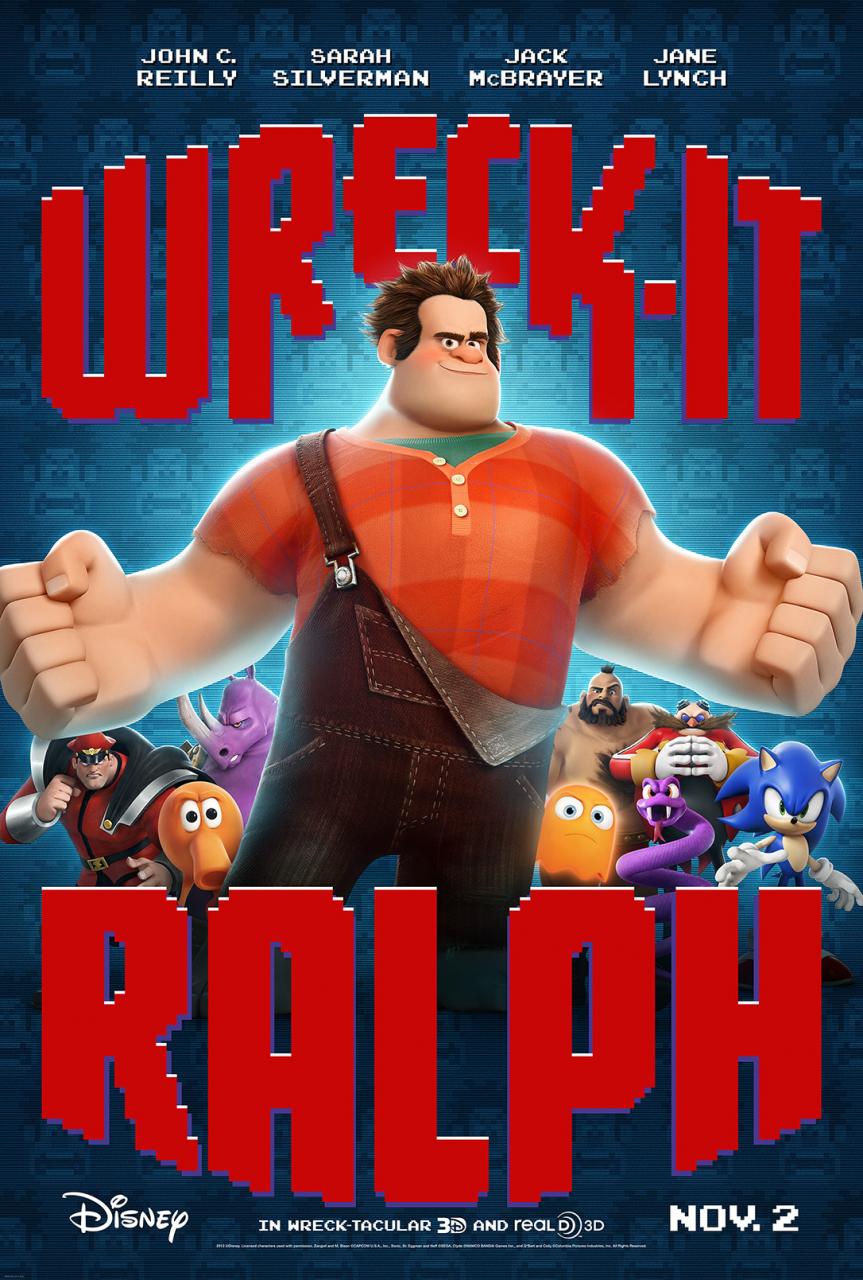
A Very Short Wreck-It Ralph Review
I loved Wreck-It Ralph. It was colorful, high-contrast, efficiently written, with very good voice performances by all parties, especially Alan Tudyk as King Candy and Jane Lynch as Sergeant Calhoun. The character designs were strong and identifiable, as opposed to the complete crap that Dreamworks so frequently puts out.
There's very little about this film that is bad. As expected, the worst part is Sarah Silverman's character, Vanellope Von Schweetz. Early on, she is as annoying as Silverman herself, which isn't surprising, since the character is apparently based on Silverman's memoir. Luckily, she gets much better as the movie goes on, and by the halfway point, she is a fully-formed character complete with pathos.
The mechanics of the movie are worth singling out; they are perfectly consistent. That is a big achievement considering that the characters jump from game to game. A significant problem with movies with extreme premises is that, almost inevitably, an inconsistency or plot hole arises. The writer had a certain scene, line, character, or event that he or she absolutely wanted, and in a less extreme premise would be completely fine, but in the more extreme movie, it makes no sense. Wreck-It Ralph has none of these inconsistencies. It is excellent.
As far as message goes, I think that they should have stressed Ralph's subjugation much more. All he seeks is acceptance, and the characters in his game are outright violent to him, and that is never fully addressed. That, to me, is a major narrative shortcoming. But much like Vanellope, that failing is soon forgotten as the rest of the movie joyfully bounds onward.
In many ways, I am perhaps a poor measure of this movie's quality since I am so affected by the nostalgia that it evokes. I watched with glee as I attempted to pick out references to old video games, frantically searching every scene, every shot, for characters wandering the background, images flashing by, or props lying around. I nearly lost my shit when Sonic gets hit by the out-of-control escape pod in Central Station and loses all his rings.
That said, I like to think that I can provide some significant analysis separate from my giddiness at seeing Pac-Man eating shrimp cocktails. Wreck-It Ralph is the best non-Pixar CGI film made by Disney. It is paced well, with perfect consistency, and rises with great work from all involved. It is the best animated film of 2012.
An Even Shorter Review Of Paperman.
As with all CGI movies, it is preceded by an animated short. Paperman is good, but a bit too twee for its own good. The story is of a man and woman office workers who meet on a train platform. They are attracted to each other, but the meeting fails in a way that only a cartoon could present. He then sees her across the street from his high-rise office, and commences making tons of paper airplanes in an attempt to reach her. The short only gets cuter from there. My personal criticism of it is that, while they set it in the 1950's (or so it appears), the female character is so painfully demure as to be annoying.
The animation is very cool. It's CGI but is rendered to look like a 2D sketch. The effect is very believable and adds a great texture to the entire work. Overall, it was a solid B+ appetizer before the full meal.
There's very little about this film that is bad. As expected, the worst part is Sarah Silverman's character, Vanellope Von Schweetz. Early on, she is as annoying as Silverman herself, which isn't surprising, since the character is apparently based on Silverman's memoir. Luckily, she gets much better as the movie goes on, and by the halfway point, she is a fully-formed character complete with pathos.
The mechanics of the movie are worth singling out; they are perfectly consistent. That is a big achievement considering that the characters jump from game to game. A significant problem with movies with extreme premises is that, almost inevitably, an inconsistency or plot hole arises. The writer had a certain scene, line, character, or event that he or she absolutely wanted, and in a less extreme premise would be completely fine, but in the more extreme movie, it makes no sense. Wreck-It Ralph has none of these inconsistencies. It is excellent.
As far as message goes, I think that they should have stressed Ralph's subjugation much more. All he seeks is acceptance, and the characters in his game are outright violent to him, and that is never fully addressed. That, to me, is a major narrative shortcoming. But much like Vanellope, that failing is soon forgotten as the rest of the movie joyfully bounds onward.
In many ways, I am perhaps a poor measure of this movie's quality since I am so affected by the nostalgia that it evokes. I watched with glee as I attempted to pick out references to old video games, frantically searching every scene, every shot, for characters wandering the background, images flashing by, or props lying around. I nearly lost my shit when Sonic gets hit by the out-of-control escape pod in Central Station and loses all his rings.
That said, I like to think that I can provide some significant analysis separate from my giddiness at seeing Pac-Man eating shrimp cocktails. Wreck-It Ralph is the best non-Pixar CGI film made by Disney. It is paced well, with perfect consistency, and rises with great work from all involved. It is the best animated film of 2012.
An Even Shorter Review Of Paperman.
As with all CGI movies, it is preceded by an animated short. Paperman is good, but a bit too twee for its own good. The story is of a man and woman office workers who meet on a train platform. They are attracted to each other, but the meeting fails in a way that only a cartoon could present. He then sees her across the street from his high-rise office, and commences making tons of paper airplanes in an attempt to reach her. The short only gets cuter from there. My personal criticism of it is that, while they set it in the 1950's (or so it appears), the female character is so painfully demure as to be annoying.
The animation is very cool. It's CGI but is rendered to look like a 2D sketch. The effect is very believable and adds a great texture to the entire work. Overall, it was a solid B+ appetizer before the full meal.
Sunday, September 16, 2012
3D Is A Freaking Gimmick
Industry analysts and Disney are all surprised and dismayed by the disappointment of Finding Nemo in 3D. I'm not. First, 3D is a gimmick. Plain and simple. It might be a cool gimmick, but it doesn't add anything to the experience of a movie other than a little "wow." That small amount of "wow" isn't enough to increase the value of the movie going experience to where more people are willing to pay. The industry instead has a smaller number of people willing to pay the same or more. This is the direct opposite of industry growth and the reason why we have seen a decrease in tickets sold from a peak way back in 2002.
Those numbers are actually much worse than they appear. The US population continues to grow at a rate of about 1.0% per year. All things being equal, we should be seeing a 1% annual increase in ticket sales. We are not. They do nothing but go down.
Second, and this is the biggest reason why I'm not surprised: movie studios and theaters seem to think that 3D is the magic bullet that will allow them to continue their constant increase in ticket prices. It is not something that is used to increase value. It is something to balance out an extant equation that is going in the wrong direction. If your business is not increasing value, it is dying.
Slapping 3D onto a nine-year-old movie and then trying to sell it at current prices is no way to add value. It does not overcome the loss of value from the movie being old and seen by pretty much everyone that would want to see it. The huge success of The Lion King in 3D was novelty, just as the massive success of Avatar was novelty. Once that novelty is gone, it's gone. Not just a studio, but the industry cannot get it back.
Monsters Inc. 3D will do worse than Nemo, and the percentage of movie sales going to more expensive 3D showings will continue to drop. Unless the studios and theaters drop 3D to the same prices as ordinary tickets, they will kill this frail golden goose. And even then, I suspect that it will fade. I hate 3D. I would pay more to avoid 3D, and I know many people who feel the same way.
Wednesday, August 22, 2012
"Horus: Prince Of The Sun" Is Back Up!
Horus: Prince of the Sun, also known as Hols: Prince of the Sun, is the first film on which Hayao Miyazaki worked. It was produced by Toei, and apparently because of the attention paid to it from Youtube uploads, Toei decided to have them ALL taken down and put up the god-awful English dub on Hulu. I don't know what they hope to get. They will not get any money for this. It's from 1969, for Pete's sake. No one but hard-core fans care and none of them are on Hulu because Hulu sucks.
Thankfully, fans continue to upload the subtitled version to Youtube, in defiance of Toei's stupidity. This newest version is great, being available in glorious high-resolution. Enjoy it while it's up!
UPDATE: And down it goes. Toei, if you're reading this, from the deepest part of my heart, go fuck yourselves.
Friday, June 22, 2012
More Evidence As To Why The MPAA Is Evil
If you haven't already seen This Film Is Not Yet Rated, I recommend it. But along with everything discussed in it, this very short, succinct, beautifully-stated video, the creators of South Park explain why the MPAA is evil to small filmmakers, regardless of the kinds of movies that they are making.
And just for fun, the entirety of This Film Is Not Yet Rated. For some reason, part one has embedding disabled, so you will have to go to YouTube to watch it.
Saturday, June 2, 2012
Is This Real?
I found a teaser poster for American Reunion, the fourth movie in the American Pie series, and... what?
Is this real? Can it be real? Am I missing something? When I first saw it, I assumed that it was some sly joke, created by someone trying to subtly communicate the stupidity of the movies. But after a quick Google search, this poster cropped up in a number of places. I think it might actually be legit!
This is mind-blowing. In the book Keys To The Kingdom, Kim Masters interviewed a bunch of industry insiders who recounted an interaction between Michael Eisner and Dawn Steel.
"Forget what you want to do," Eisner interrupted. "This is what I've done. Get 'Star Trek' finished up, then your vice-president of production in features. Congratulations."How true that must be.
"I don't know anything about movies."
"Neither does anybody else. Good-bye, good luck, and break a leg."
Friday, June 1, 2012
Favorite Movie Poster
I'm a child of the 80's. This causes me a great deal of consternation since I frequently worry that I'm simply being a curmudgeon when I say that kids today don't know what good movies and cartoons look like. I feel decently confident that this isn't the case, and actually have some data to back up that belief, but it's always in the back of my mind.
One thing that keeps my mind at ease is that I don't rate things based on whether they were in my personal childhood or not. In fact, I feel that I can trace the downward spiral of children's entertainment to the early 1990's, which was very much still in my childhood, and I frequently find works from the 1980's and 70's that I didn't even know existed, but are leaps and bounds ahead of the crap being produced today.
A decent theory that to explain this decline, while not covering everything necessary to explain the phenomenon, is that cable TV fragmented the child market, triggering a drop in quality to both increase profit while also catering to the lowest common denominator. Companies saw profit vectors shrink or simply fail completely, and they responded by retracting investment and development.
Whatever the reason, there are few examples more stark to me than An American Tail. The movie was a case study in not talking down to children. And much to the joy of any movie fan, the poster was also a fantastic example of what can be done when an artist decides what should be painted and not an executive.
The entire poster is dreary and dark, with brown, rusty, desaturated colors. Roger Ebert, in a negative review, even described the movie as "dark and gloomy." The only two points of the poster that are uplifting are Feivel, standing out from the poster in both color and structure, and the glaring light of the Statue of Liberty, which was just completed in the timeline of the movie.
The poster was painted by Drew Struzan, who's painted nearly every great movie poster of the past thirty years. I also chose to include the poster that doesn't have the movie info on it. This is simply as how Struzan painted it. It is magnificent. Fievel lets you know what the movie will be about, but the rest of the poster lets you know what the texture will be. This poster is a work of art.
The success of the first poster stands in contrast to the failure of the second. It's here where I see the degradation of children's entertainment.
This poster is so god-awful twee that it makes me want to vomit. You've got tons of bright, smiling characters, a tag-line so stupid that it could only have been written by an executive, and some character renditions with posing so poor that they may have been drawn by an intern.
There is no symbolism, no message. It does communicate something from the poster, though, and that is "adults need not apply," and holy shit, is that an accurate statement. The movie was 100% kiddie-fare, which is why everyone remembers the first one and not the second one.
Let's go back a bit further still, to the release of Don Bluth's first film, The Secret of NIMH.
Just look at the difference. This was a time where what mattered was the wonder and magic of the story. It was about making kids sit back in awe and think about what they had seen. It wasn't just about delivering bright, screaming characters, thrown on screen to spout stupid one-liners to drooling children.
During this time, from the 1980's into the 1990's, we saw a transition in entertainment. For whatever reason -rising budgets, cable TV, home video- movie inventiveness and quality, especially in productions aimed at children, took a nose-dive. Children's entertainment became engineered. The Disney Renaissance birthed an explosion of quality that, I think, saw its zenith on television with Batman The Animated Series and on the big screen with The Hunchback of Notre Dame. Both of those productions were essentially born in the 1980's, and were the last of their breed.
I am very happy to be seeing a new increase in quality. Cartoon Network has produced some really fantastic shows, and both the new Thundercats and The Legend of Korra have breathed new life into the adventure cartoon. Brave looks primed to deliver a new family film like we had in the early and mid-eighties. Truly, I feel that we may very well be entering a new renaissance.
But that's material for another post. This post is about how two movies, five years apart, and exemplified by their posters, represented the fall of a golden age, and the rise of engineered ultra-mass-media.
One thing that keeps my mind at ease is that I don't rate things based on whether they were in my personal childhood or not. In fact, I feel that I can trace the downward spiral of children's entertainment to the early 1990's, which was very much still in my childhood, and I frequently find works from the 1980's and 70's that I didn't even know existed, but are leaps and bounds ahead of the crap being produced today.
A decent theory that to explain this decline, while not covering everything necessary to explain the phenomenon, is that cable TV fragmented the child market, triggering a drop in quality to both increase profit while also catering to the lowest common denominator. Companies saw profit vectors shrink or simply fail completely, and they responded by retracting investment and development.
Whatever the reason, there are few examples more stark to me than An American Tail. The movie was a case study in not talking down to children. And much to the joy of any movie fan, the poster was also a fantastic example of what can be done when an artist decides what should be painted and not an executive.
The entire poster is dreary and dark, with brown, rusty, desaturated colors. Roger Ebert, in a negative review, even described the movie as "dark and gloomy." The only two points of the poster that are uplifting are Feivel, standing out from the poster in both color and structure, and the glaring light of the Statue of Liberty, which was just completed in the timeline of the movie.
The poster was painted by Drew Struzan, who's painted nearly every great movie poster of the past thirty years. I also chose to include the poster that doesn't have the movie info on it. This is simply as how Struzan painted it. It is magnificent. Fievel lets you know what the movie will be about, but the rest of the poster lets you know what the texture will be. This poster is a work of art.
The success of the first poster stands in contrast to the failure of the second. It's here where I see the degradation of children's entertainment.
This poster is so god-awful twee that it makes me want to vomit. You've got tons of bright, smiling characters, a tag-line so stupid that it could only have been written by an executive, and some character renditions with posing so poor that they may have been drawn by an intern.
There is no symbolism, no message. It does communicate something from the poster, though, and that is "adults need not apply," and holy shit, is that an accurate statement. The movie was 100% kiddie-fare, which is why everyone remembers the first one and not the second one.
Let's go back a bit further still, to the release of Don Bluth's first film, The Secret of NIMH.
Just look at the difference. This was a time where what mattered was the wonder and magic of the story. It was about making kids sit back in awe and think about what they had seen. It wasn't just about delivering bright, screaming characters, thrown on screen to spout stupid one-liners to drooling children.
During this time, from the 1980's into the 1990's, we saw a transition in entertainment. For whatever reason -rising budgets, cable TV, home video- movie inventiveness and quality, especially in productions aimed at children, took a nose-dive. Children's entertainment became engineered. The Disney Renaissance birthed an explosion of quality that, I think, saw its zenith on television with Batman The Animated Series and on the big screen with The Hunchback of Notre Dame. Both of those productions were essentially born in the 1980's, and were the last of their breed.
I am very happy to be seeing a new increase in quality. Cartoon Network has produced some really fantastic shows, and both the new Thundercats and The Legend of Korra have breathed new life into the adventure cartoon. Brave looks primed to deliver a new family film like we had in the early and mid-eighties. Truly, I feel that we may very well be entering a new renaissance.
But that's material for another post. This post is about how two movies, five years apart, and exemplified by their posters, represented the fall of a golden age, and the rise of engineered ultra-mass-media.
Sunday, May 6, 2012
$200mil Opening For "The Avengers"

I am in the middle of writing an article about the state of the movie industry. In a section discussing the growing disconnect between the all-time best performing movies and the best opening weekend movies, I made the prediction that with the trajectory as it is, we would see a $200 million opening within the next five years.
Well, I was so incredibly conservative in that estimate that it is now funny. The Avengers just took in $200 million on its opening weekend, essentially guaranteeing it a $1 billion worldwide take. Truly epic. And even if we assume that this movie bucks general trends and only earns 1/3 of its take on opening weekend, that still wouldn't put it in the top-25 all time movies. I see that as a problem.
Saturday, April 28, 2012
48fps Will NEVER Look Good
Peter Jackson's The Hobbit is coming for a holiday release, and early previews of the semi-completed film are garnering quite a bit of WTF.
The complaints are coming because of the 48fps process as opposed to the 24fps that is usually used for films.
This is apparently being done because the film is being produced in full 3D straight from the camera, which as far as I know, only a few movies thus far have been done this way. They claim that 3D with 24fps causes issues for many people.
I think that this just goes to show that 3D is total crap, but I digress. There is a good reason why 24fps was chosen for cinema and why it looks more "real" than higher fps film: it blurs like human vision.
Most film is recorded at 24fps with a 1/48th second exposure of each frame, and then 1/48th second of black shutter. Sometimes, they will shoot with faster exposures, creating a hard, defined, and edgy look. You'll see this sort of effect in scenes intended to give a starkly dramatic look, like the beach landing scene at the beginning of Saving Private Ryan.
Human vision blurs the world as it moves around us. 24fps, or more precisely a 1/48th second exposure, does a very good job of capturing that blur on film. Without it, things appear hard and lifeless, because life exists between the frames, not on them.
The complaints are coming because of the 48fps process as opposed to the 24fps that is usually used for films.
This is apparently being done because the film is being produced in full 3D straight from the camera, which as far as I know, only a few movies thus far have been done this way. They claim that 3D with 24fps causes issues for many people.
I think that this just goes to show that 3D is total crap, but I digress. There is a good reason why 24fps was chosen for cinema and why it looks more "real" than higher fps film: it blurs like human vision.
Most film is recorded at 24fps with a 1/48th second exposure of each frame, and then 1/48th second of black shutter. Sometimes, they will shoot with faster exposures, creating a hard, defined, and edgy look. You'll see this sort of effect in scenes intended to give a starkly dramatic look, like the beach landing scene at the beginning of Saving Private Ryan.
Human vision blurs the world as it moves around us. 24fps, or more precisely a 1/48th second exposure, does a very good job of capturing that blur on film. Without it, things appear hard and lifeless, because life exists between the frames, not on them.
Friday, April 13, 2012
New Django Unchained Poster is Decent
It's always interesting to see how movies created by real film buffs like Tarantino frequently have really great posters. That doesn't always apply, considering that Martin Scorsese is a massive film fan and most of his movie posters suck. The Last Temptation of Christ was interesting, and was, noticeably, very similar to this poster.
All of these posters harken back to the groundbreaking work of Saul Bass and the amazing movie posters of the late 50's and 1960's. And Saul Bass, I think, owes his aesthetic to the avant garde work of the Russian Constructivists.
I think that Paul Rand holds the distinction, as though he needed to be more distinct, of being the first person to apply those principles to a movie poster with his 1950 treatment for the movie No Way Out.
But that's neither here nor there. Movie posters are something that have lost much of their importance. Designers, real designers, rarely make them anymore. Directors and producers rarely have anything to do with their production. Increasingly, posters are simply an image that says "THIS MOVIE EXISTS." Tarantino has a history of great movie posters, and while I would say that this teaser is the least of them, he undoubtedly has a real killer in the offing for the official poster.
All of this just further confirms what Grindhouse laid out: Tarantino doesn't just like movies, he likes everything about movies. He likes the trailers, the posters, the ads, the credits, the sound. I'm amazed that he hasn't sold pieces of gum from the floors of old Brooklyn theaters.
We need more people like that. Not necessarily total auteurs, like Tarantino, but people involved in every aspect that love that aspect. I want poster people who love movie posters for the sake of movie posters. Trailers for the sake of trailers. Credits for the sake of credits. It's not like Tarantino has a higher midi-chlorian count than anyone else or something!
It doesn't take a special sauce. All it takes is love and dedication.
All of these posters harken back to the groundbreaking work of Saul Bass and the amazing movie posters of the late 50's and 1960's. And Saul Bass, I think, owes his aesthetic to the avant garde work of the Russian Constructivists.
I think that Paul Rand holds the distinction, as though he needed to be more distinct, of being the first person to apply those principles to a movie poster with his 1950 treatment for the movie No Way Out.
But that's neither here nor there. Movie posters are something that have lost much of their importance. Designers, real designers, rarely make them anymore. Directors and producers rarely have anything to do with their production. Increasingly, posters are simply an image that says "THIS MOVIE EXISTS." Tarantino has a history of great movie posters, and while I would say that this teaser is the least of them, he undoubtedly has a real killer in the offing for the official poster.
All of this just further confirms what Grindhouse laid out: Tarantino doesn't just like movies, he likes everything about movies. He likes the trailers, the posters, the ads, the credits, the sound. I'm amazed that he hasn't sold pieces of gum from the floors of old Brooklyn theaters.
We need more people like that. Not necessarily total auteurs, like Tarantino, but people involved in every aspect that love that aspect. I want poster people who love movie posters for the sake of movie posters. Trailers for the sake of trailers. Credits for the sake of credits. It's not like Tarantino has a higher midi-chlorian count than anyone else or something!
It doesn't take a special sauce. All it takes is love and dedication.
Sunday, January 29, 2012
The Fifty Percent Rule
I propose a new, quasi-quantifiable rule for the determination of quality in movies. I call it the Fifty-Percent Rule. Basically, if you, as a viewer, can enter a movie at the halfway point and find that anything that you missed is either deducible or irrelevant, the movie is necessarily a bad movie.
Much like Modus Tollens, though, just because the first 50% proves important does not mean that the movie is necessarily good. For example: Titanic.
I have developed this rule, as I'm sure many have, compliments of having movie channels available from my cable provider. If you have an hour to blow, sometimes you just throw on the boob-tube, which never provides you with a movie that is just starting. They are somehow always halfway done.
This has actually been a huge blessing in disguise. I can't even count the number of movies that I have watched from the halfway point, thus saving half the time, and made a determination of quality. If it was good, I am now surely motivated to go and watch the first half.
This partially-reversed way of watching has, oddly, proven to be an even richer way of experiencing movies. By knowing what's coming, but not what has been, provides a unique depth to narratives. Almost like you are watching characters fulfill their destinies of which you have perfect knowledge. There's something very tragic to it.
This applies to all forms of entertainment: books, TV shows, plays, even comics. Give it a shot. Pick up a new book and start reading from the 50% point.
Much like Modus Tollens, though, just because the first 50% proves important does not mean that the movie is necessarily good. For example: Titanic.
I have developed this rule, as I'm sure many have, compliments of having movie channels available from my cable provider. If you have an hour to blow, sometimes you just throw on the boob-tube, which never provides you with a movie that is just starting. They are somehow always halfway done.
This has actually been a huge blessing in disguise. I can't even count the number of movies that I have watched from the halfway point, thus saving half the time, and made a determination of quality. If it was good, I am now surely motivated to go and watch the first half.
This partially-reversed way of watching has, oddly, proven to be an even richer way of experiencing movies. By knowing what's coming, but not what has been, provides a unique depth to narratives. Almost like you are watching characters fulfill their destinies of which you have perfect knowledge. There's something very tragic to it.
This applies to all forms of entertainment: books, TV shows, plays, even comics. Give it a shot. Pick up a new book and start reading from the 50% point.
Friday, October 21, 2011
A Very Short Rango Review
Rango is the best, most daring animated film since The Incredibles. Unlike so many animated productions of the last twenty years, this film will last.
I frequently use the word "last" when referring to films. By this, I mean productions that become part of one's own narrative. Seeing the film nestles into one's mind, and the experience, the film, the emotions, the initial reactions, all of the elements of witnessing the film become frequently accessed memories.
Films that do not last are those without daring aspects. They hew closely to formula and desperately avoid insulting people. For example, The Fifth Element. It has lasted. It gets shown on TV at least once per week, variations on the movie are released on disc at least once per year, and the movie is famous enough to have been the first movie Sony released on Blu-Ray.
Compare this to another Bruce Willis movie from the same time: Mercury Rising. NO ONE remembers this movie. I only remember it because I wanted to write this paragraph.
Or perhaps more apt for this writing, look back on the animated films of yore that are remembered. They are dark, daring, and exciting. The Secret of NIMH, The Last Unicorn, or The Plague Dogs. compare these truly great works to a work that is masquerading as daring, but is actually just Disney formula wrapped up in darker paper, The Black Cauldron. Why do you think anime absolutely conquered the young male market in the United States? Because anime was dark and exciting. It wasn't stupid musicals filled with cute side kicks and happy endings.
Rango, more than any animated movie out of the US that I have seen in decades, captures that darkness. It captures a sense of danger, juxtaposed with comedy and color. There are moments of beautifully abstract, philosophical ideas combined with near-grotesque images. Rattlesnake Jake, a late-in-the-film bad guy, apparently had young children crying in theaters. Great! That's what you want! If the movie does not have an emotional impact on children, it will never be remembered. It will never become part of a child's personal narrative. They will take no lessons into adulthood. It is as though the movie never existed.
Rango exists and will exist for some time. It is that good.
I frequently use the word "last" when referring to films. By this, I mean productions that become part of one's own narrative. Seeing the film nestles into one's mind, and the experience, the film, the emotions, the initial reactions, all of the elements of witnessing the film become frequently accessed memories.
Films that do not last are those without daring aspects. They hew closely to formula and desperately avoid insulting people. For example, The Fifth Element. It has lasted. It gets shown on TV at least once per week, variations on the movie are released on disc at least once per year, and the movie is famous enough to have been the first movie Sony released on Blu-Ray.
Compare this to another Bruce Willis movie from the same time: Mercury Rising. NO ONE remembers this movie. I only remember it because I wanted to write this paragraph.
Or perhaps more apt for this writing, look back on the animated films of yore that are remembered. They are dark, daring, and exciting. The Secret of NIMH, The Last Unicorn, or The Plague Dogs. compare these truly great works to a work that is masquerading as daring, but is actually just Disney formula wrapped up in darker paper, The Black Cauldron. Why do you think anime absolutely conquered the young male market in the United States? Because anime was dark and exciting. It wasn't stupid musicals filled with cute side kicks and happy endings.
Rango, more than any animated movie out of the US that I have seen in decades, captures that darkness. It captures a sense of danger, juxtaposed with comedy and color. There are moments of beautifully abstract, philosophical ideas combined with near-grotesque images. Rattlesnake Jake, a late-in-the-film bad guy, apparently had young children crying in theaters. Great! That's what you want! If the movie does not have an emotional impact on children, it will never be remembered. It will never become part of a child's personal narrative. They will take no lessons into adulthood. It is as though the movie never existed.
Rango exists and will exist for some time. It is that good.
Wednesday, October 19, 2011
John Lasseter Defends Cars 2
John Lasseter has given an interview discussing Cars 2 to the New York Times. First, he denies that Cars 2 was a money grab. I think anyone who argued that it was knows nothing about the rise and operations of Pixar.
That's not to say the Cars 2 was good. Quite the opposite. I thought it was not just Pixar's worst film, but a bad film in most repsects. But because of Pixar's, and Lasseter's, history, I don't think that any judgments can be drawn from the film and extrapolated out into the corpus of the Disney Company.
The comment of Lasseter's that had me worried was his declaration that “This is not an executive-led studio." Perhaps this applies to Pixar itself, but as I argued in my post Why Tangled Reveals That Poison That's Still Inside Disney, there is no evidence to support that this applies to the rest of the company. Truly, Disney appears to be one of the most executive-led companies on Earth.
Lasseter further defended Cars 2 by saying that he makes films for "that little boy who loves the characters so much that he wants to pack his clothes in a Lightning McQueen suitcase.”He succeeded insofar as he made a movie that only a little boy could enjoy.
The reason why this is a disappointment for me is that their earlier films did just that, but also transcended the "kid-flick" mentality and construction to become something lasting, something great. Cars 2 will not last. Even if you think that it is a good film, I can't imagine anyone arguing that it will last. Wall-E will last. Toy Story will last. Cars 2 will not.
Finally, the article refers to Cars 2 as being the frontrunner for Best Animated Film and the Oscars. This is absurd. If Rango doesn't win, I'm going to have a fit. Granted, the Oscar's are certainly known for absolute stupidity. Hello, Shakespeare In Love.
That's not to say the Cars 2 was good. Quite the opposite. I thought it was not just Pixar's worst film, but a bad film in most repsects. But because of Pixar's, and Lasseter's, history, I don't think that any judgments can be drawn from the film and extrapolated out into the corpus of the Disney Company.
The comment of Lasseter's that had me worried was his declaration that “This is not an executive-led studio." Perhaps this applies to Pixar itself, but as I argued in my post Why Tangled Reveals That Poison That's Still Inside Disney, there is no evidence to support that this applies to the rest of the company. Truly, Disney appears to be one of the most executive-led companies on Earth.
Lasseter further defended Cars 2 by saying that he makes films for "that little boy who loves the characters so much that he wants to pack his clothes in a Lightning McQueen suitcase.”He succeeded insofar as he made a movie that only a little boy could enjoy.
The reason why this is a disappointment for me is that their earlier films did just that, but also transcended the "kid-flick" mentality and construction to become something lasting, something great. Cars 2 will not last. Even if you think that it is a good film, I can't imagine anyone arguing that it will last. Wall-E will last. Toy Story will last. Cars 2 will not.
Finally, the article refers to Cars 2 as being the frontrunner for Best Animated Film and the Oscars. This is absurd. If Rango doesn't win, I'm going to have a fit. Granted, the Oscar's are certainly known for absolute stupidity. Hello, Shakespeare In Love.
Saturday, August 6, 2011
Favorite Movie Poster
Great movie posters are a rare breed. Usually, they're thrown up for no other purpose than to simply say 'THIS MOVIE EXISTS!' Today, movie posters are a damned desert of art, aesthetic, and inventiveness.
With the advent of Photoshop, posters have somehow gotten worse, with most of them simply following the "line of faces" design. These say "LOOK! LOOK! A MOVIE WITH THESE PEOPLE IN IT! What's it about? THAT DOESN'T MATTER! LOOK!"
For me, though, the biggest failure is that today's posters so rarely provide a sense of wonder. They don't provide a promise of adventure, or romance, or terror. There was a time when movie posters were painted by skilled artists. Some of the posters were so amazing, they've become iconic images, like Star Wars original poster. The images on the poster look nothing like the movie! But, it doesn't matter. The poster sold itself. Now they're simply cobbled together by a Photomonkey, earning 30k, from stock photos.
This is one of my favorite posters. It's for the movie Camelot from 1967, if you couldn't guess from the huge CAMELOT on top.
I didn't like the movie all that much. I've never really liked overly dramatic portrayals of Arthur and Camelot, especially the ones that focus on romance. And the fact that the Arthur legend is absolute and total hogwash, with the real Arthur likely being a total prick, well, I just can't swallow the pill.
But the poster! The poster is great. It's got a bit of a Mucha-ish flare to it and absolutely promises wonder and fantasy. It has texture, and color, and drama. The poster makes you want to be near it, to look at it, and think about the experience that it portends.
I think that a positively minuscule group of directors today understand how important the poster is. It's like the album art for music, even though most people don't even own the LP or CD anymore. The trailer and poster are things with which the director absolutely must be involved because they are part of the gestalt. A film is not simply a series of images, projected on a screen. A film is the sound, the smell, the food, the temperature in the air, the case of the DVD, the commercials on TV.
A poster is the movie, just as much as the frames on the film, and the actors on screen.
With the advent of Photoshop, posters have somehow gotten worse, with most of them simply following the "line of faces" design. These say "LOOK! LOOK! A MOVIE WITH THESE PEOPLE IN IT! What's it about? THAT DOESN'T MATTER! LOOK!"
For me, though, the biggest failure is that today's posters so rarely provide a sense of wonder. They don't provide a promise of adventure, or romance, or terror. There was a time when movie posters were painted by skilled artists. Some of the posters were so amazing, they've become iconic images, like Star Wars original poster. The images on the poster look nothing like the movie! But, it doesn't matter. The poster sold itself. Now they're simply cobbled together by a Photomonkey, earning 30k, from stock photos.This is one of my favorite posters. It's for the movie Camelot from 1967, if you couldn't guess from the huge CAMELOT on top.
I didn't like the movie all that much. I've never really liked overly dramatic portrayals of Arthur and Camelot, especially the ones that focus on romance. And the fact that the Arthur legend is absolute and total hogwash, with the real Arthur likely being a total prick, well, I just can't swallow the pill.
But the poster! The poster is great. It's got a bit of a Mucha-ish flare to it and absolutely promises wonder and fantasy. It has texture, and color, and drama. The poster makes you want to be near it, to look at it, and think about the experience that it portends.
I think that a positively minuscule group of directors today understand how important the poster is. It's like the album art for music, even though most people don't even own the LP or CD anymore. The trailer and poster are things with which the director absolutely must be involved because they are part of the gestalt. A film is not simply a series of images, projected on a screen. A film is the sound, the smell, the food, the temperature in the air, the case of the DVD, the commercials on TV.
A poster is the movie, just as much as the frames on the film, and the actors on screen.
Sunday, July 3, 2011
A Very Short Cars 2 Review
The lesson of Cars 2 can be summed up in "be nice to retards, they just might save the world."Cars 2 opens fabulously, with a thrilling, action-packed five minutes centered around the British spy Finn McMissile. It is both legitimiate in its own creative right, while also being a spoof of spy films. This is the high point of the movie. It's all downhill from here.
We then cut to Mater, who is helping some car which has broken down in the desert. The dialog immediately shifts from witty and fun to being lifted straight from an episode of Full House. It. Is. Awful. It gets worse when Lightning McQueen shows up a minute or two later, since McQueen is not a moron, and any dialog between someone who is a moron and someone who isn't is necessarily going to be strained and unrealistic. And holy shit, is it strained and unrealistic. The relationship between Mater and McQueen would only make sense if written and staged like the relationship between Charlie and Ray in Rain Man.
Mater is a wholly unlikeable character for all but the youngest or stupidest. He is a raging idiot with essentially no redeeming qualities other than that he is not mean. This does not a person make. McQueen would not be his friend. Half of the shit that Mater pulls in Tokyo (spelled Towkyo... cute) would ruin a friendship in real life or in any other movie.
When McQueen feels bad for snapping at Mater, it should not be in the way of a friend as proposed in the movie, but in the way that one feels bad for slapping a dog for peeing in a corner. It makes no sense. And this doesn't even touch on the logical issues regarding McQueen's regret for not standing by his friend, when his friend happily abandons him during a race for a pretty lady. The lesson is hollow on all levels.
Mater takes up the vast majority of the movie, reminding you in nearly every second how contrived and stupid the setup is. His story is a fish-out-of-water tale where he is mistaken for a spy and it reminded me of The Man Who Knew Too Little. That was another movie where a goof is mistaken for a spy, but at least in that one, the protagonist is actually somewhat skilled, even if some of it is unintentional. And even there, it didn't work all of the time! So you can imagine how badly Cars 2 fails in this regard.
I liked Cars well enough. It was very simple, but pleasant. Cars 2, on the other hand, annoyed me at nearly every turn. It's fun for all the time that Mater isn't on screen, but he's on screen for 90% of the movie. Or if, barring reduced Mater time, they had toned down Mater's profound retardation by five to eight notches, it would have worked. But they did neither, and the movie suffers for it.
Thursday, June 2, 2011
We Finally See Pixar's Princess Merida

This is old news, but I wanted to talk about it.
I can't begin to describe how happy I am to see a Pixar film that stars a female. Hell, ANY animated film starring a female is great news.
Pixar doesn't have a great track record of including interesting females in its lineup. The only director to do it is Brad Bird, who gave us the ensemble cast The Incredibles, with two rich, believable female leads. He also directed Ratatouille, with a strong female secondary character. Toy Story, A Bug's Life, Monsters Inc., none of them had a strong, non-stereotypical female. Even Dorie in Finding Nemo was the stereotypical kind-hearted bubblehead.
I think that Pixar lost the chance to lead the pack when they weren't the first to have a female direct a CGI feature. They've now lost that distinction to Dreamworks who tapped Jennifer Yuh Nelson, who won awards for her direction of the opening animation to Kung Fu Panda, to direct its sequel, Kung Fu Panda 2.
Brave was supposed to be directed by its writer Brenda Chapman, who still holds the distinction of being the first female to direct an animated feature with 1998's The Prince of Egypt, but she will instead receive co-directing status. There are rumors that Pixar has actually moved her onto a future production, and that's why she left. I find that entirely plausible. Perhaps they wanted her there all along and decided that the free marketing that they would have received from her being the first female director was nullified by Dreamwork's announcement that Kung Fu Panda 2 was being directed by a woman.
Regardless, directing is one thing, but it's from the writing where the underlying tone and message of films comes. It's actually rather startling to see the differences between films written by men and women. Men produce bizarre, self-referential (and self-important, if I'm being honest) things like Synechdoche, New York, while women produce equally insightful, but much more entertaining works like Juno.
I wouldn't be surprised if the flavor of Brave is entirely different from every Pixar film up to this point.
Friday, January 14, 2011
In Anticipation of Brave
As many of you know, I lament the number of good female characters in cartoons. Unless the cartoon or children's show is specifically aimed at girls, the main character is always a male, and the female characters, while rarely without quality, are usually relegated to the "sassy" class, or the "quirky" class. As an example of this, I recall my double-review of How to Train Your Dragon and Cloudy With a Chance of Meatballs. Both casts had male and female characters portrayed positively, but in Cloudy, she's quirky, and in Dragon, she's sassy. ALL of the depth is associated with why they're quirky and sassy. There's nothing else there.It's also very interesting how the major production houses are seemingly the ones who stick most closely to these biases. Look at Hoodwinked, which was produced for about seven dollars and a pizza, and compare that to Disney's "irreverent" fairy tale take, Tangled. Notice anything... sassy, about Disney's character? This stands in comparison to a truly original rethink of the Red Riding Hood story. Disney's formulation is bland and stale in comparison, even if it's actually a better film overall.
Pixar has been the most glaring in modern animation. I'm sure that this is because Pixar produces, time and time again, fantastic films of startling imagination, depth, and quality. So the few shortcomings that they do have become all the more apparent. Pixar has one shining star in this regard, and it's no surprise that it's my favorite of their films: The Incredibles. But while this is a great film, it was a true ensemble cast. That was the point. Look at the other Pixar films and you'll notice a distinct shortage of X-chromosomes. And of the females that are there, they're usually drawn thinly (If not thinly, then they fulfill the "sassy/quirky" requirement, like Eve from Wall-E or Dory from Finding Nemo). Truly, the Bonnie Hunt voiced Porsche in Cars was so cliched that it actually pissed me off.
Again, Pixar makes excellent films of timeless quality. I have total confidence that, much like Disney's earliest work, Pixar's films will be loved and enjoyed a century from now. And also, all of the guys who started Pixar were just that, guys. So perhaps it's too much to ask them to step outside of their own gender.
No, I have to. One of the great quests of an artist is to step outside of themself and produce something that is a unique take on reality. Especially with stories, men and women aren't very different. A human story is precisely that, human.
So it's with almost fanatic anticipation that I'm looking forward to Brave. It was to be the first Pixar film to be directed by a woman AND the first one to be written by a woman. Two birds with one stone, I guess. But unfortunately Brenda Chapman is no longer directing. I have complete confidence that sexism had no part in the decision, so there must have been something going on. Perhaps they want to move her to a later project.
Precious little is known about Brave, right now. We know the voices and we know some rough character designs, the latter of which look disappointingly standard. It involves Celtic themes and styling and is apparently inspired by Hans Christian Andersen and The Brothers Grimm, which is great. I love both. Braveheart was fantastic, and Andersen and Grimm wrote... some... really disturbing stories, so I'm sure it will all work out fine.
So in conclusion, 2012 can't come quickly enough. This summer, Cars 2 is assuredly going to be entertaining, but the year separating it from Brave will just as assuredly feel like an eternity.
Friday, December 10, 2010
John Carter of Mars
John Carter of Mars is still a good 18 months away, but I figured now is as good a time as any to show the cartoon version of John Carter that never saw production. It was to be made by Bob Clampett back in the 1940's, but after test audiences saw this footage, the idea was canned as being too "out there" for the mid-west audience of retards.
Here's a shock, the same year that this project was canceled and Clampett moved on to other things, Universal Studios released Flash Gordon, which was a runaway hit and now a cultural touchstone. Even those poor mid-Western retards got it. You hear this a lot, in business in general but especially in early film. Some studio thinks that something is a terrible idea and tells the guys within the studio to stop working on it, until another studio does the exact same thing to great fame and success. The first studio than either eats it, or they desperately ask those same guys to do what they originally wanted to do, but impatiently ask for it on a reduced budget and schedule and it all fails.
We can now add Clampett to Fleischer in the list of guys who would have beaten Disney to the first feature-length animated film if only the studios for which they worked hadn't been daft.
P.S. both John Carter and Flash Gordon have vixens in them that I plan on producing one of. Deja Thoris and Dale Arden.
Here's a shock, the same year that this project was canceled and Clampett moved on to other things, Universal Studios released Flash Gordon, which was a runaway hit and now a cultural touchstone. Even those poor mid-Western retards got it. You hear this a lot, in business in general but especially in early film. Some studio thinks that something is a terrible idea and tells the guys within the studio to stop working on it, until another studio does the exact same thing to great fame and success. The first studio than either eats it, or they desperately ask those same guys to do what they originally wanted to do, but impatiently ask for it on a reduced budget and schedule and it all fails.
We can now add Clampett to Fleischer in the list of guys who would have beaten Disney to the first feature-length animated film if only the studios for which they worked hadn't been daft.
P.S. both John Carter and Flash Gordon have vixens in them that I plan on producing one of. Deja Thoris and Dale Arden.
Tuesday, November 23, 2010
Two Very Short Reviews
I'm reviewing Cloudy With a Chance of Meatballs and How to Train Your Dragon together. I'll explain this later. First, the movies.
I liked them both a great deal, and Meatballs has actually become one of my favorite CGI films. Meatballs is an immensely energetic film, filled to bursting with color, life, comedy, and a few points of genuine pathos.
The film managed to keep energy levels at a near-frantic state for the entirety of the film, with small lulls just preventing us from being overloaded. The characters are all a bit two-dimensional, but being simple is not the same thing as simplistic. The character design is actually different from Pixar, which is nice. And by different, I don't mean grossly inferior, like Hoodwinked. The animation is also lively and well-done. The characters all have different personalities based on their animation, and not just how they look.
Flint Lockwood, the manic inventor, is made out of rubber. His father, a down-to-Earth sort of guy is rigid and block-like. Steve the monkey moves in spastic spurts. It's all very well done. While on the subject of that monkey, he is both the default cute side-kick that cartoons need, but he is also integral to the story when the father and son have a closing conversation. Oh, and how fantastic is it that Steve is voiced by Doogie Howser?
Moving on to How to Train Your Dragon, this is a much more traditional story. It's more suited to a slightly older demographic. That's not to say that Meatballs won't entertain people of all ages, only that its energy and color means that even the very young will love it. Dragon might bore the the tiny childers.
The character design, the constructs, the animation, everything is much more rigid, here. This has generally been the rule in Dreamwork's ouvre. Going all the way back to Antz and Shrek, Dreamworks has chosen to use very rigid character models with a minimum of flex. This has presented problems in the past, where character is not communicated in motion, only in design and voice. And when the voice and character design are bland, like in Madagascar and Shark Tale, the film suffers.
Dreamworks animators have made great strides in extracting character from rigid designs, and they do a good job, here. The characters are all decently three-dimensional, even though many of them are only as deep as their position in the script requires.
The script is perfectly paced and moves along with the lean effectiveness that we expect from a 90-minute CGI film. It has some nice themes of understanding that give the story a sense of depth. The action scenes have great energy, the dialog is snappy, and the whole endeavor is very entertaining. It all culminates in an eye-popping final battle that, in the theater, was truly a site to behold.
Now on to why I'm reviewing them together. For some reason, CGI films, moreso than traditioally animated ones, seem to work in thematic waves. Considering the development times required for these films, I'm pretty confident that copying is not happening, but SOMETHING is. It's just too much to be coincidence.
For example, The first CGI film from Dreamworks, Antz, came out six weeks before A Bug's Life. Then Monsters Inc. came out with Shrek. Finding Nemo was followed by Shark Tale a year later. Madagascar, Open Season, and The Wild (and even Flushed Away to a degree). Hoodwinked and Happily N'Ever After. Megamind and Despicable Me. Delgo and Battle For Terra, and a little bit of Planet 51, Wall-E, and 9). All of them have similar themes, if not characters, settings, and stories.
This and Meatballs are the same thing. Both stories are about a misunderstood young man, who has great potential, has problems relating to his father, meets a girl who's his equal but different, screws things up, saves the day in an epic battle with a giant thing, saves everyone and wins the girl. That short synopsis applies identically to both films. WTF? What is it? Some outside variable? Studies about what would do well in today's market? Some script gets passed around and everyone steals it? What?!
I liked them both a great deal, and Meatballs has actually become one of my favorite CGI films. Meatballs is an immensely energetic film, filled to bursting with color, life, comedy, and a few points of genuine pathos.
The film managed to keep energy levels at a near-frantic state for the entirety of the film, with small lulls just preventing us from being overloaded. The characters are all a bit two-dimensional, but being simple is not the same thing as simplistic. The character design is actually different from Pixar, which is nice. And by different, I don't mean grossly inferior, like Hoodwinked. The animation is also lively and well-done. The characters all have different personalities based on their animation, and not just how they look.
Flint Lockwood, the manic inventor, is made out of rubber. His father, a down-to-Earth sort of guy is rigid and block-like. Steve the monkey moves in spastic spurts. It's all very well done. While on the subject of that monkey, he is both the default cute side-kick that cartoons need, but he is also integral to the story when the father and son have a closing conversation. Oh, and how fantastic is it that Steve is voiced by Doogie Howser?
Moving on to How to Train Your Dragon, this is a much more traditional story. It's more suited to a slightly older demographic. That's not to say that Meatballs won't entertain people of all ages, only that its energy and color means that even the very young will love it. Dragon might bore the the tiny childers.
The character design, the constructs, the animation, everything is much more rigid, here. This has generally been the rule in Dreamwork's ouvre. Going all the way back to Antz and Shrek, Dreamworks has chosen to use very rigid character models with a minimum of flex. This has presented problems in the past, where character is not communicated in motion, only in design and voice. And when the voice and character design are bland, like in Madagascar and Shark Tale, the film suffers.
Dreamworks animators have made great strides in extracting character from rigid designs, and they do a good job, here. The characters are all decently three-dimensional, even though many of them are only as deep as their position in the script requires.
The script is perfectly paced and moves along with the lean effectiveness that we expect from a 90-minute CGI film. It has some nice themes of understanding that give the story a sense of depth. The action scenes have great energy, the dialog is snappy, and the whole endeavor is very entertaining. It all culminates in an eye-popping final battle that, in the theater, was truly a site to behold.
Now on to why I'm reviewing them together. For some reason, CGI films, moreso than traditioally animated ones, seem to work in thematic waves. Considering the development times required for these films, I'm pretty confident that copying is not happening, but SOMETHING is. It's just too much to be coincidence.
For example, The first CGI film from Dreamworks, Antz, came out six weeks before A Bug's Life. Then Monsters Inc. came out with Shrek. Finding Nemo was followed by Shark Tale a year later. Madagascar, Open Season, and The Wild (and even Flushed Away to a degree). Hoodwinked and Happily N'Ever After. Megamind and Despicable Me. Delgo and Battle For Terra, and a little bit of Planet 51, Wall-E, and 9). All of them have similar themes, if not characters, settings, and stories.
This and Meatballs are the same thing. Both stories are about a misunderstood young man, who has great potential, has problems relating to his father, meets a girl who's his equal but different, screws things up, saves the day in an epic battle with a giant thing, saves everyone and wins the girl. That short synopsis applies identically to both films. WTF? What is it? Some outside variable? Studies about what would do well in today's market? Some script gets passed around and everyone steals it? What?!
Subscribe to:
Posts (Atom)