Showing posts with label review. Show all posts

Saturday, December 29, 2012

A Very Short Review Of Paranorman


The second exceptional animated film to break from the Disney mold in as many years? We're going to get spoiled.

Paranorman opens with scenes from faux 1950's monster movies to explicitly state where they acquired their inspiration, and indeed, the movie does derive a good deal of texture from these old concepts. It's only a gloss, though, and the underlying script, character construction, and wholly progressive undertones are far beyond anything Robot Monster, or Them could have ever hoped for.

Before I get into any detail, you should go see this movie immediately. Judging from box office receipts, there are many people who didn't, and this is a shame. I can't say that this is the best animated film of 2012--we had some exceptional films this year and choosing an absolute best is mostly academic--but it is in the top five.

If you haven't yet seen it, I also cannot blame you. The trailers are some of the worst that I have seen this side of Dreamworks Animation. They completely, totally, 100% fail to effectively advertise what the movie was going to be about and what mood the movie was going to capture. The trailers make the movie appear to be goofy and corny, and it is anything but. It is quiet and contemplative at times, and far from the constant stream of silly one-liners that comprised the advertisements.


The animation is mind-blowing. I thought that Coraline made Corpse Bride and The Nightmare Before Christmas look dated. Well, this movie makes Coraline look old and unrefined. Not only is there a stunning amount of detail and life to the character designs, not only is the film possessing of texture that other movies would kill for, but the animation itself raises the bar for stop-motion work. It's like nothing I have ever seen. It bobs and weaves, crackles and jumps, all with a jaw-dropping smoothness and vivacity. This makes Frankenweenie, released about a month later, look uninspired in comparison.

Similarly upgraded from Coraline is the sound production. Coraline's audio was disappointing, lacking depth, complexity and impact. The scene that I remember most distinctly was when Coraline spins around a door, with her yelling not fading in and out as she went behind and in front of the door. None of that in Paranorman! The audio is loaded with detail and punch. Truly, they seem to jump to scenarios that are tailor-made for wild audio after only fifteen minutes.

The problems are those that equally affected Coraline. I don't know what it is about the writers at Laika, but they don't seem to like traditional dramatic structure. Coraline had odd rises and falls in its action, culminating in a double climax that made almost no sense. Paranorman has character and concept exposition, then a stratospheric leap to maximum action, which drops off for a period of time before maxing out again, then finally the falling action and denouement.

I appreciate that not everything needs to follow the traditional dramatic pyramid, but it became a thing because it works. It is very hard to write something that doesn't follow the standard structure and still "works," and Paranorman doesn't quite work. There's very little drama in the lead-up to the action, and then there is so much drama piled on top of itself that it is hard to appreciate it. It becomes all the more important for a movie, if it is rejecting traditional dramatic structure, to ensure that its cause-and-effect chain is strong, with each cause and each effect emphasized in the dialog and direction. Paranorman fails at this on more than one occasion.

This is a structural and somewhat academic analysis and criticism of the story. My more personal view is that the story is one that has been done many times before, with characters that have been done before, but the entire thing is constructed with so much color and inventiveness that these faults are immediately lost. Yes, this is another story about an outsider, with geeks and bullies at odds, with parents that don't understand, blah, blah, blah. I didn't care though!

The voice overs are somewhat muted in comparison to the highly emotive work done by professional voice actors, but this goes well with the tone of the film. They also go well in creating the unique characters that, much like Coraline, feel as though they come from a different universe than the characters in Disney or Dreamworks films.

I mentioned how the trailers fail to capture the personality of the film, and this is a tragedy. Paranorman is an exceptional film with an atmosphere that is just this side of comedy as opposed to a traditional horror flick. It is a movie that relies heavily on atmosphere and mise-en-scène to communicate emotions and takes all of these aspects beyond Coraline's already notable achievements.

More over, the film never once condescends to the children watching the film. It is entirely sincere. It is also one of a recent batch of animated films that recognizes that children are not innocent little things that need to only be exposed to pure, traditional subject matter, or ironic takes on pure, traditional subject matter. Monster House, Coraline, Rango, Fantastic Mr. Fox, The Secret of Kells, The Adventures of Tin Tin, and even some work from the major studios like Up, Puss in Boots, and Kung Fu Panda., all of them are part of a large renaissance of animation that I assumed would happen in the smaller, independent studios, but appears to have begun in the large studios.

These films understand that for movies to have an impact, they must have real drama. They must have danger, and violence, and dirty words, and all of the other things that comprise real drama in the real world. While Paranorman may not take place in the real world, it feels more real, more alive, than anything that Disney has produced in twenty years. If they had left the script in the oven for a little while longer, they would have had a masterpiece. As it stands, Paranorman is an exceptional film, utterly deserving of your attention, with many parts so good as to make the parts where it fails all the more frustrating.

Saturday, November 10, 2012

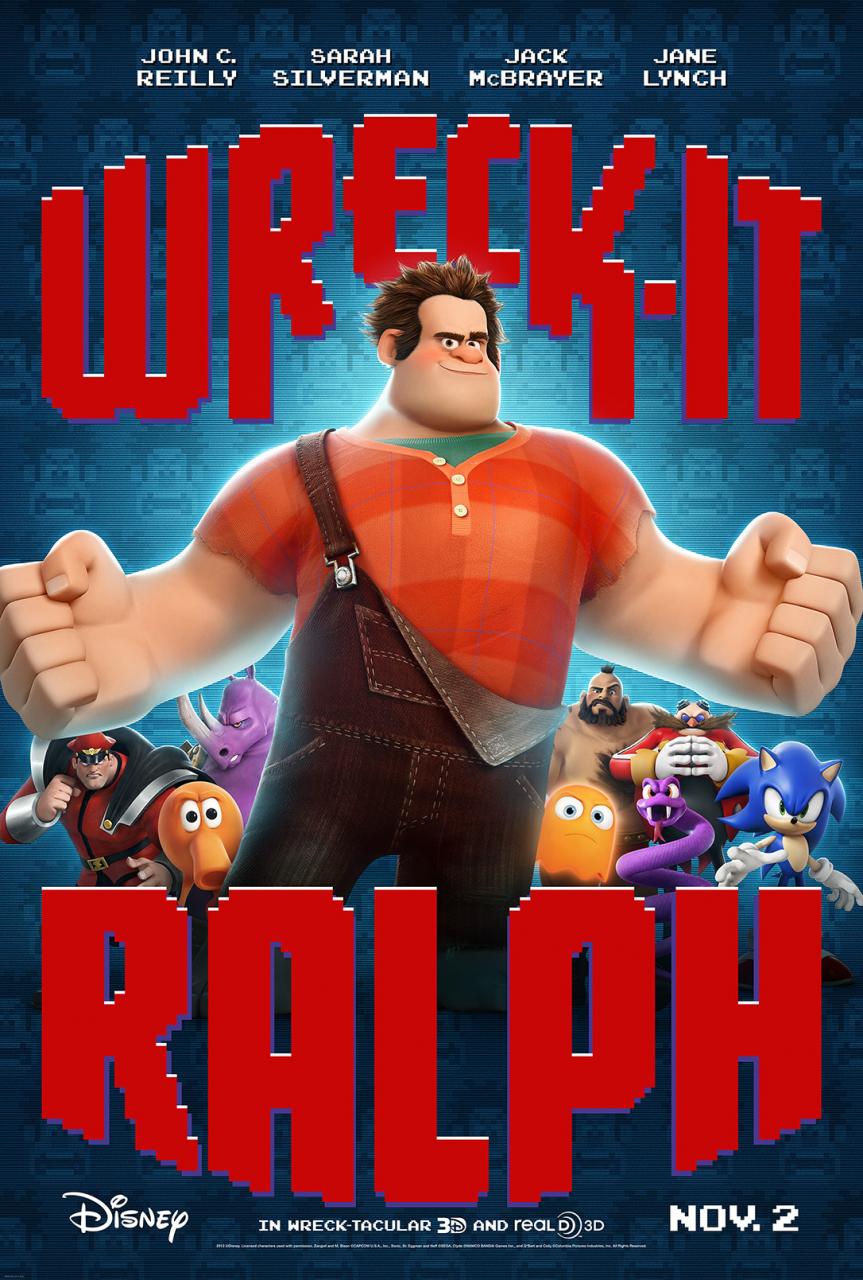
A Very Short Wreck-It Ralph Review

I loved Wreck-It Ralph. It was colorful, high-contrast, efficiently written, with very good voice performances by all parties, especially Alan Tudyk as King Candy and Jane Lynch as Sergeant Calhoun. The character designs were strong and identifiable, as opposed to the complete crap that Dreamworks so frequently puts out.

There's very little about this film that is bad. As expected, the worst part is Sarah Silverman's character, Vanellope Von Schweetz. Early on, she is as annoying as Silverman herself, which isn't surprising, since the character is apparently based on Silverman's memoir. Luckily, she gets much better as the movie goes on, and by the halfway point, she is a fully-formed character complete with pathos.

The mechanics of the movie are worth singling out; they are perfectly consistent. That is a big achievement considering that the characters jump from game to game. A significant problem with movies with extreme premises is that, almost inevitably, an inconsistency or plot hole arises. The writer had a certain scene, line, character, or event that he or she absolutely wanted, and in a less extreme premise would be completely fine, but in the more extreme movie, it makes no sense. Wreck-It Ralph has none of these inconsistencies. It is excellent.

As far as message goes, I think that they should have stressed Ralph's subjugation much more. All he seeks is acceptance, and the characters in his game are outright violent to him, and that is never fully addressed. That, to me, is a major narrative shortcoming. But much like Vanellope, that failing is soon forgotten as the rest of the movie joyfully bounds onward.

In many ways, I am perhaps a poor measure of this movie's quality since I am so affected by the nostalgia that it evokes. I watched with glee as I attempted to pick out references to old video games, frantically searching every scene, every shot, for characters wandering the background, images flashing by, or props lying around. I nearly lost my shit when Sonic gets hit by the out-of-control escape pod in Central Station and loses all his rings.

That said, I like to think that I can provide some significant analysis separate from my giddiness at seeing Pac-Man eating shrimp cocktails. Wreck-It Ralph is the best non-Pixar CGI film made by Disney. It is paced well, with perfect consistency, and rises with great work from all involved. It is the best animated film of 2012.

An Even Shorter Review Of Paperman.

As with all CGI movies, it is preceded by an animated short. Paperman is good, but a bit too twee for its own good. The story is of a man and woman office workers who meet on a train platform. They are attracted to each other, but the meeting fails in a way that only a cartoon could present. He then sees her across the street from his high-rise office, and commences making tons of paper airplanes in an attempt to reach her. The short only gets cuter from there. My personal criticism of it is that, while they set it in the 1950's (or so it appears), the female character is so painfully demure as to be annoying.

The animation is very cool. It's CGI but is rendered to look like a 2D sketch. The effect is very believable and adds a great texture to the entire work. Overall, it was a solid B+ appetizer before the full meal.

Tuesday, July 3, 2012

A Very Short Brave Review


Before you read any further, I reveal some things that may be considered spoilers, in that they were not directly stated in the trailers. There are also a few points that are definitely spoilers. So, be forewarned. In fact, you may as well watch the movie first so you can more fully understand the points that I'm trying to make.

Brave is the least Pixary Pixar film since The Incredibles. There are no cute characters to add levity to the universe a la Monsters Inc. Finding Nemo, or the god-awful cuteness shoehorned into Up. There is very little about this movie that lends itself to Disney-style merchandising. The lead character is also the most classically Shakespearean character to ever come from Pixar. It is fitting that she should be placed in a fairy tale.

Unfortunately, therein lies the problem. This is a fairy tale and, for whatever reason, Pixar didn't have the balls to fully dive into that universe. They also didn't want to apply the full Disney gloss to the story, like Disney became so good at doing in the 1990's. Perhaps because they recognized that there are very significant limitations to the Disney gloss. For example, even when Disney was at its peak, their just isn't enough of that special sauce in the galaxy to make The Hunchback of Notre Dame not dark. Stories must exist in a universe, and that universe must be created specifically to contain a system of cause and effect. If that system is going to be dangerous, don't make the movie.

Pixar tried to walk this odd line between Disney and Brothers Grimm, and was not completely successful. I criticize them because they didn't have to fail. There is nothing that said that Pixar had to attempt full fairy tale, because fairy tales have become so ingrained in our zeitgeist that their gross elements can be used to create any system that a studio wants. They can make The Brothers Grimm and Snow White And The Huntsman, and they can be used equally well to create to Tangled and Shrek. Pixar shouldn't have tried to walk into true Fairy Tale Land. They did, and the movie is less for it.

But before I get to into that, I want to talk about where this movie succeeds. The animation is without doubt the most impressive CGI work ever. Even if you mentally consider the time in which a movie was made, sort of like taking into account creative inflation, Brave is a stunning achievement. There is texture and magic to the world that simply does not exist in any other CGI work. Only Finding Nemo comes close.

I also liked how they changed the way that they rendered the characters. They are not like previous Pixar films, nor are they the Disney style seen in Tangled. They are still obviously the products of Cal Arts students, but different enough as to be refreshing.

The script is pretty tight, bumps along at good speed, and all of the action is quite entertaining. Dialog is fantastic, and scenes of comedy are at times amazingly hilarious. I loved Merida. She is the most vibrant, strongest, and singular character that Pixar has created, with the possible exception of Carl Fredrickson from Up.

Problematically, one of the biggest weaknesses with the film was also one of the best parts: the witch. As you can guess from the trailers, Merida meets a witch who gives her a spell that causes a whole bunch of trouble. The witch is not a bad witch. She's actually quite nice. Instead of simply being some evil forest-dwelling crone, she's a long-lived salesman of spells and bear-themed wood carvings (spot the Pizza Planet truck in her wood shop!). I really loved the different take on the witch, and her sidekick talking crow is a great character. So why is she also one of the biggest problems? Because she is one of the most glaring elements of the film that I suspect was originally darker and more truly Fairy Tale.

So now on to the negative bits. The witch is portrayed as being generally nice. But she gives Merida the spell that turns her mother into a bear, and does so seemingly without malice. But that makes her obfuscation as to the actual effects of the spell completely unexplained. It is also a gargantuan stretch of dialog for Merida to not even come close to asking what the spell is going to do. After the interaction, Merida is magically transported away from the Witch's cabin for no reason at all. Indeed, the entire interaction with the witch is very entertaining but entirely incoherent.

I'm glad that they wanted to do something different with the witch, but her actions could not come from a disinterested third party, as the story says. She would either have to evil, and purposely obfuscate the spell's effects, or be benevolent and obfuscate the effects for the sake of teaching Merida a lesson, or for greater purposes. By greater purposes, I mean that the story spends a great deal of time talking about fate, and they had a chance to create a physical manifestation of fate in the witch, and didn't. Similarly, they never explain the appearance of the Wisps to only Merida. There's a great deal of conflict between fate and choosing one's own path that is never addressed, nor is the question in the trailer of "paying the price for freedom" ever answered. Merida only pays the price for not asking what the freaking spell does.

Perhaps causing this lack of narrative depth is the lack of narrative itself. The story is very simple, and two extended action sequences take up about a third of the movie: getting the mother out of the castle and then getting the mother back into the castle. One of the points in the film where they could have had real character development, they fall into that bastion of lazy filmmakers everywhere, the getting better montage1. Montage in general is the fallback of poor films, but the "getting better" variant is one of the worst. It can sometimes be used for humorous effect and to explain quickly what took time. Pixar is no stranger to this trick having used it in The IncrediblesRatatouille, and even Cars. But in Brave, it butters over the fact that very little development takes place between Merida and her mother. This is made glaringly obvious when the dual epiphanies near the end of the film have nary a drop of dramatic heft to them.

Epiphany is a difficult thing to write. It requires enormous care, time for the events to stew in the minds of the audience, and enough dialog and behavior to effectively communicate the internal world of the characters. Frequently, the best time to have epiphany is at the very end of the film. The epiphany is literally the climax, and the characters don't expect the event until it happens. One of the best epiphanies that I can think of is Darth Vader at the end of Return of the Jedi. One of the worst is Anakin Skywalker at the end of Revenge of the Sith.

They didn't completely fail in Brave, but they missed the mark. I put 100% of the blame on the aofrementioned overly long action sequences. When over half of the movie is action, with little chance for character and dialog, it's no surprise that the epiphany at the end is a dud. They should have either cut the actions scenes significantly, integrated more dialog and development into the action scenes, or extended the time of the film. Ratatouille, Cars, The Incredibles, and Cars 2 were all fifteen minutes longer or more. There are certain stories that just can't effectively be told in the 90-minute "kid block." Mark Andrews, the second director, said in a review that they stripped the Merida story down to the core. They stripped it too far.

Again, I think the root of every problem in the film is that they didn't want to invest into a fully fairy tale universe, but they also didn't want to add a Disney-style sheen to the fabric of the universe. This internal conflict meant that character development that was necessary didn't take place and caused inconsistencies in the plot.

Fairy tales frequently work without much character development --Sleeping Beauty, Snow White-- because the characters are all archetypes, sometimes even bordering on cliche. This means that development is simply not needed. We all know what this person is because it is stated from the outset. It's fine to play around with the characters a bit, but they more or less remain the same. Build off of the archetypes.

I suspect that this is what Brave originally was, and caused the "creative differences" that resulted in Brenda Chapman's dismissal as director. We know that her version was filled with snow and was generally colder and more magical in its outlook. This lines up very well with the original title of the movie, The Bear And The Bow. That name just drips with traditional fairy tale values.

A traditional fairy tale is going to be dark. Those old fairy tales were almost always a narrative over an underlying story of hellfire and death. The consequences were dark and brutal because they were trying to represent a world that was dark and brutal. I mean, for Christ's sake, in an early version of Cinderella, the prince beheads the evil stepsisters.

I think that because Brave was by Pixar, they should have gone full-comic. Ditch the real bad guys, go for an anthropomorphic bear that's more a highwayman and swindler than a real, deadly threat. I would have personally preferred the dark, true fairy tale, but I understand that that sort of film doesn't really fit well with the Pixar canon. The film that they gave us is neither. It isn't satisfying from a fairy tale perspective, and isn't comic enough to fit in with other Pixar films. I very much enjoyed Brave, but there's so much there that could have been better, it's almost painful for me to watch.

Finally, this is nitpicking, I know, but when the fuck does this movie take place? The architecture is early second millennium. The characters are all wearing traditional modern kilts that weren't created until the mid 1500's (Braveheart made the same mistake). They refer to "clans" which is a concept that dates from the 1000's, although some clans claim lineage back to the 500's. One of the characters is said to have repelled Romans(!?) during a battle. Merida wears a corset, which wasn't invented, at least in the form shown in the movie, until Elizabethan times. And they are still fighting bears, which went extinct in Britain during the late first millennium during the Dark Ages.

An Even Shorter Review of La Luna.

La Luna is the requisite short that precedes Brave, and it was very cute. Not the best short that they have ever done, but light, twee, fun, and incredibly European. I am not surprised that it was created by a guy named Enrico.

-----------------------------------

1: I stole this wording of the phenomenon from my partner, Danielle.

Friday, October 21, 2011

A Very Short Rango Review

Rango is the best, most daring animated film since The Incredibles. Unlike so many animated productions of the last twenty years,  this film will last.

I frequently use the word "last" when referring to films. By this, I mean productions that become part of one's own narrative. Seeing the film nestles into one's mind, and the experience, the film, the emotions, the initial reactions, all of the elements of witnessing the film become frequently accessed memories.

Films that do not last are those without daring aspects. They hew closely to formula and desperately avoid insulting people. For example, The Fifth Element. It has lasted. It gets shown on TV at least once per week, variations on the movie are released on disc at least once per year, and the movie is famous enough to have been the first movie Sony released on Blu-Ray.

Compare this to another Bruce Willis movie from the same time: Mercury Rising. NO ONE remembers this movie. I only remember it because I wanted to write this paragraph.

Or perhaps more apt for this writing, look back on the animated films of yore that are remembered. They are dark, daring, and exciting. The Secret of NIMH, The Last Unicorn, or The Plague Dogs. compare these truly great works to a work that is masquerading as daring, but is actually just Disney formula wrapped up in darker paper, The Black Cauldron. Why do you think anime absolutely conquered the young male market in the United States? Because anime was dark and exciting. It wasn't stupid musicals filled with cute side kicks and happy endings.

Rango, more than any animated movie out of the US that I have seen in decades, captures that darkness. It captures a sense of danger, juxtaposed with comedy and color. There are moments of beautifully abstract, philosophical ideas combined with near-grotesque images. Rattlesnake Jake, a late-in-the-film bad guy, apparently had young children crying in theaters. Great! That's what you want! If the movie does not have an emotional impact on children, it will never be remembered. It will never become part of a child's personal narrative. They will take no lessons into adulthood. It is as though the movie never existed.

Rango exists and will exist for some time. It is that good.

Tuesday, August 2, 2011

Thundercats Review

Grrrrrrrr!

I posted a swear-filled rant about sexism in Thundercats about a week ago. And after a lot of comments, I decided that I should review the actual cartoon.

My criticisms of Cheetara remain unchanged. Her presence in the cartoon is the most extreme manifestation of comic book females that I have yet seen in a cartoon and this is a bad thing. The cartoon is being aimed at kids and we have study after study showing why exaggerated imagery like this has negative effects on a child's psychology. While the weight of responsibility for rearing a child falls upon the parent, we should not be introducing previously non-existent sexist tropes into children's media.

That said, after watching the new Thundercats, how do I think it holds up? I'm not going to say "read on!", I'm just going to tell you. It was very good. It was a breath of fresh air for a variety of reasons.

While it kinda' pissed me off every time Cheetara's ridiculous double-D prow was on screen, the rest of the cartoon delivered everything that you could want from an action-adventure cartoon, and this is why it's such a great show.

Action and adventure cartoons have seen a real dry spell for A LONG TIME. We had Avatar: The Last Airbender... and that was it. I mean, seriously, when was the last decent adventure cartoon? What do we have today? Ben 10, which is awful, and Teen Titans, which is serviceable.

Nickelodeon and Disney have their boy-oriented properties in the form of Nicktoons and Disney XD, and they are both trying desperately to build audiences. Disney has loaded up their network with Asian-produced Marvel properties which are all pretty bad. And Nickelodeon paid a bucket of money to acquire the rights to Dragonball Z Kai to convince boys that people now punch each other on Nick.

But it is Cartoon Network that has almost completely owned the boy market since the introduction of their Toonami/Rising Sun anime lineup in the late 90's. Cartoon Network has carried the banner of adventure cartoons and, perhaps because of the monster success of imported anime, original productions have languished.

We've had a few here and there. A He-Man update, which wasn't very good. A few permutations of Transformers, also not very good. This new Thundercats is the first one that felt like, one: it actually had a budget; and two: it actually had writers.

The new Thundercats, if the show holds up, is the best adventure cartoon since Avatar. Neither show is as good as the gold standard, Batman: The Animated Series, but then again, nothing is. The character design is a bit bland, and the animation is pretty stiff at times, but it's much better than most actual anime. The dialogue is also more than a bit stilted at a couple of points, but I consider these minor issues.

While I think that Avatar was better, in both design and writing, it was hampered by Nickelodeon's hilariously-conservative regulations. No deaths on screen. No mention of the word "kill" in a positive sense. No punching or any violent physical contact. It really sapped a lot of sense of threat from the cartoon. If it hadn't been for the skill of the creators, Avatar would have sucked. Thundercats has a real sense of danger and drama. The action scenes seem real and more mature. There's more energy to the fights.

If you're looking for nostalgia, go somewhere else. This is a complete and total reimagining of the show. I at least now understand why Lion-O sounds prepubescent, but they still should have given his voice more weight. You get the impression that he and Tygra are both well into their twenties, but only Tygra sounds like it. I've never liked the snot-nosed kid rising to power story. Well, Sword In The Stone was alright.

So in conclusion, the new Thundercats is a good cartoon. I think that it has a lot of cool images and action sequences and it stands a good shot at being the kind of cartoon that sticks in boys' minds. I say boys specifically because girls don't statistically watch many cartoons, and Cheetara certainly won't make them want to with this cartoon.

Oh, and they kept in Snarf. I actually kind of like him, now. He doesn't say anything.

Sunday, July 3, 2011

A Very Short Cars 2 Review

The lesson of Cars 2 can be summed up in "be nice to retards, they just might save the world."

Cars 2 opens fabulously, with a thrilling, action-packed five minutes centered around the British spy Finn McMissile. It is both legitimiate in its own creative right, while also being a spoof of spy films. This is the high point of the movie. It's all downhill from here.

We then cut to Mater, who is helping some car which has broken down in the desert. The dialog immediately shifts from witty and fun to being lifted straight from an episode of Full House. It. Is. Awful. It gets worse when Lightning McQueen shows up a minute or two later, since McQueen is not a moron, and any dialog between someone who is a moron and someone who isn't is necessarily going to be strained and unrealistic. And holy shit, is it strained and unrealistic. The relationship between Mater and McQueen would only make sense if written and staged like the relationship between Charlie and Ray in Rain Man.

Mater is a wholly unlikeable character for all but the youngest or stupidest. He is a raging idiot with essentially no redeeming qualities other than that he is not mean. This does not a person make. McQueen would not be his friend. Half of the shit that Mater pulls in Tokyo (spelled Towkyo... cute) would ruin a friendship in real life or in any other movie.

When McQueen feels bad for snapping at Mater, it should not be in the way of a friend as proposed in the movie, but in the way that one feels bad for slapping a dog for peeing in a corner. It makes no sense. And this doesn't even touch on the logical issues regarding McQueen's regret for not standing by his friend, when his friend happily abandons him during a race for a pretty lady. The lesson is hollow on all levels.

Mater takes up the vast majority of the movie, reminding you in nearly every second how contrived and stupid the setup is. His story is a fish-out-of-water tale where he is mistaken for a spy and it reminded me of The Man Who Knew Too Little. That was another movie where a goof is mistaken for a spy, but at least in that one, the protagonist is actually somewhat skilled, even if some of it is unintentional. And even there, it didn't work all of the time! So you can imagine how badly Cars 2 fails in this regard.

I liked Cars well enough. It was very simple, but pleasant. Cars 2, on the other hand, annoyed me at nearly every turn. It's fun for all the time that Mater isn't on screen, but he's on screen for 90% of the movie. Or if, barring reduced Mater time, they had toned down Mater's profound retardation by five to eight notches, it would have worked. But they did neither, and the movie suffers for it.

Monday, April 11, 2011

A Very Short Tangled Review

Tangled was a movie that really surprised me. It currently has an 89% on Rotten Tomatoes, while having a trailer that made it look just god-awful. It also had LOTS of animation that didn't make it into the film. In fact, most of the trailer didn't make it into the movie. Odd.


If you couldn't tell from the trailer, this movie is hip. Completely, painfully, desperately, hip. It tries so hard to convince us of its hipness bona-fides that it just gets annoying. Yeah, yeah, we got it. You're just like Shrek. You're poppy, anachronistic, and irreverent.

Unfortunately, while Shrek had irreverence right down the bone, Tangled doesn't. At its core, it's 100% Disney, in all good ways and bad. We have "non-traditional," lead characters who are actually rather traditional. We have a bad-guy who's 100% Disney, and songs that are so completely Disney that they actually seem out of place.

That's not to say that many of these Disney elements don't work, they do. It's the fact that the movie is split at its core. It can't decide if it wants to be Disney or Shrek, and it can't be both, because they are essentially antithetical.

This dichotomy results in jarring shifts of tone. I define the tone of a movie as the system of cause-and-effect that it adopts. For example, Loony Toons has a cartoon reality where cause and effect don't really exist. If you get shot, nothing related to actually being shot happens. The fact that a shift in tone can be jarring can be seen in the Family Guy episode where Elmer Fudd shoots Bugs and actually kills him. It's upsetting!


I don't like watching that clip. I experience a severe amount of anxiety and agitation because it shouldn't be happening. Family Guy has NO concept of consistent tone, with episodes wildly flipping between no cause and effect (Peter crashes a blimp into his neighbor's house), to normal cause and effect (Brian discusses suicide with Stewie).

There is nothing in Tangled that gets anywhere close to that, but it happens, a lot. The movie opens with a serious tone, flips poppy and irreverent, switches to "Disney" funny, back to irreverent, serious, funny, and eventually to a moment so dark and serious that it's completely out of place.

There are some very bright spots in the film. The animation is excellent, even if it's 100% Disney. Rapunzel, if hand-drawn, looks indistinguishable from other Disney princesses, and Flynn Rider is your standard, good-looking protagonist. Disney designs came about because it's hard to communicate complex facial features with simple, hand-animated lines. CGI gives the animator an incredibly powerful brush to fashion details and faces. As it stands, Rapunzel and her mother (both real and fake) appear to be separated by five years at the most. The only way Rapunzel looks young is that her boobs are smaller. How inventive -he said derisively.


There is one seriously cool character in Maximus, the military horse. His animation is spot-on, his facial expressions are the most dynamic of the film, truly, he's the only character that really steps outside of the mold to any significant degree. He's far more entertaining than Pascal, the chameleon, either of the leads, or any of the bad guys. In fact, the inevitable money-grab sequel starring this horse will probably be much more entertaining then Tangled.

All things considered, Tangled wasn't bad. A good deal of it was entertaining, but aside from Maximus, it felt like it is: a minor Disney production that will likely not be remembered outside of the occasional Disney Princess product.

Tuesday, February 22, 2011

What?


I'm watching some cgi film called, inventively, Race. It's in the same category of "films no one cares about" that Kaena, Battle for Terra, and Delgo. I have no idea how this got money to be made. The dialog is bad, the acting is sub-standard, and the animation is just appalling. It's worse than The Clone Wars, and better than Re-Boot only in a technical sense.

The character designs border on insulting. The faces look like most of them have some sort of developmental issue, the women all have gigantic boobs and waists measured in millimeters. Plot? Not really. The story is like a crappy video game (This impression is only amplified by the hooters), and the staging is like the pod racing scene from Star Wars Episode 1 crossed with Wipeout.

This is a truly awful film.

Tuesday, November 23, 2010

Two Very Short Reviews

I'm reviewing Cloudy With a Chance of Meatballs and How to Train Your Dragon together. I'll explain this later. First, the movies.

I liked them both a great deal, and Meatballs has actually become one of my favorite CGI films. Meatballs is an immensely energetic film, filled to bursting with color, life, comedy, and a few points of genuine pathos.


The film managed to keep energy levels at a near-frantic state for the entirety of the film, with small lulls just preventing us from being overloaded. The characters are all a bit two-dimensional, but being simple is not the same thing as simplistic. The character design is actually different from Pixar, which is nice. And by different, I don't mean grossly inferior, like Hoodwinked. The animation is also lively and well-done. The characters all have different personalities based on their animation, and not just how they look.

Flint Lockwood, the manic inventor, is made out of rubber. His father, a down-to-Earth sort of guy is rigid and block-like. Steve the monkey moves in spastic spurts. It's all very well done. While on the subject of that monkey, he is both the default cute side-kick that cartoons need, but he is also integral to the story when the father and son have a closing conversation. Oh, and how fantastic is it that Steve is voiced by Doogie Howser?


Moving on to How to Train Your Dragon, this is a much more traditional story. It's more suited to a slightly older demographic. That's not to say that Meatballs won't entertain people of all ages, only that its energy and color means that even the very young will love it. Dragon might bore the the tiny childers.

The character design, the constructs, the animation, everything is much more rigid, here. This has generally been the rule in Dreamwork's ouvre. Going all the way back to Antz and Shrek, Dreamworks has chosen to use very rigid character models with a minimum of flex. This has presented problems in the past, where character is not communicated in motion, only in design and voice. And when the voice and character design are bland, like in Madagascar and Shark Tale, the film suffers.

Dreamworks animators have made great strides in extracting character from rigid designs, and they do a good job, here. The characters are all decently three-dimensional, even though many of them are only as deep as their position in the script requires.

The script is perfectly paced and moves along with the lean effectiveness that we expect from a 90-minute CGI film. It has some nice themes of understanding that give the story a sense of depth. The action scenes have great energy, the dialog is snappy, and the whole endeavor is very entertaining. It all culminates in an eye-popping final battle that, in the theater, was truly a site to behold.

Now on to why I'm reviewing them together. For some reason, CGI films, moreso than traditioally animated ones, seem to work in thematic waves. Considering the development times required for these films, I'm pretty confident that copying is not happening, but SOMETHING is. It's just too much to be coincidence.

For example, The first CGI film from Dreamworks, Antz, came out six weeks before A Bug's Life. Then Monsters Inc. came out with Shrek. Finding Nemo was followed by Shark Tale a year later. Madagascar, Open Season, and The Wild (and even Flushed Away to a degree). Hoodwinked and Happily N'Ever After. Megamind and Despicable Me. Delgo and Battle For Terra, and a little bit of Planet 51, Wall-E, and 9). All of them have similar themes, if not characters, settings, and stories.

This and Meatballs are the same thing. Both stories are about a misunderstood young man, who has great potential, has problems relating to his father, meets a girl who's his equal but different, screws things up, saves the day in an epic battle with a giant thing, saves everyone and wins the girl. That short synopsis applies identically to both films. WTF? What is it? Some outside variable? Studies about what would do well in today's market? Some script gets passed around and everyone steals it? What?!

Tuesday, July 13, 2010

A Very Short Despicable Me Review

Despicable Me wasn't as good as I was hoping. The early trailers, especially the usage of the Hitchcock-like silhouette, made me expect a quirky, more adult CGI film, perhaps along the lines of the first Shrek. Instead, it's a very straightforward, childish film. As many of the best child-oriented films illustrate, though, that's not necessarily a bad thing, and it certainly isn't with Dee-Me. It's loaded with good slapstick, generally good voice-overs, and great character design. The story was very slight, and lacked drama, which I actually blame on poor story blocking. A solid 10-15 minutes of the early film was unnecessary and would have been well-served with simply jumping into the action and letting the characters reveal themselves throughout the rest of the film. This would have allowed them to better explore the rivalry between Gru and Vector, which makes up a very small aspect of the film, considering that the trailers made it seem like it was going to be a primary point.


About those trailers, I'm assuming that the direction of the film was changing wildly as production went on considering that each trailer presented an entirely different picture of the film. The first trailer made it seem like Gru stole the Pyramid (he doesn't), the second made it seem like Gru was trying to recapture his crown as #1 supervillain (which he's not), and only in the third trailer do they finally introduce the children and the painfully merchandiseable "minions," that comprise the biggest chunk of the film.

Oh, and, is it a requisite that all 3D films have a roller coaster scene? Seriously?

Sunday, June 20, 2010

A Very Short Toy Story 3 Review

Toy Story 3 isn't as good as the first two. It is more poignant than the first one though, and generally more emotional than the second, but as a work of craft, it falls behind. It's not as good because Lee Unkrich doesn't appear to be as good a director as John Lasseter, who directed the first two Toy Story films. In the same way that I found Up to be inferior to Wall-E or The Incredibles, the balance required to wedge lots of story into the comparatively short 90-minute "kid block" was slightly beyond him. Whereas Toy Story 1 and 2 had one primary journey and a great deal of exposition and character exploration at the key points, Toy Story 3 is much more rambling. They spend the entire movie running from place to place. I found it less focused and a less disciplined example of story blocking. This is, generally, unimportant. Taken as a whole, the movie is powerful, funny, sad, and above all, joyously entertaining.


The short before Toy Story is called Day & Night, which is Pixar's strongest short since For the Birds. It is an artistic take on a hand-drawn character awaking and representing day time. He meets another character who is asleep and represents night time. The two then begin a short adventure as they discover the joys and differences between night and day. Visually, it's just fantastic. And much like music videos, that's what makes shorts so cool. You don't need story coherency. It can be jumbled nonsense thrown on the screen for no other reason than visual wonder. This short is not jumbled nonsense, but it does take all the freedom allowed by a short and puts it to good use in the construction of something coherent and beautiful.

It reminded me a great deal of Chuck Jones' adventurous work in the late 50's and early 60's, like his now legendary Duck Amuck, but especially his hilarious (and personal favorite) Now Hear This: