Saturday, December 29, 2012

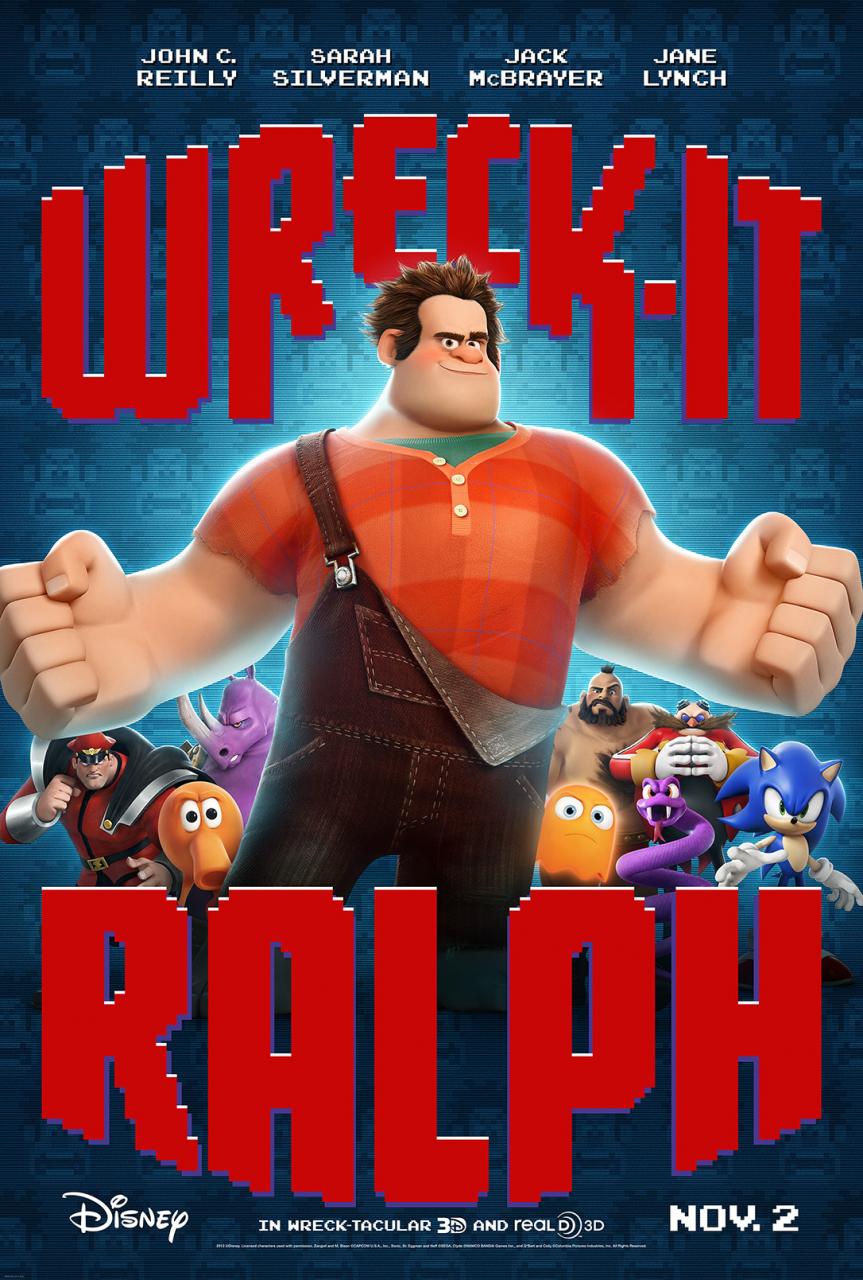
Wreck-It Ralph Limps to $240 Million

I loved Wreck-It Ralph. I think it is the best animated film of 2012. That said, I find its financial under-performance to be somewhat satisfying.

The geniuses running Disney — and by geniuses I mean complete idiots — named Tangled Tangled because they wanted to de-emphasize the female character to attract a male audience. The same logic is undoubtedly  underlying their renaming of The Snow Queen to Frozen. Honestly. Where do they get these ideas? I wish that I was as smart as them.

They believed that The Princess and the Frog under-performed because, I'm not kidding, the word "princess" was in the title. As such, one would expect a movie with the word "wreck" in the title to perform amazingly, because, ya'know, boys like violence... or whatever.

Instead, Ralph is trailing Princess's receipts by over $25 million. Account for inflation, and it's probably over $30 million. Suck it, Disney.

Now, don't misunderstand me. I am reveling in Ralph's performance in the way that I hate Disney executives, but not in the way that I hate to see artists who have dedicated five years of their life to a project only to see it not set the world on fire. The amount of work that goes into an animated film is enough to make me desire that every animated film, almost regardless of its quality, sells millions of tickets. The consummate artists behind the scenes deserve it.

But what I hate more than anything is when a movie studio condescends to us, and animation companies do it more often than anyone this side of romantic comedies. I cannot help but derive some degree of satisfaction when that condescension is proven wrong.

A Very Short Review Of Paranorman


The second exceptional animated film to break from the Disney mold in as many years? We're going to get spoiled.

Paranorman opens with scenes from faux 1950's monster movies to explicitly state where they acquired their inspiration, and indeed, the movie does derive a good deal of texture from these old concepts. It's only a gloss, though, and the underlying script, character construction, and wholly progressive undertones are far beyond anything Robot Monster, or Them could have ever hoped for.

Before I get into any detail, you should go see this movie immediately. Judging from box office receipts, there are many people who didn't, and this is a shame. I can't say that this is the best animated film of 2012--we had some exceptional films this year and choosing an absolute best is mostly academic--but it is in the top five.

If you haven't yet seen it, I also cannot blame you. The trailers are some of the worst that I have seen this side of Dreamworks Animation. They completely, totally, 100% fail to effectively advertise what the movie was going to be about and what mood the movie was going to capture. The trailers make the movie appear to be goofy and corny, and it is anything but. It is quiet and contemplative at times, and far from the constant stream of silly one-liners that comprised the advertisements.


The animation is mind-blowing. I thought that Coraline made Corpse Bride and The Nightmare Before Christmas look dated. Well, this movie makes Coraline look old and unrefined. Not only is there a stunning amount of detail and life to the character designs, not only is the film possessing of texture that other movies would kill for, but the animation itself raises the bar for stop-motion work. It's like nothing I have ever seen. It bobs and weaves, crackles and jumps, all with a jaw-dropping smoothness and vivacity. This makes Frankenweenie, released about a month later, look uninspired in comparison.

Similarly upgraded from Coraline is the sound production. Coraline's audio was disappointing, lacking depth, complexity and impact. The scene that I remember most distinctly was when Coraline spins around a door, with her yelling not fading in and out as she went behind and in front of the door. None of that in Paranorman! The audio is loaded with detail and punch. Truly, they seem to jump to scenarios that are tailor-made for wild audio after only fifteen minutes.

The problems are those that equally affected Coraline. I don't know what it is about the writers at Laika, but they don't seem to like traditional dramatic structure. Coraline had odd rises and falls in its action, culminating in a double climax that made almost no sense. Paranorman has character and concept exposition, then a stratospheric leap to maximum action, which drops off for a period of time before maxing out again, then finally the falling action and denouement.

I appreciate that not everything needs to follow the traditional dramatic pyramid, but it became a thing because it works. It is very hard to write something that doesn't follow the standard structure and still "works," and Paranorman doesn't quite work. There's very little drama in the lead-up to the action, and then there is so much drama piled on top of itself that it is hard to appreciate it. It becomes all the more important for a movie, if it is rejecting traditional dramatic structure, to ensure that its cause-and-effect chain is strong, with each cause and each effect emphasized in the dialog and direction. Paranorman fails at this on more than one occasion.

This is a structural and somewhat academic analysis and criticism of the story. My more personal view is that the story is one that has been done many times before, with characters that have been done before, but the entire thing is constructed with so much color and inventiveness that these faults are immediately lost. Yes, this is another story about an outsider, with geeks and bullies at odds, with parents that don't understand, blah, blah, blah. I didn't care though!

The voice overs are somewhat muted in comparison to the highly emotive work done by professional voice actors, but this goes well with the tone of the film. They also go well in creating the unique characters that, much like Coraline, feel as though they come from a different universe than the characters in Disney or Dreamworks films.

I mentioned how the trailers fail to capture the personality of the film, and this is a tragedy. Paranorman is an exceptional film with an atmosphere that is just this side of comedy as opposed to a traditional horror flick. It is a movie that relies heavily on atmosphere and mise-en-scène to communicate emotions and takes all of these aspects beyond Coraline's already notable achievements.

More over, the film never once condescends to the children watching the film. It is entirely sincere. It is also one of a recent batch of animated films that recognizes that children are not innocent little things that need to only be exposed to pure, traditional subject matter, or ironic takes on pure, traditional subject matter. Monster House, Coraline, Rango, Fantastic Mr. Fox, The Secret of Kells, The Adventures of Tin Tin, and even some work from the major studios like Up, Puss in Boots, and Kung Fu Panda., all of them are part of a large renaissance of animation that I assumed would happen in the smaller, independent studios, but appears to have begun in the large studios.

These films understand that for movies to have an impact, they must have real drama. They must have danger, and violence, and dirty words, and all of the other things that comprise real drama in the real world. While Paranorman may not take place in the real world, it feels more real, more alive, than anything that Disney has produced in twenty years. If they had left the script in the oven for a little while longer, they would have had a masterpiece. As it stands, Paranorman is an exceptional film, utterly deserving of your attention, with many parts so good as to make the parts where it fails all the more frustrating.

Thursday, December 20, 2012

Disappointed By Disney's Frozen


Some early images of Disney's Frozen have come out, and I can't help but be disappointed. Early reports and sketches were giving the impression that the movie would dare to be different, as it were, and contain some non-traditional elements. This stands in contrast to Tangled, which tried desperately to be hip, but was square as a Canadian wheel (South Park reference), and was super-traditional Disney through and through.

And it looks like Frozen is going to be yet another Tangled. The bright-eyed manic pixie female, the world-weary, cynical male. Puh-leeze. I'm going to wait to pass judgment, of course. While I was disappointed in Tangled, and I knew that I was going to be long before watching it, it was still an enjoyable movie. And lord knows, Disney's stuff from the 90's was a constant flow of traditional values, and I enjoyed many of those. I guess that I can only hope for the same from

Sunday, December 16, 2012

A Very Short Review Of The Hobbit


I've been looking forward to The Hobbit for some time. Not just because I liked The Lord of the Rings, but because it is the first technical demonstration of cinema development since Avatar. And being a total cinema geek, for better or worse, I was giddy as a school girl. A very large, hairy, school girl.

First, the movie. It is better than I was expecting. After learning that Jackson was going to be stretching what is arguably a simple, twee, children's adventure story into three movies, giving them the benefit of the doubt was a difficult task. The film mostly pays back that benefit.

Many have complained about the slow pacing of the film, and I didn't mind that at all. I liked the leisurely walk through Tolkien/Jackson's world, and enjoy the time given to appreciate the texture of everything. I disliked the overly-goofy portrayal of some things. The Hobbit book was distinctly more childish than The Lord of the Rings, and I don't mind that element coming into the movie, but they went a bit over the top with the trolls and especially Radagast the wizard, who is borderline Pythonesque.

But now for the part that actually got me out of my hovel and into a theater for a midnight premier: 48 frames per second.

It's not bad! I was honestly expecting it to be worse than it was. In recognition of Jackson's push to have this done, The Hobbit successfully convinces me that there may, in fact, be potential in 48fps at some point in the future. That is still only a possibility, though, and my initial beliefs may yet hold true.

Many people have had a hard time describing the sensation of 48fps. Some call it too real, but I actually see it as less real. Anyone who has ever played extensive video games knows that one of the reasons why they don't look real, regardless of the polygon count or texture detail, is because they lack blur. It doesn't matter if it is at 30fps or 300fps. Since there is no actual object moving through the visual field, there is no blur. There are, instead, 300 perfectly clear, distinct images flashing in front of the player.

Game companies tried implementing motion blur to increase realism, but that generally had a negative effect on the game play, because it is actually better to have everything crystal clear to better facilitate navigation of the world in which the game takes place. But for movies, there are no bad guys that the player needs to dispatch. No details that the player must discern else fail at the game. A movie is a movie — an artistic creation intended to be experienced, not interacted with. The director has absolute control of whether what appears on screen is clear or indistinct. Realism via blur is thus desirable.

It is for this reason why sets and props looked fake. Not because they actually looked fake, indeed, in photographs, everything looks great, and at 24fps, everything looks great. No, they looked fake for the same reason that video games look fake, no matter how detailed they get.

Perhaps think of it another way. A film is a series of still images. We need to get motion out of these images. A very short exposure for each individual frame will give very clear individual images, but it will fail to catch much motion. Much like the Heisenberg Uncertainty Principle, where measurements of particles can either be accurate about location or direction, but not both at the same time, a photo can either tell us where something is going when the photo is taken, or tell us where something is when the photo is taken, but it cannot tell us both.

Movies are not about where things are, they are about where things are going. The more we know about where things are, the less we know about where they are going, and this plays tricks on our minds when happening forty-eight times per second.

Importantly, and this is something that has been lost in the discussion, is that frame rate only tells part of the story. As I'm sure you started considering as you read the above paragraphs, the exposure time is just as important as frame rate, because it is the exposure time that determines the amount of blur. Cinema cameras are based on exposure time in the terminology of rotary disc shutters, and an excellent work up of this is available at Wikipedia.

So with all of that description out of the way, back to my belief that 48fps may actually be useful. Once I got accustomed to the new rate, it provided a unique and enjoyable texture in many of the scenes. The large, sweeping shots that would have otherwise suffered severe strobing, such as the mountain shots and field chase scenes, were buttery smooth. And since these shots would have had very little motion blur at 24fps, the majesty of the image is not greatly altered.

Likewise, any scenes that involved slow motions, such as discussions and activity in Rivendell, looked great. The water flowing and trickling around the elven city was wonderfully detailed and smooth. And during these scenes, the 3D looked great. Jackson was correct in saying that 3D looks better at a higher frame rate. Unfortunately, Jackson had a penchant for severely deep focus, which produced shots that were cluttered and overwhelming in 3D. Doubly unfortunately, not doing deep focus causes its own problems, when the eye naturally tries to refocus to see objects in the background and foreground.

And perhaps because of the skill of Jackson and his team, there are even a few high-speed scenes that look magnificent at 48fps, most memorable is the stone giants fighting with one another. It needs to be seen to be believed. And scenes shot in slow-motion, because we are accustomed to no blur, such as when Thorin walks through flame to fight his nemesis, looked awesome.

Sadly, for every scene that looked good in 48fps, there were five scenes that looked awful. The shot that most perfectly embodied every issue was when Radagast the wizard is being pulled on his sled by... magic bunnies... and there is a brief shot of the camera rushing forward through leaves. It is one of the worst-looking shots that I have seen in recent films. It looked exactly like a video game.

All things considered, The Hobbit is a success. The 48fps is only a partial failure, and while it is stretched a bit far, it's not nearly as thin as I feared. In fact, I think that it works pretty well. Moreover, Jackson's additions like the Pale Orc Azog, the conflict between the dwarves, elves, and Saruman really add some gravitas to what wasn't a really epic story to begin with. It builds excitement at seeing what else Jackson and Guillermo Del Toro have added, and turns the entire thing into something unique.

I liked The Hobbit. I liked the early extended stay in Bilbo's house. I liked the time given to appreciate the details. And while it doesn't elicit the same gleeful impatience that I felt for the second part of LOTR, I can still scarcely wait for next December.

Saturday, December 1, 2012

New Bimbo Artwork

There's a pretty popular image of Betty Boop in a chair and Bimbo acting as a director. I'm re-doing it with high-resolution vectors, and as I work, I'll upload the individual characters. So here is Bimbo, being all directorial.

Saturday, November 10, 2012

A Very Short Wreck-It Ralph Review

I loved Wreck-It Ralph. It was colorful, high-contrast, efficiently written, with very good voice performances by all parties, especially Alan Tudyk as King Candy and Jane Lynch as Sergeant Calhoun. The character designs were strong and identifiable, as opposed to the complete crap that Dreamworks so frequently puts out.

There's very little about this film that is bad. As expected, the worst part is Sarah Silverman's character, Vanellope Von Schweetz. Early on, she is as annoying as Silverman herself, which isn't surprising, since the character is apparently based on Silverman's memoir. Luckily, she gets much better as the movie goes on, and by the halfway point, she is a fully-formed character complete with pathos.

The mechanics of the movie are worth singling out; they are perfectly consistent. That is a big achievement considering that the characters jump from game to game. A significant problem with movies with extreme premises is that, almost inevitably, an inconsistency or plot hole arises. The writer had a certain scene, line, character, or event that he or she absolutely wanted, and in a less extreme premise would be completely fine, but in the more extreme movie, it makes no sense. Wreck-It Ralph has none of these inconsistencies. It is excellent.

As far as message goes, I think that they should have stressed Ralph's subjugation much more. All he seeks is acceptance, and the characters in his game are outright violent to him, and that is never fully addressed. That, to me, is a major narrative shortcoming. But much like Vanellope, that failing is soon forgotten as the rest of the movie joyfully bounds onward.

In many ways, I am perhaps a poor measure of this movie's quality since I am so affected by the nostalgia that it evokes. I watched with glee as I attempted to pick out references to old video games, frantically searching every scene, every shot, for characters wandering the background, images flashing by, or props lying around. I nearly lost my shit when Sonic gets hit by the out-of-control escape pod in Central Station and loses all his rings.

That said, I like to think that I can provide some significant analysis separate from my giddiness at seeing Pac-Man eating shrimp cocktails. Wreck-It Ralph is the best non-Pixar CGI film made by Disney. It is paced well, with perfect consistency, and rises with great work from all involved. It is the best animated film of 2012.

An Even Shorter Review Of Paperman.

As with all CGI movies, it is preceded by an animated short. Paperman is good, but a bit too twee for its own good. The story is of a man and woman office workers who meet on a train platform. They are attracted to each other, but the meeting fails in a way that only a cartoon could present. He then sees her across the street from his high-rise office, and commences making tons of paper airplanes in an attempt to reach her. The short only gets cuter from there. My personal criticism of it is that, while they set it in the 1950's (or so it appears), the female character is so painfully demure as to be annoying.

The animation is very cool. It's CGI but is rendered to look like a 2D sketch. The effect is very believable and adds a great texture to the entire work. Overall, it was a solid B+ appetizer before the full meal.

Friday, October 12, 2012

"The Croods" Trailer Is Surprisingly Not Awful

Dreamworks Animation is nigh-on-legendary for god-awful trailers. They can take good movies and make them look abysmal, ripping the proverbial defeat from the jaws of success.

The Croods lies slightly in between. First, and unfortunately most saliently, the name of the movie sucks. It sounds like something Nickelodeon conjured up, which is one of the worst insults that I can imagine. Second, the trailer makes it seem like it's trying to be Brave, which I doubt will appear in the actual movie, and this trailer is specifically calculated to make it appear as though the movie is similar to Brave. Third, is it just me, or are these some of the worst character designs since Tin Toy's baby? And finally, why do the cavemen appear to be living on Pandora?

That said, the trailer's drama is good. The movie appears to be suitably epic. The tempo is good. And aside from Nic Cage's flat voice, the others look decent. I wish Dreamworks would understand what other animation houses understand: you don't simply get stars to do voice work. You get voice actors to do voice work. Actors learn to act with everything, thus making overacting with any one element bad. They learn not to do it. But when one is a voice actor, doing 100% of acting with voice is required! Sigh. Regardless... moving on.

The trailer makes the movie look big, colorful, and a lot of fun. Unfortunately, we have a bit more information than the trailer lets on and know that a more "evolved" human named Guy, voiced by Ryan Reynolds shows up. This character, and everything associated with him, is going to be a giant cliche. I know this because the pictures of Guy are absolutely dripping with 'tude. He may as well be Sonic The Hedgehog. Seriously. How the fuck haven't be moved past 'tude? Wasn't ever male character from 1988 to 2002 having 'tude enough for people?! Why do we need more?!

So yeah. Here's the trailer.